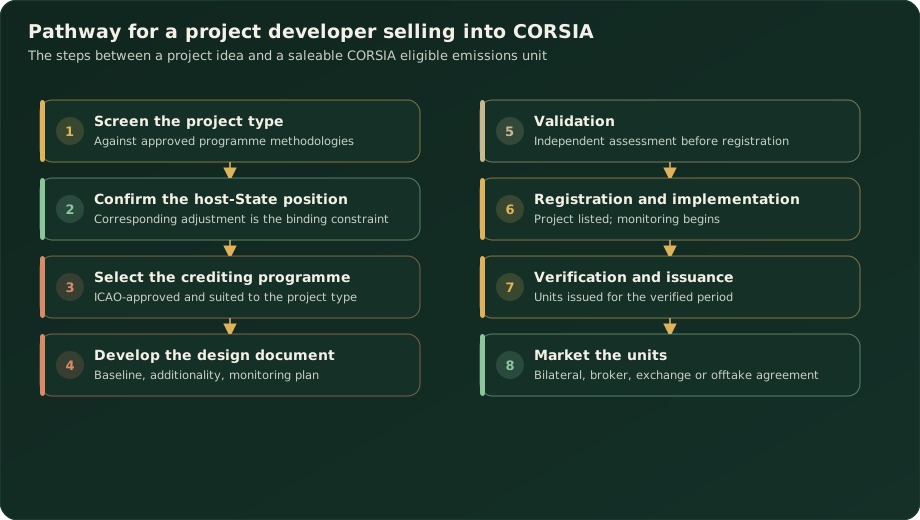
Becoming a CORSIA supplier is a multi-year undertaking with a governmental decision sitting in the middle of it that nobody in the project controls. Understanding the sequence, and particularly which steps gate which, is the difference between a project that reaches the market and one that spends its budget proving it cannot.
Stage 0: Authorisation Feasibility
Duration: two to eight weeks. Cost: low. Consequence of skipping: potentially total.
This is stage zero because everything else is conditional on it.
What to establish:
- Does the host State have a designated national authority for Article 6 authorisation?
- Is there a published process, or any precedent?
- What is the policy position on your project type specifically? Several governments authorise some types and not others.
- Are there fees, revenue-sharing requirements, or conditions on siting or benefit distribution?
- What is the realistic timeline, based on actual cases rather than stated intent?
How to interpret the answer: A clear yes with a documented process is the best case. A clear no saves you the entire project budget. The difficult case is an unclear answer, which is common — and an unclear answer should be treated as a material risk to be priced, not as an implicit yes.
Output: A written feasibility assessment with the risk stated. If the answer is negative or highly uncertain, the correct decision may be to target the voluntary market instead, and there is no shame in that — it is a large market with real demand.
Stage 1: Programme and Methodology Selection
Duration: two to six weeks.
Select an ICAO-approved crediting programme and a methodology that fits the actual activity.
What to check:
- Current approval status on the ICAO emissions units page, and whether it is full or conditional
- Whether any condition touches your project type or methodology
- When the approval is next reviewed
- Whether the methodology is itself under review — several have been narrowed or retired
- The programme's own fees, timelines and registry mechanics
- Whether the programme's corresponding adjustment handling aligns with your host State's process
Common mistake: Defaulting to whichever standard you have used before. That is habit, not a decision, and programme approval status is a live variable.
Stage 2: Project Design
Duration: two to six months.
Produce the project design documentation. The substantive elements:
Baseline. What would have happened without the project, constructed conservatively and defensibly.
Additionality. Why carbon revenue was necessary. Investment analysis, barrier analysis and a common practice test. Be realistic here — additionality arguments that succeeded a decade ago frequently fail now, particularly for grid-connected renewables in markets where they have become the least-cost option.
Quantification. Emission reduction calculations under the chosen methodology, with assumptions erring toward under-crediting.
Monitoring plan. What is measured, how, how often, by whom, with what equipment and what calibration. The realism test matters: can the project actually produce this data over its lifetime, or is the plan aspirational?
Safeguards. Environmental and social impact assessment, stakeholder consultation, free prior and informed consent where indigenous or local communities are affected, and a grievance mechanism. Land tenure clarity is essential, particularly for land-based projects — this is the most common safeguards failure.
Stage 3: Validation
Duration: three to nine months, largely determined by verifier availability.
An accredited body assesses the design against the methodology and programme rules.
What slows it: Queues, which are real. Findings requiring design revision. Incomplete stakeholder documentation, which is the most common cause of delay.
Practical point: Engage the validator early to understand their availability. The queue is not something you can compress later.
Stage 4: Registration
Duration: one to three months.
The programme registers the project. Largely administrative once validation is complete.
Stage 5: Implementation and Monitoring
Duration: ongoing; first monitoring period typically twelve months.
The activity operates and data is collected.
What goes wrong: Monitoring plans that were plausible on paper and impractical in operation. Equipment that fails and is not replaced promptly. Data gaps that cannot be filled retrospectively. Staff turnover in the field taking undocumented knowledge with it.
Practical point: Build data quality control into operations from day one. Reductions that occurred but cannot be evidenced do not become credits.
Stage 6: Verification
Duration: three to six months.
An accredited body verifies the reductions for the monitoring period. Independence rules generally prevent the validator from also verifying.
Stage 7: Issuance
Duration: one to three months.
The programme issues units into the registry, serialised and attributed to your account.
Stage 8: Authorisation and Corresponding Adjustment
Duration: highly variable — weeks to indefinite.
The host State authorises the specific units and the corresponding adjustment is applied.
This can run in parallel with earlier stages, and where the process permits it, it should. Sequencing it last, after everything else is complete, maximises the time your capital sits at risk against a decision you do not control.
Output: An authorisation document naming the specific units. This document is what buyers will ask for. Without it there is no CORSIA sale.
Stage 9: Sale and Transfer
Duration: weeks to months.
Find a buyer, negotiate, transfer, and the buyer cancels.
What buyers will demand: the authorisation document, programme approval evidence, vintage confirmation, verification report, registry records, and project documentation. See the buyer due diligence checklist to understand exactly what you will be tested against.
The Total Timeline
Eighteen months to three years from concept to first sale is realistic for a new project. Longer where authorisation is slow or validation queues are long.
Working backwards from second-phase demand from 2027 onward: developers targeting that demand need to be resolving stage zero now. Waiting until demand becomes visible means arriving after supply that was already ready has been contracted.
Aggregation and Programmes of Activities
For projects that are individually too small to justify the transaction and diligence costs, aggregation is usually the only route to a CORSIA buyer.
Programme of activities structures, offered under several crediting programmes, allow multiple similar activities to be registered under a single umbrella with a shared methodology and monitoring framework. New activities join without repeating the full design and validation process. This suits distributed interventions — cookstoves, small biogas units, efficiency measures across many sites, smallholder agriculture.
The economics improve substantially, but three things get harder.
Monitoring across many dispersed sites is operationally demanding, and sampling approaches must satisfy the methodology's requirements for statistical rigour. Under-resourcing this is the most common cause of failure in aggregated projects.
Safeguards must hold across every participating site, not on average. A tenure dispute at one location is a problem for the whole programme, not an isolated incident.
Authorisation may be granted for the programme or for individual tranches, and the host State's approach determines how much administrative work each issuance carries.
Third-party aggregators are an alternative for developers who do not want to run the structure themselves. They handle registration, monitoring and sale in exchange for a share of revenue. The trade-off is margin and control, and quality varies — assess their CORSIA-specific track record, not just their voluntary market volume.
Cost Structure
Costs vary enormously by project type and scale, but the shape is consistent:
- Feasibility and design — moderate, front-loaded, and the best value in the sequence because it is where you discover whether to proceed.
- Validation and verification — significant, recurring for each verification cycle.
- Programme fees — registration and per-unit issuance levies.
- Authorisation — may involve government fees or revenue-sharing conditions.
- Monitoring — ongoing operational cost over the project lifetime, frequently underestimated.
- Transaction — legal, buyer diligence support, intermediary margin.
The economics work only at sufficient scale, which is why small standalone projects frequently aggregate.
Reducing the Risk
Resolve stage zero first. Repeated because it is the point people skip.
Keep the voluntary fallback. Design for eligibility, retain the option to sell without an adjustment.
Run authorisation in parallel where the process allows.
Build documentation continuously. Not retrospectively.
Monitor programme approval status. It can change under you mid-project.
Aggregate where scale is marginal. Diligence and transaction costs do not scale down.
Frequently Asked Questions
Can an existing registered project become CORSIA eligible? Potentially, if the programme is ICAO approved, the vintage is eligible, and the host State authorises those units. Programme migration is possible but costly.
Do I need to be in a developing country? No. Eligibility depends on the criteria, not on the host State's development status.
What if my host State has no Article 6 process? Practically, that is a no for now. Some governments are building processes; whether yours will, and when, is the risk to assess.
Can I sell before authorisation? You can contract forward with authorisation risk allocated in the agreement. You cannot deliver a CORSIA-eligible unit without it.
How large does a project need to be? No formal minimum, but transaction and diligence costs make very small projects uneconomic without aggregation.
Where does DSTechnoverse fit? Feasibility and authorisation assessment, programme and methodology selection, design support, validation and verification coordination, and buyer matching — from stage zero through to sale.
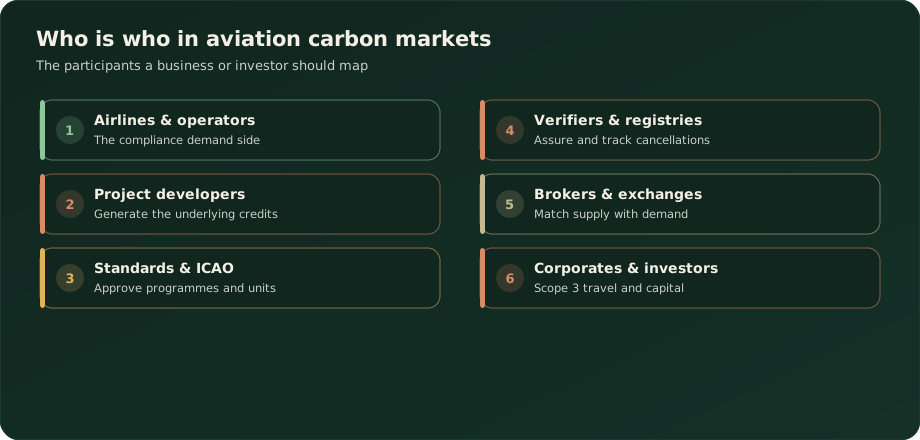
Buying or selling CORSIA units? DSTechnoverse provides specialist CORSIA carbon credit services — offsetting requirement calculation and unit sourcing for operators, and eligibility screening, host-State authorisation support and buyer matching for project developers. We are based in Indore, Madhya Pradesh and work with clients across India and internationally.
Apply as a CORSIA buyer or seller
Talk to our carbon markets team about your position.