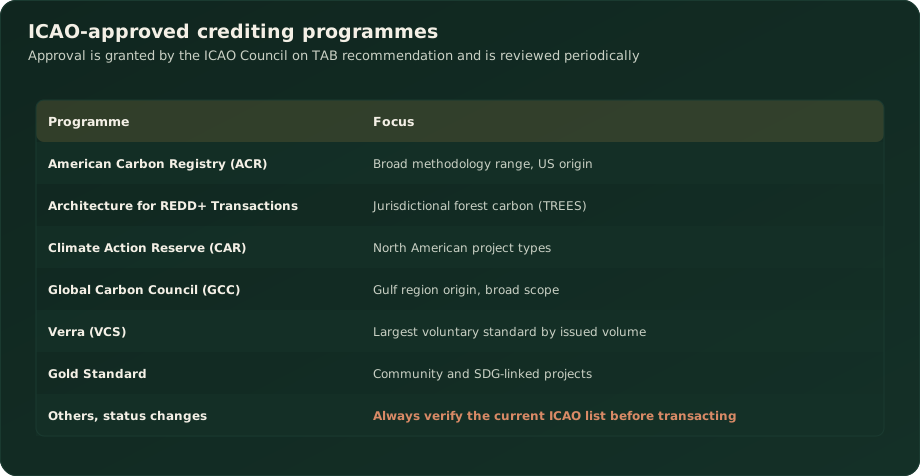
Programme approval is not a fact you check once. It is a status that changes by ICAO Council decision, and both buyers holding units and developers mid-project carry exposure to it changing.
Managing that exposure is a practical discipline, and this article is about it.
For how approval works, what the Technical Advisory Body assesses and why programme approval never makes every unit eligible, see ICAO-approved crediting programmes. This piece is about managing the risk that status changes.
The Two Exposures
As a buyer holding units. If the issuing programme's approval lapses between your purchase and your cancellation, can you still use them? The answer depends on Council decisions and on how your national authority treats the situation. It is not a question you want to be asking at cancellation time.
As a developer mid-project. A multi-year development under a programme whose approval lapses is a serious problem. Migration to another programme is sometimes possible and is costly and slow.
Both are managed the same way: check status at the points that matter, and avoid concentration.
When to Check
Not once. Four times.
| Moment | Why |
|---|---|
| Before opening a registry account | Avoid onboarding with a programme that has lapsed |
| At the point of transaction | The status that governs your purchase decision |
| Before cancelling, if time has passed | A few minutes against a material risk |
| Periodically while holding inventory | So a change is noticed before it matters |
The third is the one most often skipped. Units bought in March and cancelled in November have sat through eight months in which a Council decision could have landed.
How to Check Properly
Go to the source. The ICAO CORSIA emissions units page is the only authoritative record. A list in an article, a seller's website or a saved bookmark is a snapshot.
Read the conditions, not just the name. Approval may be full or conditional. A conditional approval frequently limits methodologies or project types, and a programme appearing on the list tells you nothing about whether the condition touches your units.
Note the reassessment date where one is published, so you know when the position could next move.
Capture what you saw. Save the page, with the date. A URL in a compliance file is not evidence of what it said on the day you relied on it, and this is exactly the kind of thing a verifier asks about years later.
Reducing Concentration
The structural protection, and it costs little to implement.
Spread across programmes. Units from three approved programmes means a single lapse affects a third of your holding rather than all of it. The administrative overhead of a second or third registry account is modest against that.
Do not hold for long periods. Time held is time exposed. Cancelling closer to acquisition reduces the window in which status can change beneath you.
Diversify vintage and host State too. Programme approval is one regulatory variable among several, and a portfolio concentrated on any one of them is exposed to a change in that one.
For a developer the equivalent is keeping a voluntary market fallback, so a lapse removes the premium rather than the entire route to market.
Contracting Around It
Where a purchase settles some time after contracting, the agreement should say what happens if approval changes in between.
Whose risk is it? Neither party caused a Council decision. Allocate it explicitly rather than leaving it to argument.
What is the remedy? Substitution with units from a programme still approved is usually more valuable to a buyer than a refund, because a refund leaves you needing units in a market you have just learned is unreliable.
Is there a status warranty at delivery, not merely at signature?
For forward agreements running over a year or more, this belongs alongside the authorisation and vintage clauses as one of the three regulatory risks a well-drafted contract addresses.
What to Do If Approval Lapses While You Hold Units
Not a hypothetical — it has happened.
Establish the position with your national authority first, before acting. Transitional arrangements sometimes apply to units issued while approval was in force, and the answer may be better than you fear.
Do not assume the units are worthless. They remain valid credits in the voluntary market even where CORSIA eligibility is affected, so the loss may be a value reduction rather than a total one.
Check your contracts. If the units were bought recently with a status warranty, you may have a remedy.
Plan replacement on a realistic timeline, and inform your authority early if the compliance position is genuinely at risk. A foreseeable problem raised in advance is handled very differently from one discovered at the deadline.
For Developers Choosing a Programme
Approval status is one of six considerations, and it is worth weighing alongside the others rather than in isolation.
| Consideration | Question |
|---|---|
| Current status | Approved, and full or conditional? |
| Stability | How long held, when next reassessed? |
| Methodology fit | Does one exist for your activity, and is it under review? |
| Adjustment handling | Does the process align with your host State's? |
| Buyer familiarity | Will buyers already hold accounts there? |
| Fees and queues | Registration, levies, realistic validation timelines |
Defaulting to whichever standard you used before is habit rather than a decision, and it is how developers end up mid-project under a programme whose approval was already conditional when they registered.
Building the Check Into Your Process
Status checking fails when it depends on someone remembering. Three places to embed it so it does not.
In the purchase checklist, as a gate before diligence proceeds. Not as an item to tick afterwards.
In the pre-cancellation reconciliation, as a mandatory re-check where more than a few months have passed since purchase. This is the one most often skipped and the one with the most exposure behind it.
In a periodic review, quarterly, covering every programme you hold units from or have accounts with. Fifteen minutes, and it converts a surprise into a managed decision.
Each check should produce a captured record — the page as at that date — filed with the relevant transaction. A verifier asking why you believed a programme was approved needs to see what you saw.
What Good Looks Like in the File
For any parcel of units, the approval evidence should let someone uninvolved answer three questions without asking you.
Was the programme approved when we bought? A captured page dated at or near the transaction, showing the programme and its status.
Was the approval full or conditional, and did any condition affect these units? The condition text, captured, with a note on why it did or did not apply.
Was it still approved when we cancelled? A second captured page from the cancellation date.
Three saved pages and two short notes. It takes minutes at the time and it is not reconstructable afterwards, which is the whole argument for doing it at the time.
A Standing Watch Item
Programme status belongs on somebody's list rather than in nobody's.
The practical arrangement is a quarterly item owned by whoever holds the compliance obligation: check each programme you hold units from or have accounts with, capture the page, note any change in status or conditions, and flag anything that touches inventory you are holding.
Fifteen minutes a quarter. What it buys is that a lapse becomes a decision you make with time in hand, rather than something discovered at cancellation with a deadline approaching and no alternative supply arranged.
The same review is the natural moment to check vintage window decisions and participation list changes, since all three are Council-driven and all three move your position without any change to your own operation.
Frequently Asked Questions
Does a lapse affect units already cancelled? Cancellation completed and reported against a compliance period is generally settled. The exposure is on units held but not yet cancelled, which is the argument for not holding inventory longer than necessary.
Can we insure against approval risk? Not as a standard product. The practical mitigations are diversification across programmes, shorter holding periods, and contractual allocation with a substitution remedy.
How many programmes is enough diversification? Two meaningfully reduces single-point exposure; three is comfortable for a substantial obligation. Beyond that the administrative overhead outweighs the marginal risk reduction.
How often does approval change? Infrequently, but it has changed, and conditions attach and are lifted more often than full approvals lapse.
Where do I check current status? The ICAO CORSIA emissions units page. Nothing else is authoritative.
Can I still use units if approval lapses after issuance? It depends on Council decisions and your national authority's treatment. Establish the position rather than assuming either way.
Should we hold accounts with several programmes? For anything beyond a small obligation, yes. The concentration risk outweighs the administrative overhead.
Does a conditional approval mean the units are unusable? Not necessarily. Read the condition — it may exclude specific methodologies rather than the whole programme.
What should the contract say? Who bears the risk of a status change between signature and delivery, and what the remedy is. Substitution is generally more valuable than a refund.
How do I document status for verification? Capture the ICAO page as at the transaction date and retain it with the purchase file.