ICAO-Approved Crediting Programmes and What Approval Means
How the Technical Advisory Body assesses crediting programmes, what full and conditional approval mean, why programme approval never makes every unit eligible, and how to handle approval risk as a buyer or developer.
ICAO does not approve individual projects or units. It approves programmes — the standards bodies that publish methodologies, register projects, oversee verification and operate registries. Understanding the gap between programme approval and unit eligibility prevents the most common purchasing mistake in this market.
How Approval Works
| Stage | Who | What |
|---|---|---|
| Application | Crediting programme | Submits against the Emissions Unit Criteria |
| Assessment | Technical Advisory Body (TAB) | Evaluates and recommends |
| Decision | ICAO Council | Approves, conditions, or declines |
| Review | TAB and Council | Periodic reassessment; approval can lapse |
Approval outcomes:
- Full — approved for the scope assessed
- Conditional — approved subject to specified limitations or required changes
- Declined
- Lapsed — previously approved, criteria not maintained or reassessment not sought
What the TAB Examines
Governance and independence
Whether the body setting methodologies is sufficiently separated from commercial pressure, how decisions are made, and whether there is meaningful oversight of the programme's own management.
Methodology development
How methodologies are created, reviewed and revised. Whether there is public consultation, independent expert input, and a mechanism for retiring methodologies that no longer hold up.
Additionality and quantification
What developers must demonstrate and how rigorously. Whether methodologies require uncertainty to be resolved toward under-crediting, and whether default values are conservative.
Permanence
For storage-based reductions: buffer pool design, sizing methodology, and how reversals are detected and handled.
Validation and verification oversight
How the programme accredits and supervises third-party bodies, and how conflicts of interest are managed.
Registry infrastructure and double-counting safeguards
Serialisation, transfer controls, cancellation records, public transparency, and critically the ability to identify authorised units and record corresponding adjustment status.
This last point has produced most of the conditions attached to approvals. Programmes designed before Article 6 mechanics existed have had substantial retrofitting to do, and not all have satisfied ICAO.
Social and environmental safeguards
Impact assessment requirements, stakeholder consultation, consent processes and grievance mechanisms.
The Programmes
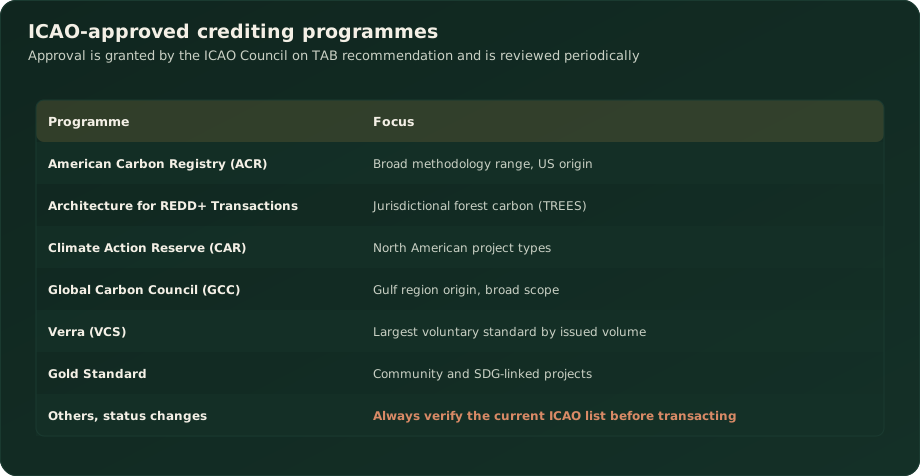
Programmes that have held ICAO approval include the American Carbon Registry, Architecture for REDD+ Transactions, the Climate Action Reserve, the Global Carbon Council, Verra and Gold Standard, among others.
That list is deliberately not presented as current. Approvals change by Council decision, conditions attach and are lifted, and programmes have had approval lapse. Any list published in an article is a snapshot of the day it was written.
The only reliable source is the ICAO CORSIA emissions units page. Check it at the point of transaction, and capture what it says on the day — a saved page or screenshot. A URL in your compliance file is not evidence of what the page said when you relied on it.
Approval Is Necessary, Never Sufficient
An approved programme issues units that are not eligible, because unit-level criteria apply independently:
Vintage. Approved programmes have decades of issuance history, most of it outside current windows.
Corresponding adjustment. The programme cannot provide this — it is a sovereign act by the host State. This single point removes the large majority of units from eligibility, including from the most reputable programmes.
Methodology scope under conditional approval. Where approval is conditional, the condition may exclude particular methodologies or project types.
Conditional Approval in Practice
Conditional approvals are common and frequently misread.
A condition typically requires the programme to demonstrate or implement something — most often relating to corresponding adjustment handling and how authorised units are labelled, sometimes to methodology governance or safeguards.
For a buyer, three questions:
- What exactly is the condition?
- Does it affect the units I am buying?
- What happens if the condition is not satisfied by its deadline?
A conditional approval that excludes your methodology makes your units ineligible even though the programme appears on the approved list. Reading only the programme name and skipping the condition is a genuine and avoidable failure mode.
Approval Risk
Approval status can change during the life of a transaction or a project.
For buyers holding units
If approval lapses, can you still cancel units issued while it was in force? The answer depends on Council decisions and on how your national authority treats the situation. This is not something to discover at cancellation.
Mitigations: diversify across programmes; do not hold units for extended periods before cancelling; re-verify approval status before cancelling if significant time has passed since purchase; address the scenario contractually.
For developers mid-project
A multi-year development under a programme whose approval lapses is a serious problem. Migration to another programme is sometimes possible but costly and slow.
Mitigations: monitor status actively; understand the reassessment timeline; keep a voluntary market fallback so a lapse does not eliminate your route to market.
Choosing a Programme as a Developer
Beyond current approval status:
| Consideration | Why it matters |
|---|---|
| Approval stability | How long held, full or conditional, when reassessed |
| Methodology fit | Does it match your activity, and is it itself under review |
| Corresponding adjustment handling | Does the process align with your host State's |
| Registry and buyer familiarity | Buyers with existing accounts transact more easily |
| Fees and timelines | Registration, issuance levies, validation queue times |
| Reputation | Buyers apply their own scrutiny beyond ICAO approval |
Defaulting to whichever standard you have used before is habit, not a decision.
Why the List Is Shorter Than the Market Expects
Programme approval is genuinely demanding, and programmes have been declined or conditioned on governance, methodology process, safeguards and registry infrastructure.
The double-counting infrastructure requirement has been particularly consequential. A programme must be able to identify authorised units, reflect authorisation status in its registry, and support the accounting that prevents double claiming.
This is a feature rather than a defect. A scheme whose credibility rests on unit integrity cannot approve programmes that cannot demonstrate it. But it does mean the eligible pool is far smaller than the general carbon market — and it is the structural reason eligible supply commands a premium.
Where to Go Next
- The emissions unit criteria — what programmes are assessed against
- CORSIA Eligible Emissions Units — the two-layer test
- Corresponding adjustments — why conditions cluster here
- CORSIA governance — the TAB and the Council
DSTechnoverse verifies programme approval status and conditions as part of pre-transaction due diligence. Talk to our team.
Need this applied to your position?
We assess operators’ obligations and developers’ eligibility pathways directly.