Not all forest carbon comes from stopping deforestation. Improved Forest Management (IFM) credits are earned by managing an existing, working forest so that it stores more carbon than it would under business-as-usual — longer harvest rotations, lighter thinning, or a shift from timber extraction toward conservation. The climate logic is sound, and the accounting is subtle. This representative case study shows how an IFM portfolio is checked.
The Engagement
A buyer was considering an IFM portfolio issued under a forest-carbon standard such as ACR. Unlike a conservation project, an IFM project keeps producing — it is a managed forest — so the credit rests on a comparison between two management scenarios rather than on avoided clearance. Our role was to test whether that comparison, and the data behind it, would survive scrutiny.
Where IFM Integrity Is Won or Lost
The management baseline
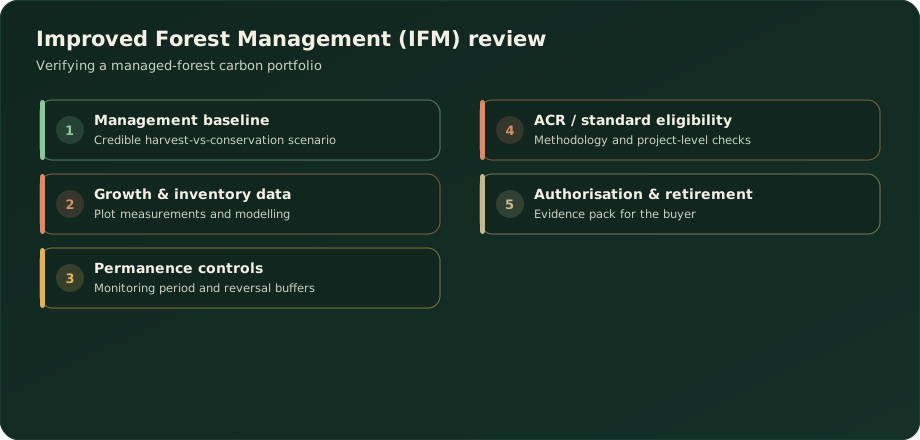
The heart of an IFM credit is the baseline: the harvesting the owner would have done without carbon finance. If that hypothetical harvest is exaggerated, the "improvement" is inflated and so is the credit. We examined how the business-as-usual scenario was justified — against the owner's own history, legal harvest rights and regional practice — rather than against an aggressive assumption chosen to maximise volume. This is the IFM equivalent of the deforestation-baseline debate in REDD+.
Inventory and growth data
IFM is data-heavy in a way conservation projects are not. The carbon stock is estimated from forest inventory plots and growth models, then re-measured over time. We reviewed the sampling design, the plot data and the modelling assumptions, because this is where quiet over-estimation hides — an optimistic growth curve compounds into a lot of phantom tonnes over a crediting period.
Permanence and monitoring
A managed forest is still exposed to fire, pests and a future owner who reverts to heavy harvesting. We checked the permanence provisions: the length of the monitoring commitment, the reversal buffer, and what happens if management reverts. A credit backed by a long commitment and an adequate buffer is worth more than a cheaper one that is not.
Eligibility and authorisation
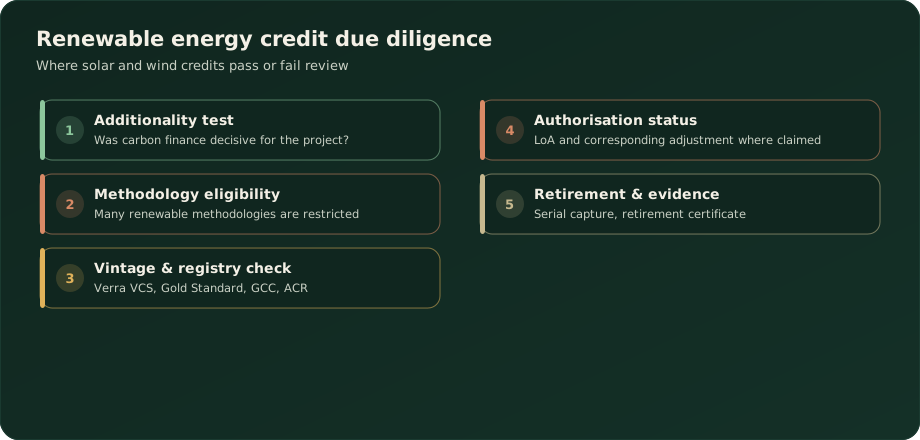
Finally, the standard and methodology were checked for continued eligibility, and — where the buyer's use required it — the authorisation and corresponding-adjustment position was verified rather than assumed.
The Result
The portfolio held up better than the renewable-energy pool in an earlier engagement, precisely because its integrity rests on measurable inventory data rather than a contested additionality argument. The main work was in the baseline and the growth modelling, where we recommended the buyer rely on the more conservative of the available estimates. With that adjustment, the units were cleared for retirement with a defensible evidence pack.
Key Takeaways
- IFM credits compare two management scenarios, so the business-as-usual baseline is everything.
- The credit is only as good as the inventory and growth data behind it — review the sampling, not just the summary.
- Permanence still matters for a working forest; check the monitoring period and buffer.
- Prefer the conservative estimate where the data allows a range.
Frequently Asked Questions
What is Improved Forest Management? Managing an existing forest to store more carbon than business-as-usual — for example through longer rotations or reduced-impact logging — and crediting the difference.
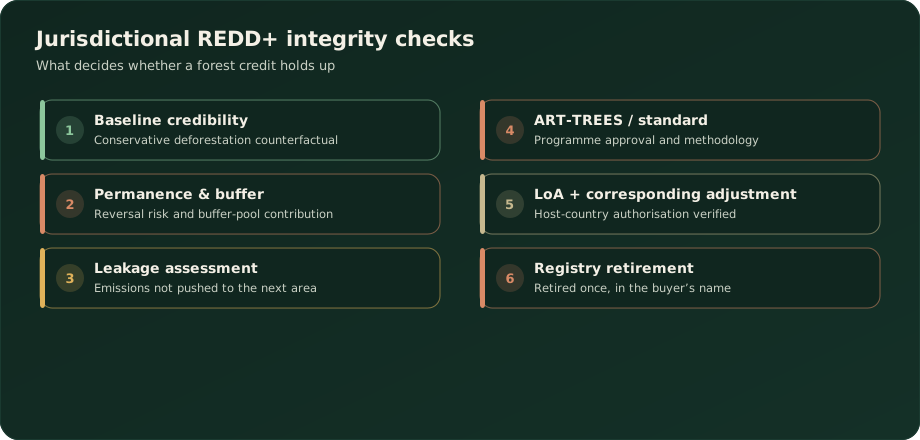
How is IFM different from REDD+? REDD+ credits avoided deforestation; IFM credits better management of a forest that keeps operating.
What makes an IFM credit high quality? A conservative, well-evidenced management baseline, sound inventory and growth data, and real permanence provisions.
Can IFM credits be used for compliance schemes? Where the standard, methodology and unit meet the scheme's eligibility and authorisation requirements.
Why review the inventory data? Because small, optimistic assumptions in growth modelling compound into large over-estimates of stored carbon over time.
Evaluating carbon credits across standards and project types? DSTechnoverse works on the data and integrity side of carbon procurement — project screening, registry and eligibility verification, MRV and monitoring-data analysis, reconciliation and defensible reporting. See our CORSIA carbon credit services and data analytics. We are based in Indore, Madhya Pradesh and work across India and internationally.
Apply as a carbon credit buyer or seller
Talk to our team, or start with the complete carbon credits guide.
This is an anonymised, representative case study that illustrates our approach. It does not identify any specific client, project, price or transaction.