Few credit types carry as much promise, or as much scrutiny, as forestry. Jurisdictional REDD+ — reducing emissions from deforestation and forest degradation across a whole state or country rather than a single project — offers large volumes and a genuine climate story. It has also been at the centre of the market's hardest integrity debates. This representative case study shows how a jurisdictional REDD+ offer is checked before a buyer relies on it.
The Brief
A buyer was offered a substantial allocation of jurisdictional REDD+ credits issued under a forest-carbon standard such as ART-TREES. The offer looked strong on paper: a recognised programme, a whole-jurisdiction accounting boundary, and — the seller said — host-country authorisation in place. Our mandate was to verify the integrity and the authorisation independently, not to take the seller's word for either.
The Four Questions That Decide a Forest Credit
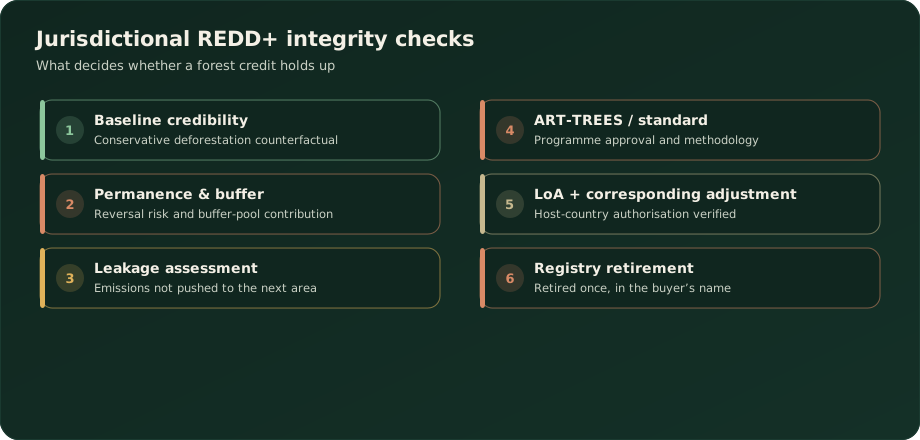
Forestry credits live or die on four technical judgements. We worked through each.
Baseline credibility
A REDD+ credit is measured against a baseline — what deforestation would have happened without the programme. Inflate that baseline and you manufacture reductions that never occurred; this is precisely the criticism that has dogged some project-level REDD+. The jurisdictional approach helps, because the accounting boundary is a whole state rather than a cherry-picked project area, but the baseline still has to be conservative and evidence-based. We examined how it was set and how recently it had been reset.
Permanence and the buffer
A tonne stored in a forest that later burns or is cleared has not been reduced. We checked the permanence provisions: the length of the monitoring commitment and the contribution to a buffer pool — the shared reserve that standards hold back to cover reversals. A thin buffer against a high reversal risk is a red flag.
Leakage
If protecting one area simply pushes logging into the next valley, the emissions have leaked rather than been avoided. We looked at how leakage was measured and deducted, since a jurisdictional boundary reduces but does not eliminate the risk.
Authorisation and double counting
This is where many forestry offers stall. For the buyer's intended use, the unit needed a host-country Letter of Authorisation (LoA) and a corresponding adjustment — the government formally deducting the traded tonnes from its own national total under Article 6, so the same reduction is not counted twice. We verified that status against the published source. As with many forestry offers, part of the pipeline turned out to be arrangeable rather than authorised — credible, but pending authorisation, and therefore not yet safe to rely on for a compliance claim.
What the Review Produced
The output was a clear split between what was ready and what was still pending. The authorised, corresponding-adjusted portion, backed by a conservative baseline and an adequate buffer, was cleared for retirement in the buyer's name with an evidence pack. The pipeline portion — genuine, but awaiting host-country authorisation — was kept out of the compliance claim and flagged as indicative only.
That distinction, authorised now versus pending authorisation, is the single most useful thing a REDD+ buyer can get straight before contracting.
Key Takeaways
- A jurisdictional boundary strengthens the baseline story but does not remove the need to check it.
- Permanence depends on the monitoring period and a real buffer pool, not a promise.
- Leakage must be measured and deducted, not assumed away.
- For compliance use, verify the LoA and corresponding adjustment against the live source — never on the seller's assertion.
The same double-counting logic runs through CORSIA eligible emissions units.
Frequently Asked Questions
What is jurisdictional REDD+? A REDD+ programme accounted at the level of a whole state or country, rather than a single project, which reduces baseline-gaming and leakage risk.
Why has REDD+ been controversial? Mainly because some project baselines over-estimated the deforestation that would otherwise have occurred, inflating credit volumes.
What is a buffer pool? A shared reserve of credits standards withhold to cover reversals such as fire or clearance, protecting the integrity of issued units.
What does "pending authorisation" mean? The credits are real but the host country has not yet issued the Letter of Authorisation and corresponding adjustment needed for a compliance claim.
Do jurisdictional REDD+ credits qualify for CORSIA? They can, where the programme is approved and the units carry the required authorisation and corresponding adjustment for the phase.
Evaluating carbon credits across standards and project types? DSTechnoverse works on the data and integrity side of carbon procurement — project screening, registry and eligibility verification, MRV and monitoring-data analysis, reconciliation and defensible reporting. See our CORSIA carbon credit services and data analytics. We are based in Indore, Madhya Pradesh and work across India and internationally.
Apply as a carbon credit buyer or seller
Talk to our team, or start with the complete carbon credits guide.
This is an anonymised, representative case study that illustrates our approach. It does not identify any specific client, project, price or transaction.