Most carbon credits avoid an emission. Afforestation and Reforestation (ARR) credits do something rarer and, to many buyers, more valuable: they remove carbon from the atmosphere by growing new forest where there was none. That distinction — a removal rather than an avoidance — puts ARR credits in demand, and it also raises the bar on evidence, because you are now claiming carbon that has physically been drawn down and stored. This representative case study covers how ARR removals are monitored and verified.
The Context
A buyer with a preference for removal credits, rather than avoidance, was evaluating an ARR portfolio issued under a standard such as a national or premium VER programme. Removals command a premium, so the buyer wanted assurance that the trees existed, the growth was real, and the carbon would stay stored. Our mandate was the monitoring and verification data.
How a Removal Is Evidenced
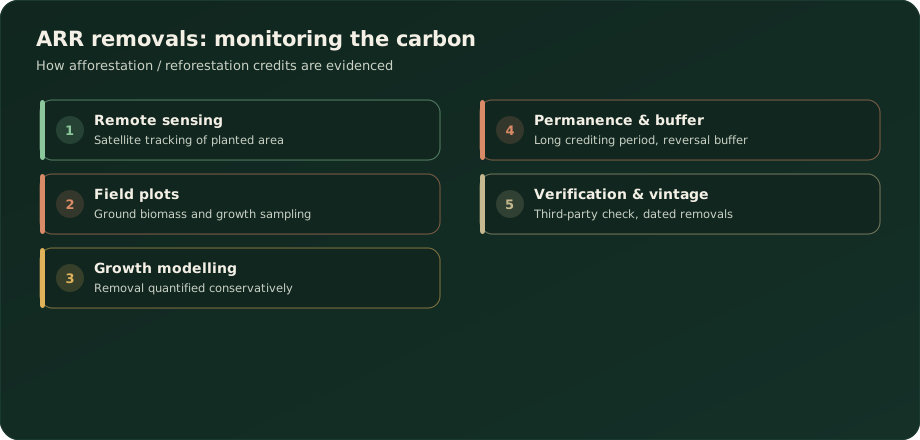
ARR is measured, not assumed, and the measurement stack has three layers.
Remote sensing
The first layer is satellite and remote-sensing data: confirming that the planted area is real, is the size claimed, and has actually established. This is where a desk review starts, because it catches the most basic failure — an area credited but never planted, or planted and lost.
Field plots and biomass
Remote sensing shows extent; it does not, on its own, give you tonnes. The second layer is field sampling — measured plots where tree diameter, height and density feed biomass equations. We reviewed the sampling design and the plot data, since a removal claim is only as strong as the ground-truth behind the satellite picture.
Conservative growth modelling
New forests grow over time, so the removal is quantified with a growth model. The integrity question is whether the model is conservative. An optimistic growth curve inflates future removals; we recommended the buyer rely on cautious assumptions and on removals actually evidenced to date rather than projected.
Permanence: The ARR-Specific Risk
Every nature-based removal shares one exposure: the carbon can come back. A young plantation is vulnerable to fire, drought, pests and clearance. So we checked the permanence architecture — a long crediting and monitoring period, and a buffer pool contribution sized to the reversal risk. For removals, permanence is not a footnote; it is the difference between a durable removal and a temporary one.
Finally, we confirmed vintage and that the units were verified by an accredited third party and un-retired in the registry, before clearing them for retirement in the buyer's name.
The Outcome
The portfolio's strength was that its claim was measurable and its weakness was the usual one for young forests: permanence. The buyer proceeded on the evidenced, verified removals, relying on conservative growth assumptions and confirming the buffer contribution — and treated projected future removals as upside rather than as contracted volume.
Key Takeaways
| Layer | What it proves |
|---|---|
| Remote sensing | The planted area is real and established |
| Field plots | The biomass — and therefore the tonnes — is measured |
| Growth model | Future removal, quantified conservatively |
| Buffer pool | Reversal risk is covered |
For how continuous sensor evidence is changing this kind of monitoring, see digital MRV.
Frequently Asked Questions
What does ARR stand for? Afforestation and Reforestation — establishing new forest on land that was not previously forested, or re-establishing it where it was lost.
Why are removal credits valued more than avoidance credits? Because they physically draw carbon out of the atmosphere rather than preventing a future emission, which many buyers see as higher quality.
What is the main risk with ARR credits? Permanence — young forests can be lost to fire, drought or clearance, so the buffer pool and monitoring period matter.
How are ARR removals measured? A combination of remote sensing for area, field plots for biomass, and conservative growth modelling for the carbon removed over time.
Should I pay for projected future removals? Prefer removals already evidenced and verified; treat projected growth as upside rather than contracted volume.
Evaluating carbon credits across standards and project types? DSTechnoverse works on the data and integrity side of carbon procurement — project screening, registry and eligibility verification, MRV and monitoring-data analysis, reconciliation and defensible reporting. See our CORSIA carbon credit services and data analytics. We are based in Indore, Madhya Pradesh and work across India and internationally.
Apply as a carbon credit buyer or seller
Talk to our team, or start with the complete carbon credits guide.
This is an anonymised, representative case study that illustrates our approach. It does not identify any specific client, project, price or transaction.