Renewable-energy carbon credits look like the easy option. Solar PV and wind are abundant, the volumes are large, and the price is often the lowest on the market. That very cheapness is the warning sign, and it is exactly where careful buyers slow down. This representative case study walks through how the data side of a renewable-energy purchase is assessed before any money moves.
The Situation
A corporate buyer wanted a large block of low-cost credits to cover a voluntary target, and renewable-energy units — grid-connected solar PV and wind, across registries including Verra VCS, Gold Standard, the Global Carbon Council and ACR — were the obvious candidates on price. The brief to us was narrow and data-focused: screen the candidate projects for integrity and eligibility before the buyer contracted, and produce an evidence pack a verifier or an auditor could rely on.
Why Renewables Need Extra Scrutiny
The problem with grid renewables is not fraud; it is additionality. A credit is only real if the reduction happened because of carbon finance. In many regions, solar and wind are now the cheapest new generation on their own economics, so a project that would have been built anyway produces credits that represent no extra reduction. This is why several standards have restricted or excluded whole categories of renewable-energy methodology, and why the same technology can be creditable in one country and not in another.
So the first filter is not the price and not even the registry — it is whether the methodology and the specific project still qualify at all.
How the Portfolio Was Assessed
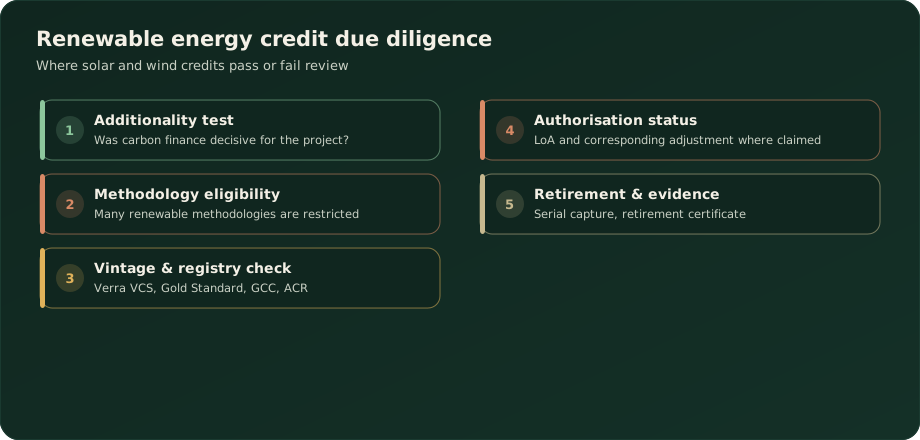
We ran each candidate project through the same sequence.
1. Methodology-level eligibility
Before looking at a single credit, we checked whether the methodology was still active and accepted for the buyer's purpose. Many renewable-energy methodologies are restricted, grandfathered or excluded, and a technically valid project on a retired methodology produces units the buyer cannot use.
2. The additionality question
For projects that cleared the methodology filter, we examined the additionality argument on its merits: the counterfactual, the financial case at the time of the investment decision, and whether carbon revenue was plausibly decisive. Projects whose own economics clearly stood without carbon finance were flagged, regardless of how cheap the credits were.
3. Vintage, registry and serial integrity
We verified each unit against the registry of record — issuance, vintage, and that the serial numbers were live and un-retired. Old vintages sold at a discount, with little recent monitoring, were treated with caution.
4. Authorisation status, where claimed
Where a seller claimed a unit carried a Letter of Authorisation (LoA) and a corresponding adjustment under Article 6, we verified that against the published source rather than accepting the assertion. For a plain voluntary claim this is optional; for compliance use it is decisive.
5. Counterparty checks
In parallel, KYC and sanctions screening on the seller, so an integrity-clean credit was not undermined by a counterparty problem.
The Outcome
The screening did what screening is meant to do: it separated the pool. A portion of the cheapest candidates were set aside at the methodology and additionality stage — not because anything was fraudulent, but because the reductions were not credibly additional. The buyer proceeded with a smaller, defensible subset, and retired those units in its own name with a full evidence pack behind each one.
The lesson the buyer took away was the one worth repeating: in renewable-energy credits, the lowest price on the screen is usually the highest risk on the desk.
Key Takeaways
| Check | Why it mattered here |
|---|---|
| Methodology eligibility | Several renewable methodologies are restricted or excluded |
| Additionality | Cheap renewables often would have been built anyway |
| Vintage & serials | Confirms real, un-retired units of a usable age |
| Authorisation | LoA and corresponding adjustment verified, not assumed |
| Counterparty | KYC and sanctions screening protects the whole deal |
For the broader framework behind these checks, see how to evaluate carbon offset quality.
Frequently Asked Questions
Are renewable-energy carbon credits bad? Not inherently — but grid solar and wind often struggle on additionality, so the methodology and project must be checked before relying on the units.
Why are renewable credits so cheap? Large supply and questionable additionality push prices down; the low price frequently reflects lower integrity rather than a bargain.
Can renewable credits be used for CORSIA? Only where the programme, methodology and unit meet CORSIA's eligibility criteria, which many renewable methodologies do not.
What is methodology-level eligibility? Whether the specific accounting methodology behind a credit is still active and accepted for your purpose — a separate question from whether the project is real.
Do you take title to the credits? No. We work on the data, screening and verification side; the purchase sits directly between the buyer and the seller.
Evaluating carbon credits across standards and project types? DSTechnoverse works on the data and integrity side of carbon procurement — project screening, registry and eligibility verification, MRV and monitoring-data analysis, reconciliation and defensible reporting. See our CORSIA carbon credit services and data analytics. We are based in Indore, Madhya Pradesh and work across India and internationally.
Apply as a carbon credit buyer or seller
Talk to our team, or start with the complete carbon credits guide.
This is an anonymised, representative case study that illustrates our approach. It does not identify any specific client, project, price or transaction.