The names are similar enough that they get used interchangeably, and they cover entirely different ground. Choosing the wrong one wastes an audit cycle.
The Short Answer
ISCC CORSIA certifies aviation fuel against the CORSIA sustainability criteria, so that an aircraft operator can reduce its offsetting obligation. It is recognised by ICAO for that purpose.
ISCC PLUS certifies bio-based and circular materials across many sectors — food, feed, chemicals, plastics, packaging and fuels — for voluntary market and brand purposes. It is not a CORSIA instrument.
They share an issuing organisation and a general approach to chain of custody. They do not share a purpose.
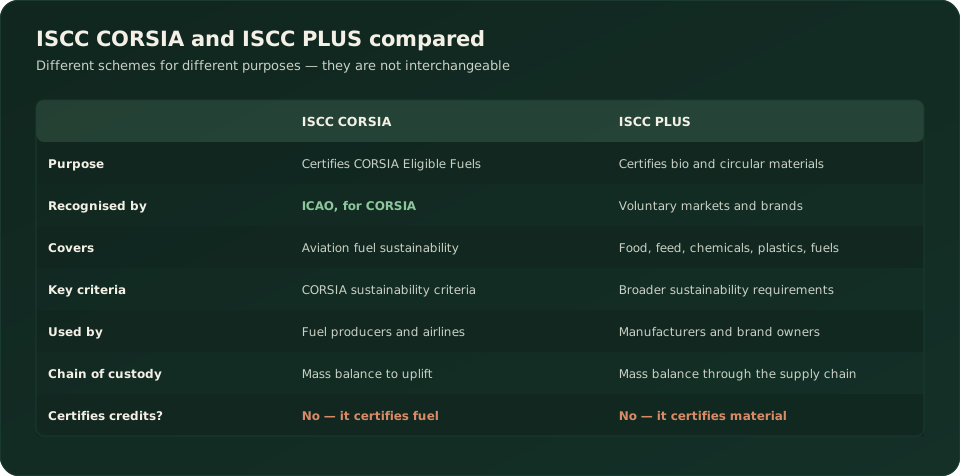
Side by Side
| ISCC CORSIA | ISCC PLUS | |
|---|---|---|
| Purpose | Certifies CORSIA Eligible Fuels | Certifies bio-based and circular materials |
| Recognised by | ICAO, for CORSIA compliance | Voluntary markets, brands, supply chains |
| Covers | Aviation fuel sustainability | Food, feed, chemicals, plastics, fuels |
| Key criteria | CORSIA sustainability criteria | Broader ISCC sustainability requirements |
| Typical certificate holder | Feedstock, conversion, blending, supply | Manufacturers, processors, brand owners |
| Chain of custody | Mass balance through to uplift | Mass balance through the supply chain |
| Drives | A regulatory compliance reduction | A market claim about material content |
| Certifies carbon credits? | No | No |
That final row is the one worth repeating. Neither scheme certifies carbon credits. Credits are issued under crediting standards — Verra, Gold Standard, ACR and others. ISCC operates in a different part of the system entirely.
When You Need ISCC CORSIA
You need it if you are in the aviation fuel supply chain and your product is intended to support an operator's CORSIA claim:
- A feedstock supplier providing material for SAF production
- A conversion plant producing SAF or LCAF
- A trader or blender handling certified volumes
- A fuel supplier delivering into an airport
You also need to understand it — without holding it — if you are an aircraft operator intending to claim CORSIA Eligible Fuels, because you must obtain and retain the resulting documentation to survive verification.
When You Need ISCC PLUS
You need it if you are making a material content claim outside the CORSIA context:
- A chemical producer claiming bio-based or recycled content
- A packaging manufacturer supplying brands with sustainability commitments
- A food or feed processor certifying sustainable inputs
- A fuel producer selling into voluntary rather than CORSIA markets
The driver here is commercial and reputational rather than regulatory. Brand owners increasingly require certification through their supply chains, and ISCC PLUS is one of the schemes that satisfies that.
Can You Hold Both?
Yes, and some organisations do — typically a producer whose output splits between aviation fuel destined for CORSIA claims and material sold into voluntary or industrial markets.
They are separate certifications with separate audits, separate scopes and separate certificates. Holding one does not shorten the process for the other, though the underlying traceability systems overlap substantially, which does reduce the preparation effort.
The Confusion Worth Clearing Up
Three misconceptions that recur:
"ISCC certified" is not a complete statement. It says nothing about which scheme, which scope or which product. Ask which certificate, covering what.
ISCC CORSIA does not make fuel into credits. Certified fuel reduces an offsetting requirement directly. It does not generate tradable units.
ISCC PLUS certification does not support a CORSIA claim. If an operator is offered fuel certified under ISCC PLUS and told it supports CORSIA, that is wrong. The scheme must be one ICAO has approved for CORSIA purposes.
Where Each Sits in the Wider System
Placing both schemes against the instruments they are frequently confused with clears most of the remaining ambiguity.
| Instrument | What it is | Certified or issued by |
|---|---|---|
| ISCC CORSIA | Certification that fuel meets CORSIA criteria | ISCC, via approved certification bodies |
| ISCC PLUS | Certification of bio-based or circular material content | ISCC, via approved certification bodies |
| Carbon credit | A tonne of CO2e avoided or removed | Crediting standards — Verra, Gold Standard, ACR, CAR |
| CORSIA Eligible Emissions Unit | A credit usable for CORSIA compliance | A crediting programme, plus host-State authorisation |
| Guarantee of Origin / REC | An attribute certificate for energy | Energy attribute registries |
| Allowance | A permit to emit under a cap | A regulator, under an ETS |
Reading across that table answers most of the questions people arrive with. Fuel certification and credit issuance are different systems run by different institutions for different purposes, and no certificate from one converts into an instrument of the other.
The one connection worth understanding: for an aircraft operator, both routes reduce the same bottom line. Certified fuel reduces the offsetting requirement; eligible credits discharge whatever requirement remains. They are complements rather than alternatives, and the sensible question is which delivers more reduction per rupee at current prices — see the complete carbon credits guide.
Which Do You Actually Need?
A short decision path:
Are you producing or handling aviation fuel intended to support an operator's CORSIA claim? ISCC CORSIA, or another ICAO-approved scheme.
Are you producing material where a customer requires bio-based or recycled content certification? ISCC PLUS, or a comparable scheme your customer accepts.
Are you an aircraft operator? Neither as a certificate holder. You need the documentation from a certified chain, and you need to be able to evidence it.
Are you trying to generate carbon credits? Neither. You need a crediting standard and a methodology.
Are you buying carbon credits? Neither is relevant to that transaction.
How to Verify a Certificate
Whichever scheme is claimed:
- Obtain the certificate itself, not a statement that one exists
- Check the scheme named on it — CORSIA, PLUS, EU or another
- Check the scope — which sites, which products, which pathways
- Check validity dates, and whether surveillance audits are current
- Verify it on the issuing body's public register where available
- Trace the chain of custody from that certificate to your batch
Step 6 is where claims most often break down. A valid certificate upstream does not by itself connect to the specific fuel you uplifted; the mass balance documentation is what makes that link.
Common Misuses of the Names
Three patterns worth recognising, because each signals a supplier who does not understand what they are selling.
"ISCC certified carbon credits." No such thing. If a seller describes credits this way, they either mean the project holds an unrelated certification, or they are confusing the two systems. Ask which crediting standard issued the units and check the registry.
"ISCC PLUS approved for CORSIA." ISCC PLUS is not an ICAO-approved scheme for CORSIA fuel claims. A fuel batch certified only under PLUS supports no CORSIA reduction, however sustainable the fuel genuinely is.
"ISCC certified" with no scheme named. ISCC operates several schemes covering different regulatory regimes and markets. The certificate names one; a supplier who cannot say which has probably not read it.
A fourth, subtler one: a valid certificate covering a facility, offered as evidence for a specific batch. Certification establishes that a producer's system meets the standard. The mass balance documentation is what connects a certified system to the volume you actually bought, and it is a separate document.
What to Ask a Supplier
Five questions that establish the position quickly:
- Which ISCC scheme is the certificate issued under, and may I see it?
- What is the certified scope — which sites, products and pathways?
- Are the validity dates current, and are surveillance audits up to date?
- What mass balance documentation connects this certificate to my batch?
- Is this volume claimed under any other scheme or mandate?
A supplier who answers all five without hesitation is one who has done this before. Hesitation on question four or five is the signal to look harder, because those are the two that most often break a claim at verification.
Frequently Asked Questions
What is the difference between ISCC CORSIA and ISCC PLUS? ISCC CORSIA certifies aviation fuel for CORSIA compliance and is recognised by ICAO. ISCC PLUS certifies bio-based and circular materials across many sectors for voluntary market purposes.
Which one do I need for carbon credits? Neither. Carbon credits are certified under crediting standards, not under ISCC.
Can ISCC PLUS support a CORSIA fuel claim? No. The certification scheme must be one ICAO has approved for CORSIA.
Do airlines need either? Not as certificate holders. Airlines need the documentation from a certified supply chain to support a CORSIA Eligible Fuels claim.
How do I get an ISCC certificate? Define the scope, establish traceability and mass balance procedures, prepare the evidence, then undergo an audit by an ISCC-approved certification body. Preparation is usually longer than the audit.
How long is a certificate valid? For a defined period with surveillance audits during it, then recertification. Check the dates on the certificate rather than assuming.
Can one organisation hold both? Yes, as separate certifications with separate audits. The underlying traceability systems overlap, which reduces preparation effort.
Where does this fit in CORSIA overall? Fuel certification reduces the offsetting requirement; credits discharge what remains. See the complete carbon credits guide.
Assessing credits before you buy? DSTechnoverse runs pre-transaction due diligence on carbon credits — programme approval status, vintage, corresponding adjustment evidence, verification and registry chain of custody. See our CORSIA carbon credit services. We are based in Indore, Madhya Pradesh and work across India and internationally.
Apply as a CORSIA buyer or seller
Talk to our carbon markets team, or start with the complete carbon credits guide.