Read anything about emissions and you will hit the same little unit everywhere: CO2e, or "carbon dioxide equivalent." It sits behind every carbon credit, every corporate footprint and every climate target — and it is far simpler than it looks. Once you understand CO2e, a lot of carbon jargon falls into place.
The Problem CO2e Solves
Carbon dioxide is not the only greenhouse gas. Methane, nitrous oxide and several industrial gases also warm the planet — and they do so with very different strengths. A tonne of methane traps far more heat than a tonne of CO2. So if you want to add up a company's total climate impact, you cannot just add tonnes of different gases together; a tonne of one is not equivalent to a tonne of another.
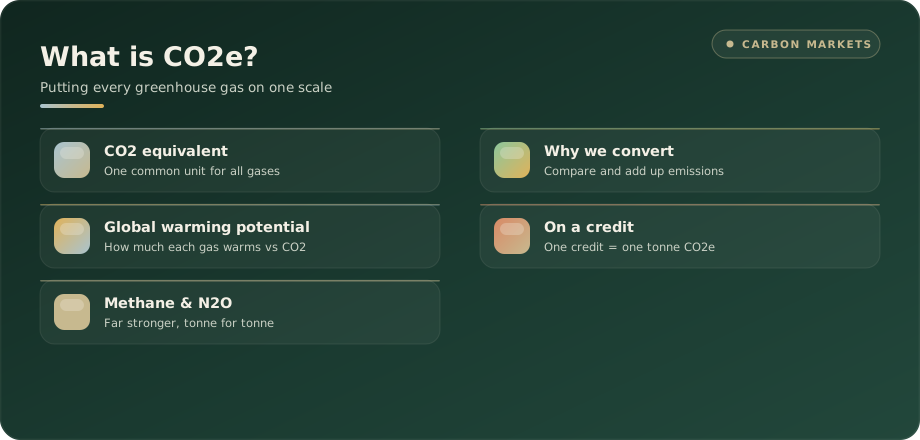
CO2e is the common currency that fixes this. It expresses the warming effect of any greenhouse gas as the amount of CO2 that would cause the same warming. Convert everything to CO2e and you can finally compare and add up emissions on one scale.
Global Warming Potential: The Conversion Factor
The conversion uses a value called Global Warming Potential (GWP) — how much a gas warms the atmosphere over a given period (usually 100 years) compared with CO2, which is the benchmark at 1.
| Gas | Approx. GWP (100-yr) | Meaning |
|---|---|---|
| Carbon dioxide (CO2) | 1 | The reference |
| Methane (CH4) | ~28–30 | ~28× stronger per tonne |
| Nitrous oxide (N2O) | ~265–273 | ~265× stronger per tonne |
So one tonne of methane is counted as roughly 28 tonnes of CO2e, because it does about 28 times the warming. (Exact GWP values are updated by climate science over time, which is why you may see slightly different numbers.)
A Simple Example
Suppose a project stops 1 tonne of methane from escaping. In plain tonnes that is "1 tonne of gas." In climate terms it is far more significant: 1 × ~28 = ~28 tonnes of CO2e of avoided warming. That is why methane-capture projects (landfill gas, biogas) can generate large volumes of credits from modest amounts of gas — the CO2e conversion reflects methane's outsized punch.
Why It Matters for Carbon Credits
Here is the tidy part: one carbon credit equals one tonne of CO2e. Not one tonne of "some gas" — one tonne of carbon-dioxide-equivalent warming. That standardisation is what lets a forestry credit, a methane credit and a removal credit all be measured in the same unit and traded against each other. When you retire a credit, you are cancelling one tonne of CO2e. It is also why every footprint and science-based target is stated in CO2e rather than raw gas tonnes.
Frequently Asked Questions
What does CO2e mean? Carbon dioxide equivalent — a unit that expresses the warming effect of any greenhouse gas as the equivalent amount of CO2, so different gases can be compared and added up.
What is Global Warming Potential (GWP)? A measure of how much a gas warms the atmosphere over a period compared with CO2; it is the factor used to convert a gas into CO2e.
Why is methane counted as more than one tonne of CO2e? Because methane traps far more heat per tonne than CO2 — roughly 28 times over 100 years — so a tonne of methane equals about 28 tonnes of CO2e.
Is one carbon credit one tonne of CO2e? Yes — a standard carbon credit represents one tonne of carbon-dioxide-equivalent emissions avoided or removed.
Why do CO2e figures sometimes differ? Because GWP values are periodically updated by climate science, and figures can use different time horizons (commonly 100 years).
Working with carbon credits or a climate target? DSTechnoverse works on the data and integrity side of carbon — project screening, registry and eligibility verification, MRV and monitoring-data analysis, reconciliation and defensible reporting. See our CORSIA carbon credit services and data analytics. We are based in Indore, Madhya Pradesh and work across India and internationally.
Apply as a carbon credit buyer or seller
Talk to our team, or start with the complete carbon credits guide.