Almost every serious conversation about carbon credits eventually hits two words: Article 6. It sounds like impenetrable treaty language, and the official text is. But the idea underneath is simple, and once it clicks, a lot of the modern carbon market — including CORSIA eligibility and the price premium on "authorised" credits — suddenly makes sense.
The One-Sentence Version
Article 6 of the Paris Agreement is the part that lets countries cooperate across borders to meet their climate targets — including by trading emission reductions — while making sure the same reduction is not counted twice.
That last clause is the whole game. Without it, a reduction made in one country and sold to another could be claimed by both, and global accounting would inflate. Article 6 is the rulebook that stops that.
The Three Pieces
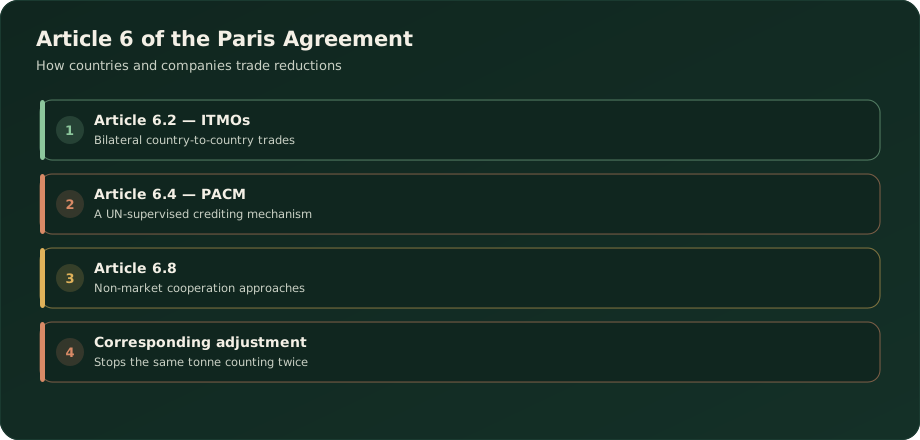
Article 6 has three parts. Two matter for carbon markets.
Article 6.2 — ITMOs (the bilateral route)
Article 6.2 lets two countries strike a bilateral deal: one transfers a reduction to the other, which counts it toward its national target. The traded units are called Internationally Transferred Mitigation Outcomes (ITMOs). Think of it as country-to-country trade, governed by agreements between the two governments rather than a central UN body.
Article 6.4 — the mechanism (the centralised route)
Article 6.4 creates a UN-supervised crediting mechanism — the Paris Agreement Crediting Mechanism — the successor to the Kyoto-era Clean Development Mechanism. Projects register under it, credits are issued under central rules, and they can be used by countries or, in many cases, by companies. It is the more standardised, centrally governed path.
Article 6.8 — non-market approaches
The third part, Article 6.8, covers non-market cooperation — climate collaboration that does not involve trading units (finance, technology, capacity building). It matters politically but is not where carbon credits come from.
Corresponding Adjustments: The Key Idea
Here is the concept that ties Article 6 to everyday credit buying. When a reduction is transferred across a border under Article 6, the host country makes a corresponding adjustment — it adds those tonnes back to its own emissions total, so it can no longer count them toward its own target. The buyer counts them; the seller un-counts them. Net effect: the tonne is counted once.
This is why you keep seeing "corresponding adjustment" attached to price and eligibility. A credit that carries one has been through this accounting and can be used for compliance without double counting — which is exactly what CORSIA's first phase requires (see CORSIA eligible emissions units). A credit without one is cheaper and, for those uses, unusable.
Why This Matters to a Buyer
You do not need to read the treaty. You need to know three practical things:
- Authorised units carry a corresponding adjustment and command a premium because they avoid double counting and unlock compliance demand.
- A Letter of Authorisation (LoA) from the host government is what enables that adjustment — and not every government will grant it, which is why authorised supply is scarcer.
- For a plain voluntary claim, an adjustment is often optional; for CORSIA and similar compliance uses, it is essential.
Get those three straight and Article 6 stops being jargon and becomes a simple filter on which credits you can actually use.
Frequently Asked Questions
What is Article 6 of the Paris Agreement? The section that allows countries to cooperate — including by trading emission reductions across borders — to meet their climate targets, with rules to prevent double counting.
What are ITMOs? Internationally Transferred Mitigation Outcomes — the emission-reduction units traded bilaterally between countries under Article 6.2.
What is the Article 6.4 mechanism? A UN-supervised crediting mechanism (the Paris Agreement Crediting Mechanism) that issues credits under central rules, succeeding the Clean Development Mechanism.
What is a corresponding adjustment? An accounting step where the host country adds transferred reductions back to its own total, so the same tonne is not counted by both the buyer and the seller.
Do I need Article 6 authorisation to use a carbon credit? For compliance uses such as CORSIA, yes — the unit needs a corresponding adjustment. For many voluntary claims it is optional but increasingly expected.
Buying, selling or evaluating carbon credits? DSTechnoverse works on the data and integrity side of carbon procurement — project screening, registry and eligibility verification, MRV and monitoring-data analysis, reconciliation and defensible reporting. See our CORSIA carbon credit services and data analytics. We are based in Indore, Madhya Pradesh and work across India and internationally.
Apply as a carbon credit buyer or seller
Talk to our team, or start with the complete carbon credits guide.