The single most consequential question in aviation carbon compliance is deceptively small: does this particular credit count? A unit can be real, verified and cheap and still be useless to an airline because it fails one of CORSIA's eligibility filters. This article walks through those filters in the order a credit must pass them.
"Eligible" Is a Technical Word
In everyday use, an offset is an offset. Under CORSIA, "eligible" has a precise meaning: a unit accepted by ICAO for compliance in a given phase. Eligibility is decided centrally, not by the buyer, and it is narrower than the broader universe of credible carbon credits. Treat it as a gate, not a spectrum.
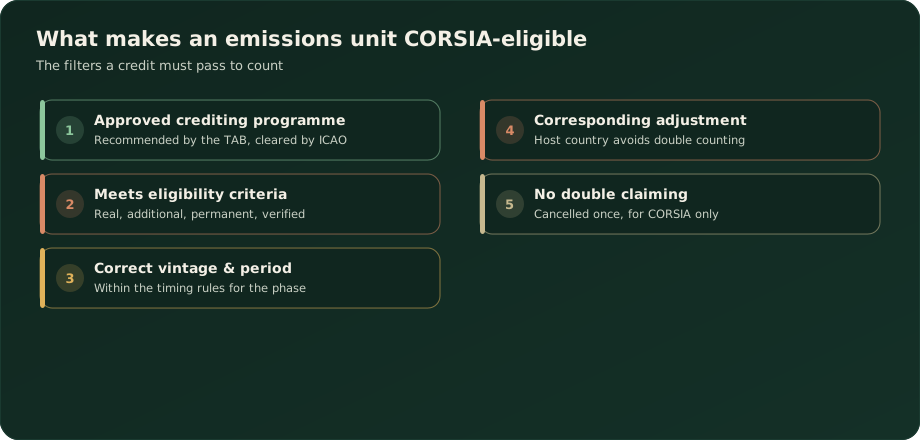
The Four Eligibility Filters
A credit passes through four gates, in order. Fail any one and it cannot be used.
Filter One: An Approved Crediting Programme
Credits are issued by crediting programmes — Verra's VCS, Gold Standard, the American Carbon Registry, the Climate Action Reserve, ART, the Global Carbon Council and others. For CORSIA, the programme itself must be assessed by ICAO's Technical Advisory Body (TAB) and approved by the ICAO Council. The TAB reviews governance, methodologies, registry integrity and safeguards, and recommends approval — sometimes with conditions or scope limits. A credit from an unapproved programme cannot be used, however good the underlying project.
Filter Two: The Eligibility Criteria
Approval of the programme is necessary but not sufficient. The individual unit must also satisfy CORSIA's Emissions Unit Eligibility Criteria, which require, in essence, that the reduction is:
- Additional — it would not have happened without carbon finance;
- Real and quantified conservatively, with a credible baseline;
- Permanent, or backed by mechanisms that address reversal risk;
- Verified by an independent third party;
- Not associated with net harm to environmental or social safeguards;
- Counted only once, which leads to the next filter.
Filter Three: Corresponding Adjustments
This is the filter that reshaped the market. To prevent the same reduction being claimed by both the airline and the country where the project sits, first-phase CORSIA units (from 2024) must carry a corresponding adjustment. The host country formally adds the traded tonnes back to its own emissions balance under Paris Agreement Article 6 accounting, so it cannot also count them toward its national target. Without that authorisation, an otherwise perfect credit is not first-phase eligible. Because not every host country will authorise adjustments — some prefer to keep reductions for their own targets — the pool of qualifying units is materially smaller than the pool of good credits.
Filter Four: Vintage and Timing
Credits carry a vintage — the period in which the reduction occurred. CORSIA sets timing rules on which vintages may be used for which compliance period, to stop very old reductions from flooding in to meet current obligations. A unit outside the accepted vintage window fails even if everything else checks out.
Putting the Filters Together
| Attribute | Eligible? |
|---|---|
| From an ICAO-approved programme, adjusted, in-vintage | Yes |
| Credible project, but programme not ICAO-approved | No |
| Approved programme, but no corresponding adjustment (first phase) | No |
| Approved and adjusted, but vintage outside the window | No |
| Meets every filter but never cancelled by the airline | Obligation not yet met |
The last row is a reminder from the airline compliance workflow: eligibility gets a unit usable, but it only discharges the duty once it is cancelled.
Why This Matters Commercially
Eligibility is not bureaucratic trivia — it is the main driver of price segmentation in the market. Corresponding-adjusted, CORSIA-eligible units trade at a premium precisely because the filters remove most of the supply. A developer who can secure a host-country adjustment holds a more valuable product than one who cannot, from the identical project. For buyers, confirming eligibility before contracting is the difference between compliance and a stranded purchase.
Frequently Asked Questions
What are CORSIA Eligible Emissions Units? Carbon credits that ICAO accepts for CORSIA compliance because they come from an approved programme and meet the eligibility criteria, including a corresponding adjustment for the first phase.
What is the Technical Advisory Body? An expert group that assesses crediting programmes and units against CORSIA's criteria and recommends eligibility decisions to the ICAO Council.
What is a corresponding adjustment? An accounting step where the host country deducts the traded reduction from its own national total, preventing the same tonne being counted twice.
Does a Verra or Gold Standard credit automatically qualify? No. The programme must be ICAO-approved for the relevant scope and the specific unit must meet all criteria, including the adjustment requirement.
Why are eligible units more expensive? The eligibility filters — approval, adjustment and vintage — remove most supply, leaving a smaller, higher-integrity pool in demand from airlines.
Working on aviation emissions, CORSIA compliance or carbon credit due diligence? DSTechnoverse handles the data side of carbon and environmental compliance — monitoring design, emissions reconciliation, verification support and defensible reporting. See our CORSIA carbon credit services and data analytics. We are based in Indore, Madhya Pradesh and work across India and internationally.
Apply as a CORSIA buyer or seller
Talk to our team, or start with the complete carbon credits guide.