Generating credits is a technical problem. Selling them is a commercial one, and developers who solve the first without planning for the second end up holding verified inventory they cannot place at a price they expected.
This guide covers who buys, how they decide, which channel to use, and what the contract has to cover.
Who Actually Buys
| Buyer type | Motivation | What they value | Price sensitivity |
|---|---|---|---|
| Domestic obligated entities | CCTS compliance | Eligibility, delivery certainty | High — buying an instrument |
| Indian corporates with net-zero targets | Voluntary claims, ESG reporting | Story, co-benefits, local relevance | Moderate |
| Multinational corporates | Global climate commitments | Standard recognition, co-benefits, integrity | Lower for high-quality credits |
| Airlines | CORSIA obligations | ICAO-eligible programmes and vintages | Moderate |
| Brokers and traders | Resale margin | Volume, liquidity, standardisation | High |
| Retail platforms | Consumer offsetting | Compelling narrative, small parcels | Low, but small volumes |
Two observations that shape strategy.
Compliance buyers are price-driven; voluntary buyers are quality-driven. An obligated entity needs a valid instrument at the lowest cost. A multinational with a public commitment needs a credit that will withstand scrutiny in its sustainability report. Selling a co-benefit-rich cookstove project into a compliance market wastes the premium you paid to create.
The airline segment has its own eligibility rules. CORSIA accepts only credits from ICAO-approved programmes meeting specific vintage and corresponding-adjustment criteria. If that is your target market, design for it from the start — see ICAO-approved crediting programmes and how to become a CORSIA carbon credit supplier.
The Channels
| Channel | Best for | Typical cost | Trade-off |
|---|---|---|---|
| Direct to corporate buyer | Large volumes, strong story | No intermediary margin | Long sales cycle, needs a commercial team |
| Broker | Most first-time developers | 10-30% of gross | Fast access to buyers, margin lost |
| Exchange / trading platform | Standardised, liquid credit types | Platform fees | Price transparency, no story premium |
| Aggregator or developer partner | Small projects | Share of revenue | Simplicity, least control |
| Retail offsetting platform | Small volumes, strong narrative | Platform commission | Higher unit price, low volume |
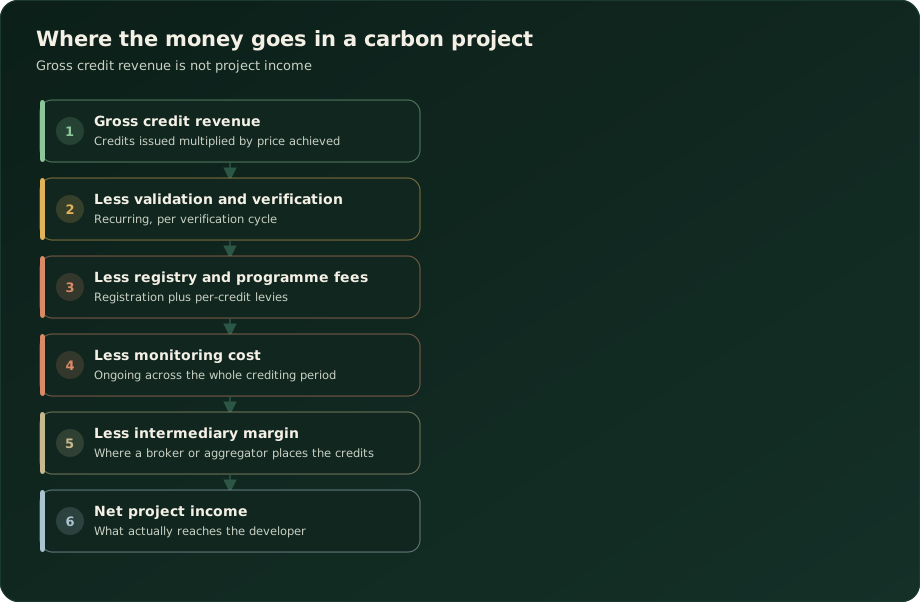
For a first project, a broker is usually the pragmatic choice — they know the buyers and can move inventory. Once you have a track record and repeatable annual volume, direct relationships are worth building, because the 10-30% intermediary margin is the largest single deduction from gross revenue.
How Buyers Run Due Diligence
Serious buyers now investigate before purchasing, driven by several years of critical reporting on credit quality. Expect questions across five areas:
1. Project integrity. Methodology used, additionality argument, baseline justification, verifier identity and findings. Any adverse verification finding will be found and asked about.
2. Registry status. Credits actually issued and serialised, held in your account, unretired and untransferred. Buyers verify this on the registry directly.
3. Corresponding adjustment status. Whether the host country has made — or will make — the adjustment. This determines what claim the buyer can make and is the most consequential accounting question in the transaction.
4. Safeguards and consent. For land-based and community projects: free prior informed consent, benefit sharing, grievance mechanisms, land tenure documentation.
5. Co-benefit substantiation. Measured and verified, or asserted? Buyers reporting SDG contributions need evidence, not photographs.
Assemble this as a credit information pack before going to market. Every question answered in advance shortens the sales cycle, and a developer who cannot produce registry serial numbers and verification reports quickly signals problems. Our credit due diligence checklist is written from the buyer's side and shows exactly what will be asked.
Contract Essentials
| Clause | Why it matters |
|---|---|
| Definition of the credit | Standard, methodology, vintage, project ID, serial range |
| Volume and delivery schedule | Fixed, or best-efforts against issuance |
| Price and payment terms | Fixed, indexed, or floor with upside share |
| Delivery mechanism | Registry transfer, retirement instruction, account details |
| Delivery failure remedy | What happens if issuance is delayed or short |
| Representations and warranties | Title, no double sale, no prior retirement, no double counting |
| Corresponding adjustment | Who bears the risk if the position changes |
| Regulatory change | Allocation of policy risk, including export restrictions |
| Retirement and claim rights | Who retires the credit and what claim may be made |
| Dispute resolution and governing law | Standard, but check it |
The two clauses that most often cause trouble later:
Delivery failure. Credits are issued only after verification, and verification can be delayed. A forward contract with a hard delivery date and a punitive remedy transfers a risk that is only partly within your control. Negotiate a cure period and a proportionate remedy.
Regulatory change. India's position on credit exports and corresponding adjustments is evolving. A contract that leaves this risk entirely with the seller can become unperformable through no fault of yours. Address it explicitly.
Use a recognised template as a starting point — the IETA standard documents are widely used and familiar to counterparties, which shortens negotiation.
Timing the Sale
| Approach | When it suits |
|---|---|
| Spot sale after issuance | Strong balance sheet, expecting firm prices |
| Forward sale before issuance | Need to fund development |
| Long-term offtake | Project would not proceed without committed revenue |
| Streaming / prepay | Capital needed upfront; effectively expensive finance |
| Staged sale | Sell part forward for certainty, keep part for upside |
Staged selling is the sensible default for most developers: contract enough forward to cover verification and monitoring costs, keep the balance for spot sale. It funds the project without betting the entire crediting period on today's price.
What Kills Transactions
Unclear title. Who owns the credits — landowner, operator, financier, community? If this is not documented, diligence stalls and the buyer moves on.
Registry mismatches. Serial numbers that do not reconcile, or credits held in an intermediary's account rather than yours. Buyers treat this as a red flag.
Adverse verification findings. Not always fatal, but must be disclosed upfront with the remediation. Discovered late, it destroys the negotiation.
Over-promised volumes. A developer who forecast 50,000 credits and delivered 30,000 has a credibility problem that follows into every future transaction. Forecast conservatively.
Corresponding adjustment ambiguity. If neither party can state clearly what claim the buyer may make, the transaction has no defined product.
Double-sale exposure. Selling the same credits to two buyers, usually through poor record-keeping across brokers. This is commercially and legally serious. Maintain a single authoritative inventory ledger.
Building a Repeatable Sales Function
For developers with more than one project, treat credit sales as a business function rather than a series of one-off events:
- An inventory ledger — every credit, its status, serial range, contract commitment and retirement position.
- A standard information pack kept current, so diligence requests are answered in a day rather than a fortnight.
- A buyer pipeline with relationships built before you have inventory to place.
- A pricing policy — what you will and will not accept, decided calmly in advance rather than under pressure with unsold inventory.
- A contract template you understand, with pre-agreed fallback positions on the clauses above.
- Post-sale reporting to buyers on project progress and co-benefits. Repeat buyers are far cheaper to serve than new ones, and voluntary buyers value continuity with a project they can name.
That last point is underrated. Corporate buyers with multi-year commitments prefer to renew with a project they already understand and can point to in their reporting. A developer who reports well retains buyers at better prices than one who treats each sale as a transaction.
Frequently Asked Questions
How do I sell carbon credits in India? Through a broker, directly to corporate buyers, on a trading platform, or through an aggregator. Domestic Carbon Credit Certificates under the CCTS trade through notified power exchanges.
Who buys carbon credits in India? Obligated entities under the CCTS, Indian and multinational corporates with voluntary commitments, airlines with CORSIA obligations, and brokers reselling into all of these.
What price will I get? It depends on project type, quality, vintage and standard. See carbon credit prices in India.
Can I sell Indian credits internationally? It depends on the programme, credit type and prevailing policy on exports and corresponding adjustments. Take current regulatory advice before contracting.
What is an offtake agreement? A commitment to buy future credits at agreed terms, usually below spot price, which funds development in exchange for price certainty.
How long does a sale take? Spot sales of standard credits can close in weeks. First-time direct corporate sales commonly take months, most of it due diligence.
What documents do buyers ask for? Registry serial numbers, project design document, validation and verification reports, methodology reference, co-benefit evidence, and title documentation.
Should I use a broker? For a first project, usually yes — access to buyers is worth the margin. Build direct relationships once you have repeatable volume.
What is double counting? The same emission reduction being claimed by more than one party or towards more than one target. Preventing it is the core function of registries and corresponding adjustments.
Can I sell before credits are issued? Yes, through forward contracts — but understand the delivery risk if verification is delayed or issuance falls short of forecast.
Planning a carbon credit project in India? DSTechnoverse supports feasibility screening, baseline and additionality assessment, monitoring plan design, data systems and MRV documentation — and works with buyers on credit due diligence. We are based in Indore, Madhya Pradesh and work with developers across India. See our carbon credit services, or talk to our team about your project.
This article is general information, not legal, financial or regulatory advice. India's carbon market rules are still being built out — verify the current position with the Bureau of Energy Efficiency and your legal advisers before committing capital.