For years, judging a carbon credit's quality meant doing your own deep due diligence — or trusting the seller. That gap created an opening for a new kind of business: carbon credit rating agencies, which grade credits on integrity the way a credit-rating agency grades a bond. Names like BeZero, Sylvera and Calyx have become fixtures, and their ratings are reshaping how the market prices quality.
What a Rating Actually Measures
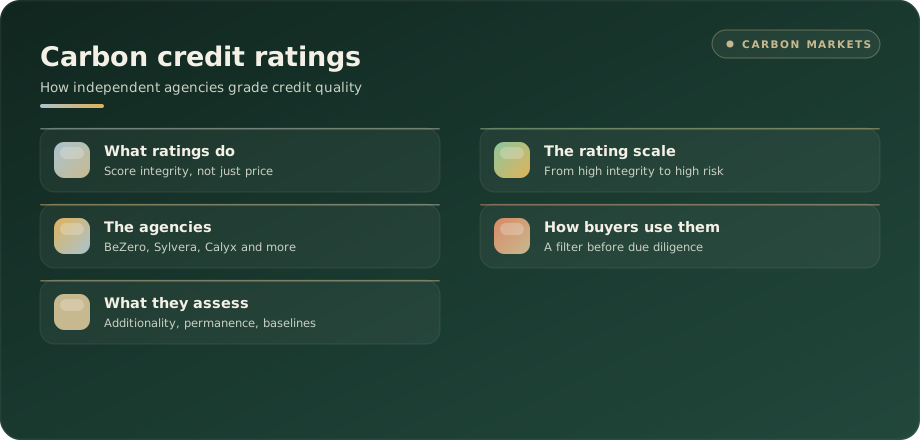
A carbon credit rating is a quality score, not a price. It answers one question: how likely is it that this credit represents a real, additional tonne of avoided or removed CO2? A high rating says the reduction is very likely genuine; a low rating flags serious doubts. Crucially, this is orthogonal to cost — a cheap credit can be low-rated, and a high-rated credit usually commands a premium, which is exactly the point.
Who the Agencies Are
Several independent firms now rate credits, each with its own methodology:
| Agency | Role |
|---|---|
| BeZero Carbon | Risk-based rating of the likelihood a credit achieves a tonne |
| Sylvera | Data-driven ratings, strong on forestry and geospatial analysis |
| Calyx Global | Ratings emphasising over-crediting and additionality risk |
They differ in scale and emphasis, and they do not always agree — which itself is useful information. A credit rated highly by more than one agency is a stronger signal than one that splits opinion.
What They Assess
The rating criteria will look familiar, because they are the same integrity questions that run through the whole market:
- Additionality — did the reduction need carbon finance? (See additionality explained.)
- Baseline — is the counterfactual conservative and evidenced?
- Permanence — will the carbon stay stored, with reversal risk managed?
- Over-crediting risk — is the project issuing more credits than the real reduction?
- Co-benefits and safeguards — is there social or environmental harm?
The agencies gather project data, apply their methodology, and publish a rating on a scale — from high integrity down to high risk.
How Buyers Use Ratings
A rating is a filter, not a substitute for judgement. Sophisticated buyers use ratings to screen a large market down to a credible shortlist quickly, then still run their own due diligence on the finalists. Increasingly, ratings also feed price: high-rated credits trade at a premium, and some buyers set a minimum rating as a purchasing policy. For sellers, a strong rating is becoming a market-access advantage.
The Limits of Ratings
Ratings are a huge improvement on "trust the seller," but they are not infallible. Methodologies differ, agencies can disagree, and a rating is only as good as the data behind it. Treat a high rating as strong evidence, not a guarantee — and where two respected agencies concur, trust it more than where they diverge.
Frequently Asked Questions
What is a carbon credit rating? An independent assessment of a credit's quality — the likelihood it represents a real, additional tonne of CO2 reduced or removed — separate from its price.
Who rates carbon credits? Independent agencies such as BeZero Carbon, Sylvera and Calyx Global, each with its own methodology.
Do carbon credit ratings affect price? Yes — higher-rated credits generally command a premium, and some buyers require a minimum rating before purchasing.
Can I rely on a rating alone? It is a strong filter but not a full substitute for project-level due diligence, especially for large purchases.
Why do rating agencies sometimes disagree? They use different methodologies and weightings; agreement between agencies is a stronger quality signal than a split verdict.
Working with carbon credits or a climate target? DSTechnoverse works on the data and integrity side of carbon — project screening, registry and eligibility verification, MRV and monitoring-data analysis, reconciliation and defensible reporting. See our CORSIA carbon credit services and data analytics. We are based in Indore, Madhya Pradesh and work across India and internationally.
Apply as a carbon credit buyer or seller
Talk to our team, or start with the complete carbon credits guide.