A carbon credit is only as credible as the standard that issued it. Understanding what standards actually do — and what the differences between them mean in practice — is the difference between informed buying and buying on brand recognition.
What a Standard Actually Does
A crediting standard is not a certifier of individual credits in the way people often assume. It is an institution that performs five functions:
Publishes methodologies. The rulebooks defining how a particular project type establishes a baseline, demonstrates additionality and quantifies reductions. Without a methodology covering your activity, no credits can be issued regardless of the activity's merit.
Registers projects. Maintaining the public record of what exists, where, and under which methodology.
Accredits and oversees verifiers. Standards do not verify projects themselves. They approve the independent bodies that do, and set the rules those bodies work to.
Operates a registry. The system holding serialised units and recording issuance, transfer and retirement.
Governs the rules. Revising methodologies, retiring those that no longer hold up, and handling disputes.
That third point is worth dwelling on, because it explains a common misunderstanding. When someone says a credit is "Verra certified", what has happened is that a project was registered under a Verra methodology and independently verified by an accredited third party — not that Verra itself inspected the site.
The Major Standards
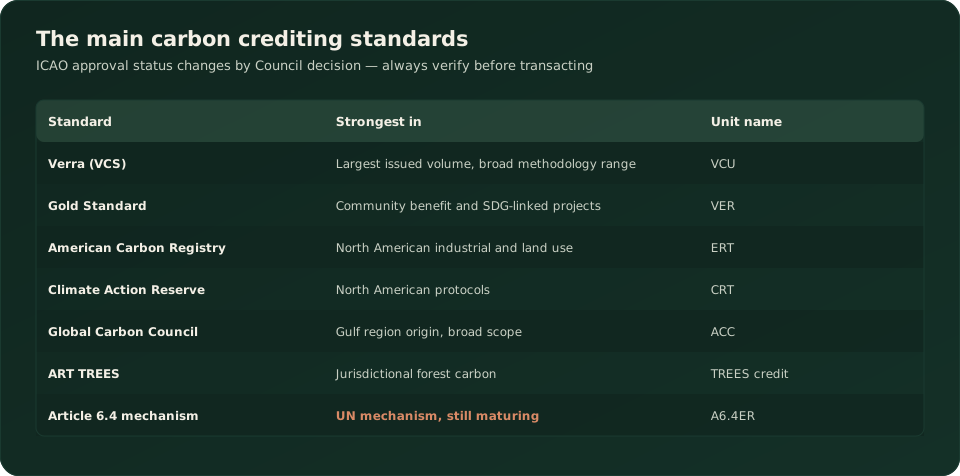
| Standard | Unit | Strongest in | Watch for |
|---|---|---|---|
| Verra (VCS) | VCU | Largest issued volume, broadest methodology range | Scale brings scrutiny; several methodologies revised |
| Gold Standard | VER | Community benefit, SDG-linked projects | Smaller volume, higher unit prices |
| American Carbon Registry | ERT | North American industrial and land use | Regional methodology focus |
| Climate Action Reserve | CRT | North American protocols, strong governance | Limited geographic scope |
| Global Carbon Council | ACC | Gulf region origin, broad scope | Newer, smaller track record |
| ART TREES | TREES credit | Jurisdictional forest carbon at scale | Jurisdictional rather than project level |
| Article 6.4 mechanism | A6.4ER | UN mechanism under the Paris Agreement | Still maturing; rules evolving |
Verra dominates by volume, which cuts both ways. It has the widest methodology coverage and the deepest liquidity, and its scale has made it the focus of most public criticism of the voluntary market — particularly on avoided-deforestation baselines.
Gold Standard positions on co-benefits and community outcomes, which supports higher prices in the voluntary market where buyers care about the story. For compliance buyers who need discharge rather than narrative, that premium buys less.
ACR and CAR are the North American incumbents, with methodology sets shaped by that regulatory context. Both have strong governance reputations.
Global Carbon Council is newer and originated in the Gulf, which gives it regional relevance that the older standards lack.
ART TREES works at jurisdictional scale — crediting a whole state or country rather than a project boundary. This structurally addresses the leakage problem that project-level forest crediting struggles with.
Article 6.4 is the UN mechanism succeeding the Clean Development Mechanism. It is the newest and its rules are still settling, which means both opportunity and uncertainty.
What ICAO Approval Means
For CORSIA specifically, the ICAO Council approves programmes, on the recommendation of its Technical Advisory Body, against the Emissions Unit Criteria.
Three things follow that are routinely misunderstood:
Approval is of the programme, not the credit. An approved programme issues enormous volumes, only a fraction of which are CORSIA eligible.
Approval can be full, conditional, or can lapse. Conditions frequently relate to how the programme handles corresponding adjustments and labels authorised units. A conditional approval may exclude specific methodologies.
The list changes. Any list published in an article — including the table above — is a snapshot of its publication date. Verify against the ICAO emissions units page at the point of transaction, and capture what it says on the day.
What the TAB Examines
Understanding the assessment explains why some well-known standards have been conditioned rather than fully approved:
| Area | What is assessed |
|---|---|
| Governance | Independence from commercial pressure, decision-making, oversight |
| Methodology development | Consultation, expert input, mechanism for retiring weak methodologies |
| Additionality | What developers must demonstrate, and how rigorously |
| Quantification | Whether uncertainty is resolved conservatively |
| Permanence | Buffer design, sizing and reversal handling |
| Verification oversight | Accreditation and supervision of third-party bodies |
| Registry | Serialisation, transfer controls, transparency |
| Double-counting safeguards | Ability to identify authorised units and record adjustment status |
| Safeguards | Impact assessment, consultation, consent, grievance mechanisms |
The double-counting row has produced most of the conditions attached to approvals. Programmes designed before Article 6 mechanics existed have had substantial retrofitting to do, and not all have satisfied ICAO.
Choosing a Standard as a Developer
Beyond current approval status, five practical considerations:
Methodology fit. Does a methodology exist for your activity, and is it itself stable or under review? A methodology retired mid-project is a serious problem.
Approval stability. How long has the programme held ICAO approval, is it full or conditional, and when is reassessment due?
Corresponding adjustment handling. Does the programme's process align with your host State's? Mismatches create administrative friction and delay.
Buyer familiarity. Buyers with existing registry accounts and process familiarity find you easier to transact with. This is a real commercial factor.
Fees and timelines. Registration, issuance levies, validation and verification requirements, and realistic queue times.
Defaulting to whichever standard you have used before is habit, not a decision.
Reading a Standard as a Buyer
Registration is not verification. A registered project has had its design validated. Credits are only issued after a monitoring period is independently verified. Check which stage a project is at.
Methodology version matters. Standards revise methodologies, sometimes substantially. A project registered under an older version may be operating to assumptions since tightened.
Check for a corrective action history. Standards publish disputes, suspensions and corrective actions. A project with a history is not automatically disqualified and is worth understanding.
The registry is the authority, not the marketing. Serialisation, status, retirement — all of it is in the registry record. A seller's summary is a summary.
Methodologies: Where the Real Rules Live
The standard is the institution; the methodology is the rulebook that actually determines what your project can claim. Two projects under the same standard but different methodologies can face entirely different requirements.
A methodology specifies:
| Element | What it fixes |
|---|---|
| Applicability conditions | Which projects may use it at all |
| Baseline approach | How the counterfactual is constructed |
| Additionality test | What must be demonstrated, and how |
| Quantification equations | Exactly how reductions are calculated |
| Default values | Where measurement is impractical |
| Monitoring requirements | What must be measured, how often, to what precision |
| Leakage treatment | How displaced emissions are deducted |
| Uncertainty deductions | How conservatism is applied |
Check the version. Standards revise methodologies, sometimes substantially. A project registered under version 3 of a methodology is operating to different rules from one registered under version 5, and the older version may embed assumptions since tightened. The registry record states which applies.
Check whether it is under review. A methodology under consultation may be revised or retired. For a developer that is a material planning risk; for a buyer it is a signal to look harder at the assumptions.
Check the applicability conditions carefully if you are a developer. Projects have been rejected at validation for failing a condition nobody read closely — geographic restrictions, technology vintage limits, or scale thresholds.
The practical instruction: when assessing a credit, ask which methodology and which version. "It's a Verra credit" tells you the institution. The methodology tells you the rules.
Registries: What They Actually Hold
Each standard operates a registry, and it is the authoritative record — not the project webpage, not the seller's summary.
A registry record shows the project identifier and location, the methodology and version, the crediting period, verification history including any qualifications, issuance by vintage, current holdings, transfer history, and retirement or cancellation records with their stated purpose.
Two practical points. Serialisation is what prevents double use — every unit carries a unique identifier encoding programme, project, vintage and batch position. A compliance file referencing volumes without serials cannot be reconciled against the registry, which is the first thing an auditor attempts.
And registries are public in most respects. You can generally look up a project before speaking to a seller, which is a cheap first filter that surprisingly few buyers use.
Do Standards Compete on Rigour?
An uncomfortable structural point worth naming: standards are funded largely by fees from the projects they register. That creates an incentive tension between rigour and volume, and it is the strongest argument for the independent scrutiny the market has received.
The counterweights are real — reputational exposure, buyer sophistication, ratings agencies and regulatory attention including ICAO's own assessment. Several standards have narrowed or retired methodologies under that pressure, which suggests the counterweights function.
The practical implication for a buyer is not to distrust standards, but to recognise that the standard's approval is a floor rather than a guarantee, and to do your own due diligence on top of it.
Frequently Asked Questions
Which carbon credit standard is best? There is no general answer. Verra has the broadest coverage and deepest liquidity; Gold Standard leads on co-benefits; ACR and CAR are strong in North America. Choose by methodology fit and, for CORSIA, current ICAO approval.
Is a Verra credit automatically CORSIA eligible? No. Programme approval is necessary but not sufficient — vintage and corresponding adjustment apply at unit level regardless.
What is the difference between a standard and a registry? The standard sets the rules; the registry is the system holding the units. Most standards operate their own registry.
Who actually verifies a project? An accredited independent Validation and Verification Body, not the standard itself. A body that validated a design generally cannot verify its performance.
Can a project move between standards? Sometimes, but it is costly and slow. Choose deliberately at the outset.
What happens if a methodology is retired? Existing registered projects are usually allowed to continue under transitional arrangements, but new registrations stop. Check the transition rules before relying on a methodology under review.
Where do I check current ICAO approval? The ICAO CORSIA emissions units page. Nowhere else is authoritative, and any list elsewhere is a snapshot.
Does ISCC issue carbon credits? No — ISCC certifies fuels and materials, not credits. See ISCC CORSIA certification.
Assessing credits before you buy? DSTechnoverse runs pre-transaction due diligence on carbon credits — programme approval status, vintage, corresponding adjustment evidence, verification and registry chain of custody. See our CORSIA carbon credit services. We are based in Indore, Madhya Pradesh and work across India and internationally.
Apply as a CORSIA buyer or seller
Talk to our carbon markets team, or start with the complete carbon credits guide.