ISCC CORSIA is frequently misdescribed as a carbon credit certification. It is not. It certifies fuel — and understanding that distinction is the first step to understanding where it fits.
What It Actually Certifies
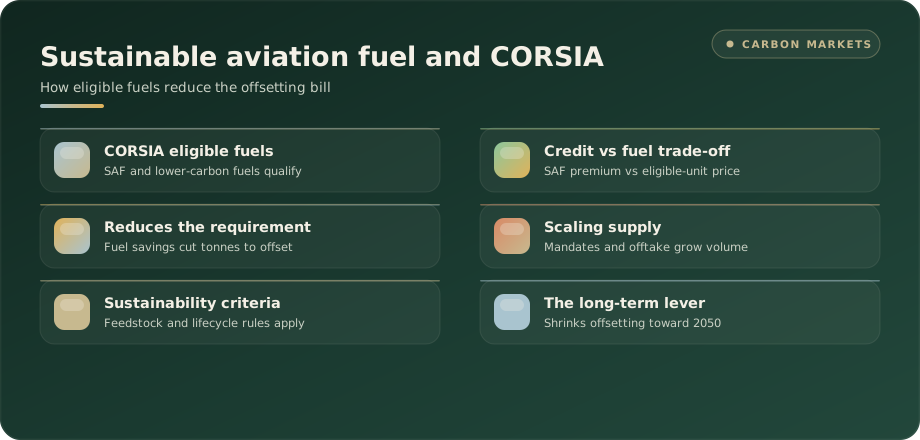
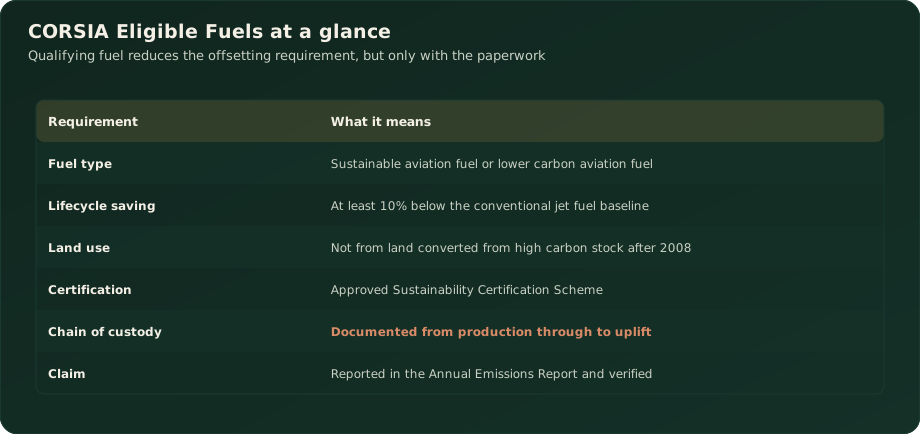
Under CORSIA, an operator's offsetting requirement can be reduced by using CORSIA Eligible Fuels — sustainable aviation fuel (SAF) or lower carbon aviation fuel (LCAF) meeting defined sustainability criteria.
But qualifying fuel does not produce a claim on its own. Three conditions must all hold:
- The fuel meets the CORSIA sustainability criteria
- It is certified under a Sustainability Certification Scheme approved by ICAO
- The chain of custody is documented from production through to uplift
ISCC CORSIA is one of those approved certification schemes. Its role is to audit and certify that a batch of fuel meets the criteria, and to underpin the chain of custody that connects that batch to the aircraft that burned it.
Burning genuinely sustainable fuel without approved certification and chain-of-custody documentation produces a real environmental benefit and no CORSIA claim whatsoever. This is the point operators most often miss, and it is expensive — the claim is disallowed at verification, after the budget was set on the reduced figure.
The Sustainability Criteria
| Requirement | What it means |
|---|---|
| Lifecycle reduction | At least 10% below the conventional jet fuel baseline, well-to-wake |
| Carbon stock protection | Not from land converted after 1 January 2008 from high carbon stock land |
| Induced land use change | An ILUC value added to the lifecycle figure where relevant |
| Wider themes | Water, soil, air, conservation, waste, human and labour rights, land use rights, food security |
Lifecycle means well-to-wake — feedstock production, collection, transport, conversion, distribution and combustion. Not combustion alone. This is why a fuel that burns identically to fossil jet fuel can still deliver a large reduction: the saving is upstream.
The 2008 land conversion cut-off prevents the perverse outcome of clearing carbon-rich land to grow fuel feedstock. It is a hard date, and demonstrating compliance requires evidence about land status going back to that year.
ILUC accounts for emissions caused when feedstock production displaces food production onto other land. Values vary substantially by feedstock, which is a large part of why waste and residue feedstocks are favoured — they displace nothing.
Who Needs Certification
Certification applies along the supply chain, not just at one point:
| Actor | Why they need it |
|---|---|
| Feedstock producer or collector | Establishes origin and eligibility of the input |
| Processing and conversion plant | Certifies the production pathway and lifecycle value |
| Trader or blender | Maintains the chain of custody through handling |
| Fuel supplier at the airport | Delivers the certified batch with documentation |
| Aircraft operator | Uses the documentation to make the claim |
The operator does not hold ISCC certification themselves. They rely on the certified chain and must be able to evidence it — which means obtaining and retaining the documentation, not merely trusting that it exists somewhere upstream.
Chain of Custody: Where It Gets Difficult
Aviation fuel is a commingled commodity. The physical molecules that entered the system as SAF are not the molecules that reach your wing.
Mass balance is the model CORSIA's requirements are built around. It permits physical commingling while tracking the sustainability attribute, requiring quantities to balance over a defined period. This is the standard approach.
Book-and-claim decouples the attribute from physical delivery entirely, allowing a buyer to claim SAF used elsewhere in the system. It solves a real problem — SAF is unavailable at most airports — but its treatment under CORSIA is more restrictive than in voluntary programmes.
Establish which model applies before contracting for fuel, not after uplift. An operator who buys on a book-and-claim basis assuming a CORSIA claim, and finds the treatment does not permit it, has bought an expensive fuel premium with no compliance benefit.
The Certification Process
For a producer or supply chain actor:
- Scope definition. Which sites, products and pathways are covered.
- System setup. Documented procedures for feedstock traceability, mass balance accounting and record keeping.
- Internal preparation. Evidence assembled — feedstock origin, land status, conversion data, lifecycle calculation.
- Audit by an ISCC-approved certification body, on site.
- Non-conformity resolution where findings arise.
- Certificate issued, valid for a defined period.
- Surveillance audits and periodic recertification.
Timelines vary with complexity, and the preparation is generally longer than the audit. The most common cause of delay is feedstock traceability evidence — proving where material originated and that the land status test is satisfied.
What the Operator Must Retain
For the CORSIA claim to survive verification:
- Certification documentation from the approved scheme, per batch
- Chain-of-custody records connecting the batch to your uplift
- The lifecycle emissions value applied, and its basis
- Fuel volumes and the aerodromes where uplifted
- Reconciliation between fuel purchase records and claimed quantities
- Evidence the same fuel is not claimed under another scheme
That last point matters increasingly. SAF used to satisfy a European or UK mandate, or claimed under a voluntary programme, may not be separately claimable under CORSIA. Double claiming across schemes is exactly what verification looks for.
Lifecycle Values: Default or Actual
An operator's claim depends on the lifecycle emissions value applied to the fuel, and there are two routes to it.
Default values. ICAO publishes default lifecycle values for defined production pathways — a particular feedstock processed by a particular conversion technology. Using a default is administratively simpler and requires less evidence.
Actual values. A producer can calculate a pathway-specific value for their own operation, which is generally lower than the conservative default and therefore supports a larger reduction. This requires substantially more evidence and audit scope.
The trade-off is straightforward: defaults are cheaper to substantiate and deliver a smaller claim; actual values cost more to establish and deliver more. For a producer selling into a market that pays for the saving, actual values usually justify the effort. For a small volume, defaults may be the sensible choice.
For an operator, the practical point is to know which was used, because it affects both the size of your claim and the evidence you must retain. A claim built on an actual value depends on the producer's calculation surviving scrutiny, which makes the certification documentation more important rather than less.
Where Claims Fail at Verification
Six failure modes, in rough order of how often they arise:
Chain-of-custody gaps. The certificate exists upstream, but the documentation linking it to your specific uplift does not. This is the most common failure and it is usually a procurement process problem rather than a supply problem.
Batch-level documentation missing. Certification covers a period or a facility; the claim requires evidence for the volumes you actually took.
Double claiming across schemes. The same fuel claimed under a blending mandate and under CORSIA. Verification specifically looks for this.
Book-and-claim assumed to work. Treatment is more restrictive under CORSIA than in voluntary programmes, and an assumption here is expensive.
Volume reconciliation failure. Claimed quantities do not tie to fuel purchase records.
Scheme not ICAO-approved for CORSIA. A valid certificate under the wrong scheme supports no CORSIA claim.
Each is prevented by establishing the evidence path before contracting for fuel, which costs nothing at that stage and is impossible to retrofit afterwards.
The Indian Context
India has been developing SAF policy and blending targets, and domestic production capacity is growing from a small base.
Two practical points for Indian operators. Availability is regional and thin — modelling a claim on fuel you cannot actually obtain at the stations you serve overstates the reduction and understates the budget. And the documentation burden is real: establish the certification and chain-of-custody evidence path before contracting, because retrofitting it to a completed uplift is not possible.
Frequently Asked Questions
Does ISCC CORSIA certify carbon credits? No. It certifies fuel against the CORSIA sustainability criteria. Carbon credits are certified under crediting standards such as Verra or Gold Standard.
Do airlines need ISCC certification? Generally no. The certification sits with the supply chain. Operators must obtain and retain the resulting documentation to support their claim.
How much does the fuel reduce my obligation? By the lifecycle saving relative to the conventional baseline, applied to the fuel mass. A high-saving SAF can remove a disproportionate share of an offsetting obligation — see how SAF reduces your requirement.
Is book-and-claim accepted under CORSIA? Treatment is more restrictive than in voluntary programmes. Confirm the position before contracting rather than assuming.
What is the minimum lifecycle saving? At least 10% below the conventional jet fuel baseline for the fuel to qualify at all.
Can we claim the same fuel under CORSIA and an EU mandate? No. Establish which scheme a batch is claimed under before purchase.
What is the difference between ISCC CORSIA and ISCC PLUS? Different schemes for different purposes — see ISCC CORSIA vs ISCC PLUS.
Assessing credits before you buy? DSTechnoverse runs pre-transaction due diligence on carbon credits — programme approval status, vintage, corresponding adjustment evidence, verification and registry chain of custody. See our CORSIA carbon credit services. We are based in Indore, Madhya Pradesh and work across India and internationally.
Apply as a CORSIA buyer or seller
Talk to our carbon markets team, or start with the complete carbon credits guide.