A newer word has crept into corporate climate strategy: insetting. It is often presented as a better, more credible cousin of offsetting — and sometimes as a marketing gloss for the same thing. The distinction is real and worth getting right, because it changes both what you actually achieve and what you are allowed to claim.
The Core Difference
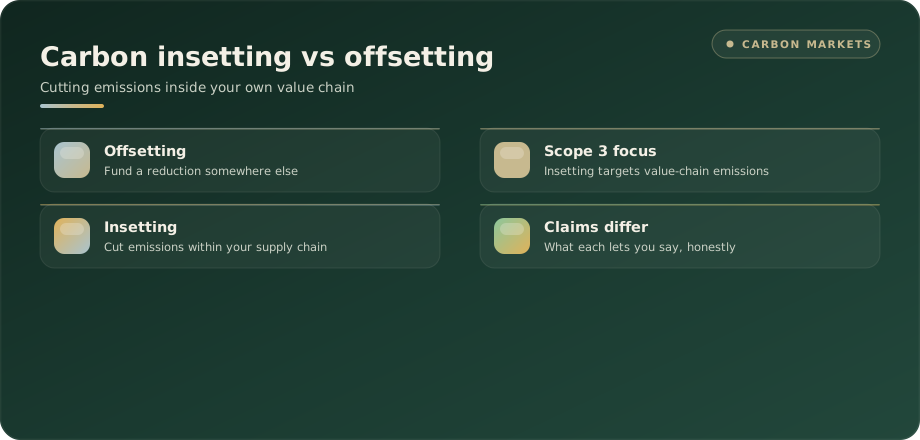
Offsetting means funding an emissions reduction outside your own operations and value chain — buying and retiring a carbon credit from an unrelated project. Insetting means investing in emissions reductions inside your own value chain, usually in the supply chain that produces your goods.
The clearest way to see it: offsetting is a payment to a stranger's project; insetting is fixing the emissions attached to your own product.
| Offsetting | Insetting | |
|---|---|---|
| Where the reduction happens | Outside your value chain | Inside your value chain |
| What it counts against | A separate compensation claim | Often your own Scope 3 emissions |
| Example | Retire a REDD+ credit | Fund regenerative practices at your suppliers |
| Main risk | Credit quality and double counting | Measurement and attribution |
Why Insetting Appeals to Companies
Most of a typical company's footprint sits in Scope 3 — the emissions of its supply chain, not its own factories or electricity. Offsetting does nothing to those numbers; it compensates for them elsewhere. Insetting, done properly, actually reduces Scope 3 emissions at the source — a farmer adopting lower-emission practices, a supplier switching fuels, a logistics partner cutting fuel burn. Because the reduction is inside the value chain, it can lower the company's reported footprint rather than merely balancing it.
Where Insetting Gets Hard
The catch is measurement. An offset is a discrete, registry-tracked unit; an inset is a change deep in a supply chain that must be measured, attributed to your company specifically, and not double-counted by the supplier or another buyer. Weak insetting is just as prone to over-claiming as weak offsetting — the failure mode is different, but the discipline required (a credible baseline, real additionality, careful attribution) is the same.
What You Can Honestly Claim
This is where the two diverge for reporting. A genuine inset that reduces your Scope 3 emissions can be reflected as a reduction in your footprint. An offset is a compensation outside your footprint and should be reported as such — not folded into your emissions total as if you had cut it. Blurring the two is a common route to greenwashing; keeping them distinct is what makes a net-zero claim defensible. For the related net-zero distinction, see carbon neutral vs net zero.
Frequently Asked Questions
What is carbon insetting? Investing in emissions reductions within your own value chain — typically your supply chain — rather than buying credits from an unrelated project.
How is insetting different from offsetting? Offsetting funds a reduction outside your value chain; insetting reduces emissions inside it, which can lower your own Scope 3 footprint.
Is insetting better than offsetting? It targets your actual emissions rather than compensating for them, which is generally preferred — but it is harder to measure and attribute.
Can insetting reduce my Scope 3 emissions? Yes, if the reduction is genuinely inside your value chain, additional and correctly attributed to your company.
Do I still need offsets if I inset? Many companies do both — insetting to cut value-chain emissions and high-integrity offsets for the residual they cannot yet remove.
Navigating carbon credits and climate claims? DSTechnoverse works on the data and integrity side of carbon — project screening, registry and eligibility verification, MRV and monitoring-data analysis, reconciliation and defensible reporting. See our CORSIA carbon credit services and data analytics. We are based in Indore, Madhya Pradesh and work across India and internationally.
Apply as a carbon credit buyer or seller
Talk to our team, or start with the complete carbon credits guide.