"Carbon neutral" and "net zero" get used as if they mean the same thing. They do not, and regulators and standard-setters increasingly treat the difference as material. Getting it wrong is one of the most common — and most reputationally damaging — climate-claim mistakes a company can make.
The Short Version
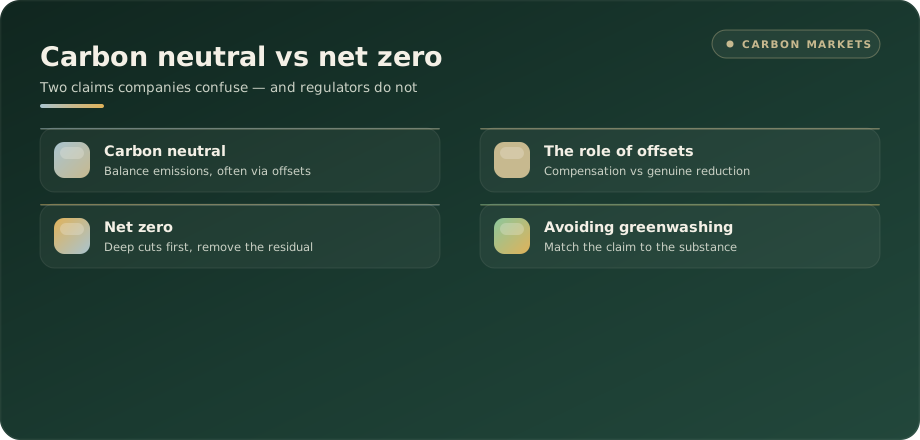
Carbon neutral usually means a company has balanced its emissions for a given period, often largely by buying offsets equal to what it emitted. Net zero means a company has reduced its emissions as close to zero as possible — across scopes, on a science-aligned trajectory — and only then neutralises a small residual, ideally with removals rather than avoidance credits.
The difference, in one line: carbon neutral is mostly about compensation; net zero is mostly about reduction.
Why the Distinction Matters
You can, in principle, call yourself carbon neutral this year by buying enough cheap offsets to match your emissions, without changing your business at all. That is exactly the practice that has drawn greenwashing criticism. Net zero, as defined by credible frameworks, does not allow that shortcut: it requires deep, absolute cuts first, with offsetting confined to a genuine residual — and increasingly requires that residual to be neutralised with durable removals, not avoidance credits.
| Carbon neutral | Net zero | |
|---|---|---|
| Primary mechanism | Balance emissions (often via offsets) | Cut emissions deeply, then neutralise |
| Role of offsets | Can be large | Small residual only |
| Preferred credit type | Any credible offset | Durable removals |
| Time frame | Usually annual | A long-term target with a trajectory |
How to Make a Defensible Claim
Three principles keep either claim honest.
Reduce first. Both claims are strongest when real reductions do the heavy lifting. A claim resting almost entirely on offsets is fragile whatever you call it.
Use the right credits. Compensation should use high-integrity credits, and net-zero residuals increasingly call for removals. Weak, non-additional offsets undermine any claim — see carbon credit greenwashing red flags.
Be specific. Say what is included (which scopes), what was reduced versus offset, and what the credits were. Vague "carbon neutral" badges with no detail are precisely what invites scrutiny.
Which Should You Claim?
If you have genuinely cut emissions and are neutralising a small residual on a science-aligned path, net zero is the stronger, more future-proof claim. If you are compensating current emissions while you build a reduction plan, carbon neutral can be legitimate — provided you are transparent that it is compensation, not reduction, and you use credible credits. The danger is never the words themselves; it is claiming the substance of one while doing the other.
Frequently Asked Questions
What is the difference between carbon neutral and net zero? Carbon neutral usually balances emissions, often via offsets; net zero requires deep emissions cuts first and neutralises only a small residual, ideally with removals.
Is net zero better than carbon neutral? It is a stronger, more scrutiny-resistant claim because it prioritises real reductions over compensation.
Can I be carbon neutral just by buying offsets? Technically yes, but a claim resting almost entirely on offsets — especially low-quality ones — is widely seen as greenwashing.
Do net-zero targets require carbon removals? Increasingly, yes — credible frameworks expect the residual to be neutralised with durable removals rather than avoidance credits.
Which claim should my company make? If you have real reductions on a science-aligned path, net zero; if you are compensating while building a plan, carbon neutral — stated transparently as compensation.
Navigating carbon credits and climate claims? DSTechnoverse works on the data and integrity side of carbon — project screening, registry and eligibility verification, MRV and monitoring-data analysis, reconciliation and defensible reporting. See our CORSIA carbon credit services and data analytics. We are based in Indore, Madhya Pradesh and work across India and internationally.
Apply as a carbon credit buyer or seller
Talk to our team, or start with the complete carbon credits guide.