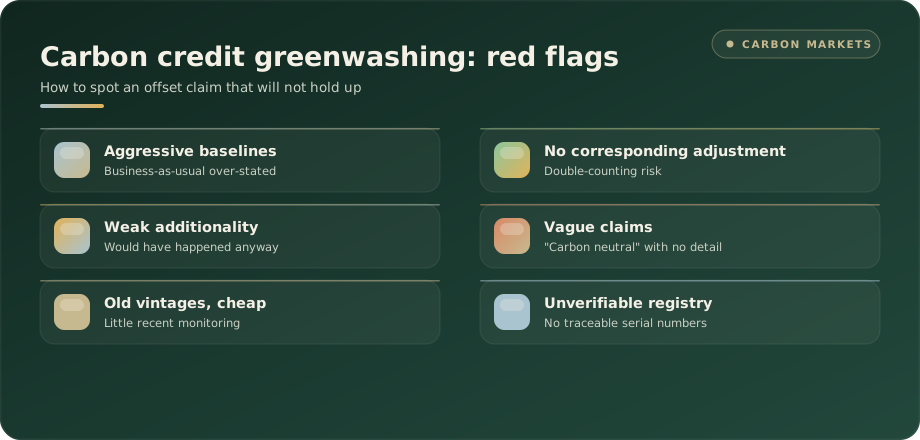
The carbon-credit controversies that make headlines almost never involve outright fraud. They involve credits that were technically issued but did not represent the reductions claimed — and, crucially, buyers who could have seen the warning signs and did not look. Here are the six red flags that separate a credible offset from a reputational landmine.
1. Aggressive Baselines
Every credit is measured against a baseline — what would have happened anyway. Inflate that baseline and you manufacture reductions that never occurred. This is the single most common failure, especially in avoided-deforestation projects where the "threat" of clearance was overstated. Red flag: a baseline that assumes dramatic business-as-usual emissions with thin evidence.
2. Weak Additionality
A credit is only real if the reduction happened because of carbon finance. A renewable project that was already the cheapest option, or a forest that was never going to be cut, produces credits representing no extra reduction. Red flag: a project whose own economics clearly stood without carbon revenue — a pattern common in renewable-energy credits.
3. Old Vintages Sold Cheap
A suspiciously low price is often just a very old vintage with little recent monitoring. Old credits can be legitimate, but a bargain-basement price is usually the market telling you something. Red flag: cheap credits from years ago with no recent verification.
4. No Corresponding Adjustment (Where One Is Needed)
If both the project's host country and the buyer count the same reduction, the tonne is counted twice. For compliance uses, a corresponding adjustment prevents this; many voluntary credits lack one. Red flag: a compliance-style claim on credits with no corresponding adjustment. (See Article 6 explained.)
5. Vague, Unqualified Claims
"Carbon neutral" stamped on a product with no explanation of what was reduced, what was offset, and with which credits, is a claim designed not to be checked. Red flag: a bold headline claim with no substantiating detail — the carbon neutral vs net zero confusion is often deliberate.
6. An Unverifiable Registry Trail
A real credit has a traceable life: an approved programme, a serial number, a vintage, and a registry record you can inspect. Red flag: credits you cannot independently verify in a recognised registry, or a programme with weak governance.
The Underlying Rule
Notice the pattern: every red flag is a shortcut that makes a credit cheaper and weaker at the same time. That is why cheapness is the most reliable warning sign in this market. A defensible offset costs what its type, vintage and integrity justify; a credit that is dramatically cheaper than its peers is usually cheaper for a reason you would not want to explain to an auditor. The full positive framework is in how to evaluate carbon offset quality.
Frequently Asked Questions
What is carbon credit greenwashing? Making a climate claim on the back of carbon credits that do not represent the real, additional reductions claimed — often due to weak baselines, additionality or double counting.
How can I tell if a carbon credit is low quality? Watch for inflated baselines, weak additionality, old cheap vintages, missing corresponding adjustments, vague claims and an unverifiable registry trail.
Why is a cheap carbon credit a warning sign? Because most integrity shortcuts make a credit both cheaper and weaker; a price far below peers usually reflects lower quality, not a deal.
What is a corresponding adjustment and why does it matter? An accounting step that stops the same reduction being counted by both the host country and the buyer; without it, compliance claims risk double counting.
How do I avoid buying greenwashed credits? Define your purpose, buy within the matching quality band, and verify additionality, baseline, permanence, authorisation and the registry record before contracting.
Navigating carbon credits and climate claims? DSTechnoverse works on the data and integrity side of carbon — project screening, registry and eligibility verification, MRV and monitoring-data analysis, reconciliation and defensible reporting. See our CORSIA carbon credit services and data analytics. We are based in Indore, Madhya Pradesh and work across India and internationally.
Apply as a carbon credit buyer or seller
Talk to our team, or start with the complete carbon credits guide.