Everyone talks about the credits. But the part of CORSIA that consumes most of an airline's compliance effort happens long before any unit is bought: proving, to an auditor's satisfaction, exactly how much CO2 it emitted. This is the MRV layer — Monitoring, Reporting and Verification — and getting it wrong invalidates everything downstream.
Why MRV Comes First
An offsetting obligation is a number, and that number is only as trustworthy as the data behind it. CORSIA therefore builds a rigorous measurement process ahead of any market activity. No verified emissions, no valid obligation; no valid obligation, no meaningful offsetting. MRV is the foundation the rest of the scheme stands on.
The MRV Process, Step by Step
The measurement side of CORSIA runs through four connected stages.
The Emissions Monitoring Plan
Compliance begins with an Emissions Monitoring Plan (EMP) — a document each covered operator prepares and has approved by its national authority before the monitoring year. The EMP specifies which flights are covered, which fuel-use monitoring method the operator will use, how data gaps will be handled, and the systems and controls that keep the data reliable. Think of it as the audit-ready rulebook the airline commits to in advance, so it cannot choose a convenient method after seeing the results.
Monitoring Fuel Burn
CORSIA emissions derive from fuel burned, converted to CO2 with standard factors. Operators use one of several ICAO-defined fuel-use monitoring methods — for example, methods based on fuel uplift and tank readings, or on block-off/block-on fuel measurement. Larger operators typically use aircraft data; smaller ones may use a simplified estimation tool that ICAO provides. The chosen method must match what the EMP declared and must be applied consistently across the year.
Compiling the Emissions Report
After the year closes, the operator assembles an annual Emissions Report from its monitored data: total covered emissions, broken down as CORSIA requires, with the documentation to support each figure. This is where weak data discipline during the year turns into a painful reconciliation exercise — missing uplift records or unexplained gaps have to be resolved before an auditor will sign off.
Independent Verification
The Emissions Report must be checked by an accredited verification body — an independent third party, not the airline's own staff. The verifier assesses whether the data is complete, the method was applied correctly, and the reported figure is free of material misstatement, then issues a verification opinion. Only a verified report is valid for the scheme. This independence is what gives states and ICAO confidence in aggregated figures they never see the raw data behind.
Submission and the State's Role
The verified report goes to the operator's state, which implements CORSIA in national law, aggregates operator data, and reports to ICAO. States are the enforcement layer: they approve monitoring plans, oversee verification, and act on non-compliance. CORSIA is an ICAO framework, but the legal obligations land on operators through their national authorities.
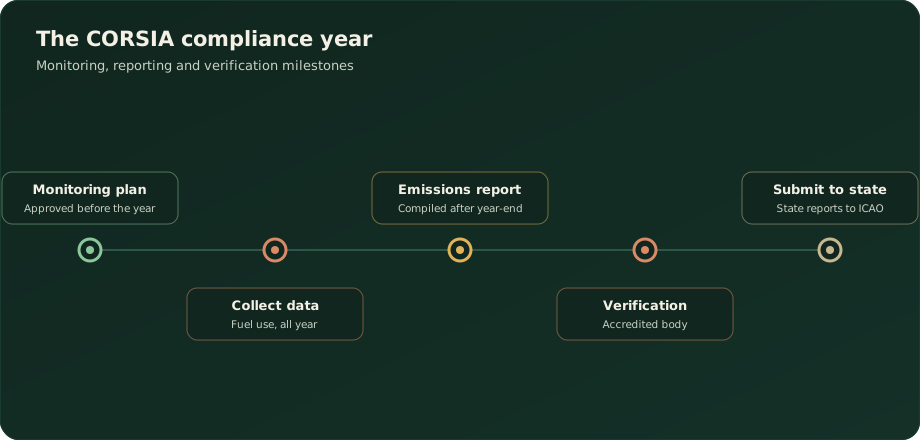
The Compliance Calendar
The cycle is predictable, which is its saving grace:
| Stage | Timing |
|---|---|
| Emissions Monitoring Plan approved | Before the monitoring year |
| Monitor fuel use | Throughout the year |
| Compile Emissions Report | After year-end |
| Third-party verification | Following report compilation |
| Submit verified report to the state | On the state's deadline |
| Offsetting settled with cancelled units | Per the compliance-period schedule |
Only after this chain completes does the credit-buying workflow begin in earnest.
Where Operators Get Caught Out
The recurring failures are mundane but costly: monitoring plans that do not match actual practice, fuel data with unexplained gaps, late engagement of a verifier, and treating verification as a formality rather than a real audit. None of these are exotic — they are the same data-governance failures that undermine any reporting regime, which is why building clean data pipelines during the year is the single highest-leverage investment an operator can make.
Frequently Asked Questions
What does MRV stand for in CORSIA? Monitoring, Reporting and Verification — the process of measuring emissions, reporting them and having them independently checked.
What is an Emissions Monitoring Plan? A document approved before the monitoring year that sets out which flights are covered and how the operator will monitor and report fuel use and emissions.
Who verifies an airline's emissions? An accredited independent verification body, separate from the airline, which issues a formal opinion on the emissions report.
Do small operators follow the same process? They are covered above a threshold but may use simplified monitoring methods and tools that ICAO provides to reduce the burden.
Who enforces CORSIA compliance? The operator's state, which implements the scheme in national law, oversees verification and reports aggregated data to ICAO.
Working on aviation emissions, CORSIA compliance or carbon credit due diligence? DSTechnoverse handles the data side of carbon and environmental compliance — monitoring design, emissions reconciliation, verification support and defensible reporting. See our CORSIA carbon credit services and data analytics. We are based in Indore, Madhya Pradesh and work across India and internationally.
Apply as a CORSIA buyer or seller
Talk to our team, or start with the complete carbon credits guide.