Improved cookstove projects sit at an awkward intersection: genuinely large development benefits, genuinely large credit volumes, and the most sustained methodological criticism in the voluntary market.
Both halves of that are true simultaneously, and understanding why is useful whether you are developing one or buying from one.
How the Crediting Works
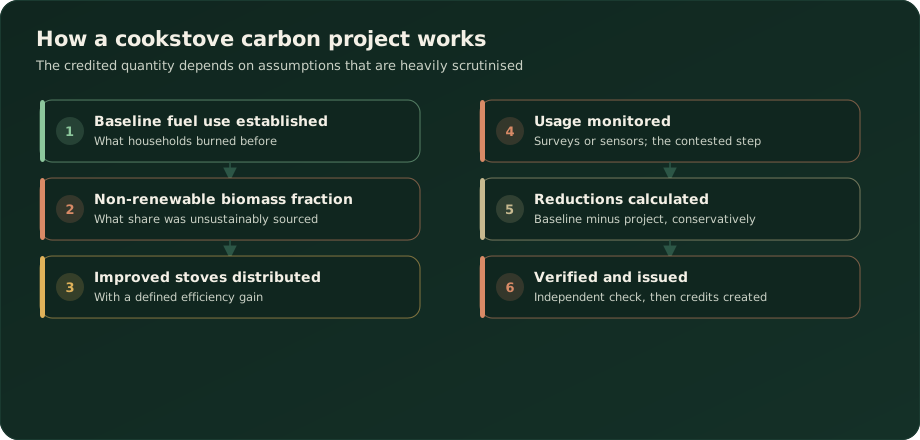
The logic is straightforward. Households cooking on open fires or inefficient stoves burn a quantity of biomass. An improved stove burns less for the same cooking. If some of the displaced biomass was harvested unsustainably, burning less of it means less net CO2.
The credited quantity depends on a chain of four figures:
| Figure | What it is | How contested |
|---|---|---|
| Baseline fuel consumption | What the household burned before | Moderate |
| Stove efficiency improvement | How much less the new stove burns | Low — measurable in lab and field |
| Usage rate | How often the stove is actually used | High |
| Fraction of non-renewable biomass | What share was unsustainably sourced | High |
The first two are relatively tractable. The last two are where the argument lives, and both act as multipliers — a modest overstatement in each compounds into a substantial overstatement of credits.
The Usage Rate Problem
The core difficulty: a distributed stove is not a used stove.
Households may use the improved stove alongside the traditional one rather than instead of it — "stove stacking" — cooking some dishes on each. They may use it seasonally. It may break and not be repaired. It may be resold.
Early methodologies relied heavily on distribution counts and periodic surveys. Both have weaknesses: distribution says nothing about use, and surveys are subject to courtesy bias, where respondents tell the visitor what they think is wanted.
Independent field research has repeatedly found real-world usage below the assumptions used in crediting, with the gap large enough to matter materially to the credited volume.
What credible projects do now: sensor-based usage monitoring rather than survey alone, conservative assumptions where measurement is impractical, and explicit treatment of stacking rather than assuming full displacement. See digital MRV.
The Non-Renewable Biomass Fraction
The second multiplier, and the less visible one.
Burning biomass is only a net emission if the biomass is not regrowing. Wood harvested from a sustainably managed forest that regrows is broadly carbon-neutral in this accounting; wood from a stock being depleted is not.
The fraction of non-renewable biomass — fNRB — is the share treated as depleting. It is a regional estimate, not a project measurement, and different sources have produced materially different values for the same regions.
Because it multiplies directly into the credited volume, an fNRB assumption that is too high inflates every credit the project issues. This has been one of the sharpest criticisms of the category, and standards have responded by tightening the evidence required and, in some cases, revising default values downward.
Why the Category Persists Despite the Criticism
It would be easy to conclude the category is not worth engaging with. That is too simple, for three reasons.
The development benefits are real and large. Household air pollution from cooking is a major health burden, falling disproportionately on women and children. Time spent collecting fuel is time not spent on education or income. These are genuine outcomes independent of the carbon accounting.
The carbon finance is often what makes distribution viable. Improved stoves at a price the target households can pay frequently do not cover their own cost of distribution. Carbon revenue closes that gap. Remove it and many programmes do not happen.
The methodological problems are addressable. Sensor monitoring, conservative fNRB values and honest treatment of stacking substantially narrow the gap between credited and actual reductions. Projects doing this exist.
The reasonable position is not to dismiss the category but to assess individual projects on how they handle the two contested multipliers, and to discount heavily where they rely on the older approaches.
What a Credible Project Looks Like
Assessing one as a buyer, or designing one as a developer:
| Element | What good looks like |
|---|---|
| Usage monitoring | Sensor-based on a statistically valid sample, not survey alone |
| Stacking | Explicitly measured and deducted, not assumed away |
| fNRB | Current, defensible source; conservative where uncertain |
| Baseline | Measured in the project population, not borrowed from literature |
| Methodology version | Current, reflecting recent revisions |
| Stove durability | Maintenance and replacement addressed over the crediting period |
| Community engagement | Genuine consultation, not distribution alone |
| Co-benefits | Measured rather than asserted |
The single most informative question to ask: how is usage measured, and over what sample? A project that answers with a sensor methodology and a sample size has thought about the problem. One that answers "annual surveys" is using the approach the criticism was aimed at.
Economics of a Cookstove Programme
Understanding where the money goes explains why the category is structured as it is, and why carbon revenue is load-bearing rather than incidental.
| Cost element | Note |
|---|---|
| Stove manufacture | Falls with volume; the smaller share than expected |
| Distribution and last mile | Frequently the largest single cost in rural programmes |
| Household awareness and training | Determines whether the stove is actually used |
| Monitoring | Sensors, sampling and field visits over the crediting period |
| Validation and verification | Recurring, per verification cycle |
| Registry and programme fees | Registration plus per-credit levies |
| Maintenance and replacement | Over a crediting period of several years |
The distribution line is the one outsiders underestimate. Reaching dispersed rural households costs more per unit than the stove itself in many programmes, and it is why a stove that could be manufactured cheaply still cannot be sold at a price the target household will pay.
That gap is what carbon finance closes. It also explains a structural tension: the monitoring that makes a project credible costs money that competes with the distribution that makes it useful. A programme that spends heavily on sensors reaches fewer households; one that spends nothing on monitoring produces credits nobody should buy. Credible projects resolve this with statistically valid sampling rather than universal monitoring — measuring enough households well rather than all households badly.
The Indian Context
India has one of the largest potential populations for clean cooking interventions, and substantial policy activity around LPG access has changed the baseline in many areas.
That policy interaction matters for additionality. Where a government programme is already providing cleaner cooking fuel, a carbon project claiming to displace traditional biomass has to demonstrate that its intervention is additional to what was happening anyway. In areas with high LPG penetration this is a genuine difficulty; in areas without it, less so.
For a developer, this means the additionality argument is geographically specific in a way it was not a decade ago, and it needs establishing for the actual project area rather than for the country.
Buying From This Category
If you are considering cookstove credits, three positions are defensible and one is not.
Defensible: buy selectively, at the top of the category. Projects using sensor-based usage monitoring, conservative fNRB values and current methodology versions exist, and they are meaningfully different from the projects the criticism was aimed at. Pay the premium they command.
Defensible: exclude the category. Some buyers have concluded that the reputational exposure is not worth the price advantage. That is a reasonable risk decision, not an environmental judgement.
Defensible: buy for the co-benefits, and say so. Framing the purchase as supporting clean cooking access — with the carbon reduction as one outcome among several — is honest, and it is more robust than a pure tonnage claim.
Not defensible: buy cheaply from the category and make a strong carbon claim. The cheapest supply here is cheapest for reasons that are documented publicly. A buyer doing this is acquiring exactly the exposure that has generated the criticism, and doing so after it was well publicised.
The general principle applies beyond this category: price is information. Supply that is much cheaper than comparable alternatives is usually cheaper because of a risk somebody else has already declined to take.
Frequently Asked Questions
Are cookstove carbon credits legitimate? The category is legitimate and the quality varies enormously. Assess the individual project's treatment of usage rates and non-renewable biomass fraction rather than the category as a whole.
Why have cookstove credits been criticised? Independent research has found real-world reductions below crediting estimates for some methodologies, driven mainly by optimistic usage and fNRB assumptions.
What is stove stacking? Households using the improved stove alongside the traditional one rather than replacing it. It reduces the actual displacement below what full-replacement assumptions imply.
What is fNRB? The fraction of non-renewable biomass — the share of displaced fuel treated as depleting rather than regrowing. It multiplies directly into the credited volume.
Can cookstove credits be used for CORSIA? Potentially, if the project is under an ICAO-approved programme, in an eligible vintage, and the host State has authorised with a corresponding adjustment. The category is not excluded, but the usual eligibility tests apply.
How can a project prove usage? Sensor-based monitoring on a statistically valid sample is the current best practice, and it is what distinguishes a credible project from one relying on assumptions.
Do these projects have development value? Yes, substantially — household air pollution, fuel collection time and health outcomes. That value is independent of how well the carbon accounting is done.
Developing a carbon project, or assessing one before you buy? DSTechnoverse provides CORSIA carbon credit services — eligibility screening, host-State authorisation assessment, methodology selection and buyer matching. We are based in Indore, Madhya Pradesh and work across India and internationally.
Apply as a CORSIA buyer or seller
Talk to our carbon markets team, or start with the complete carbon credits guide.