Clean cooking is one of the most compelling stories in carbon markets — efficient cookstoves cut fuel use, indoor air pollution and emissions, often for some of the poorest households on earth. It is also one of the most criticised, because for years the credits leaned on an assumption that turned out to be shaky: that a stove distributed is a stove used, at the rate the methodology claimed. This representative case study shows how that assumption is now tested with data.
The Problem in One Sentence
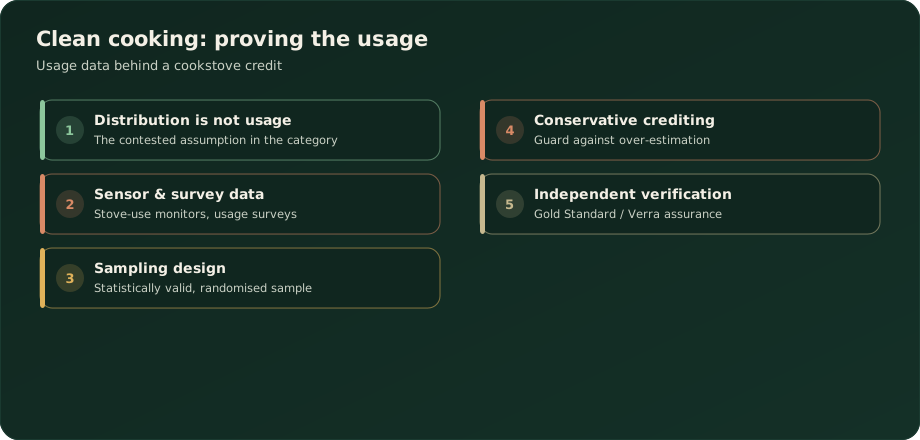
Distribution is not usage. A cookstove handed out but not used, broken and not repaired, or used alongside the old stove rather than instead of it, produces far less reduction than a simple distribution count implies. Over-crediting in the category has almost always traced back to this gap. So the entire integrity question for a clean cooking credit is: how do you know the stoves are actually being used, and by how much?
The Engagement
A buyer was evaluating a clean cooking programme issued under a standard such as Gold Standard or Verra. The programme looked strong on reach and on the development story. Our mandate was narrow and exactly on the pressure point: assess the usage evidence and the crediting assumptions before the buyer relied on the volumes.
How Real Usage Was Verified
Usage data, not distribution counts
We looked first for usage measurement rather than distribution numbers. The stronger programmes now combine stove-use sensors — devices that log cooking events — with structured usage surveys, so the usage rate is measured over time instead of assumed at handover. A programme that could only show how many stoves were distributed, with no usage evidence, was treated very differently from one that could show how many were still in regular use a year later.
Sampling design
You cannot instrument every household, so the credibility rests on the sample. We reviewed whether the monitored sample was statistically valid and randomly selected, or whether it was a convenient sample of the most accessible, best-supported households — which biases the usage rate upward. As covered in digital MRV, the sampling design usually carries more of the integrity than the sensors themselves.
Conservative crediting
Finally, we examined the crediting assumptions — the fraction of non-renewable biomass, the stacking allowance (households using two stoves), and how silent or dropped-out devices were treated. The consistent theme was conservatism: where an assumption could go either way, the defensible choice is the one less likely to inflate the result.
The Outcome
The programme that could back its numbers with measured, well-sampled usage data was a different proposition from one relying on distribution counts, even at a higher price. The buyer proceeded on the evidenced usage, with the more conservative crediting assumptions applied, and treated the usage monitoring as an ongoing condition rather than a one-off check. Independent verification by the standard's accredited body closed the loop.
Key Takeaways
- The whole integrity question in clean cooking is usage, not distribution.
- Look for sensor plus survey evidence of usage over time, not a handover count.
- The sampling design carries most of the credibility — insist it is statistically valid and randomised.
- Prefer conservative crediting assumptions on non-renewable biomass and stove stacking.
Frequently Asked Questions
Why were cookstove credits criticised? Because many relied on distribution counts and optimistic usage assumptions, over-estimating the emissions actually avoided.
What is stove stacking? When a household uses a new efficient stove alongside its old one rather than replacing it, which reduces the real saving.
How is real usage measured now? Through stove-use sensors that log cooking events, combined with usage surveys across a statistically valid sample.
Does better data make cookstove credits trustworthy? It addresses the central usage question; conservative assumptions and independent verification are still needed.
Are clean cooking credits eligible for CORSIA? They can be, where the programme and unit meet the scheme's eligibility and authorisation requirements.
Evaluating carbon credits across standards and project types? DSTechnoverse works on the data and integrity side of carbon procurement — project screening, registry and eligibility verification, MRV and monitoring-data analysis, reconciliation and defensible reporting. See our CORSIA carbon credit services and data analytics. We are based in Indore, Madhya Pradesh and work across India and internationally.
Apply as a carbon credit buyer or seller
Talk to our team, or start with the complete carbon credits guide.
This is an anonymised, representative case study that illustrates our approach. It does not identify any specific client, project, price or transaction.