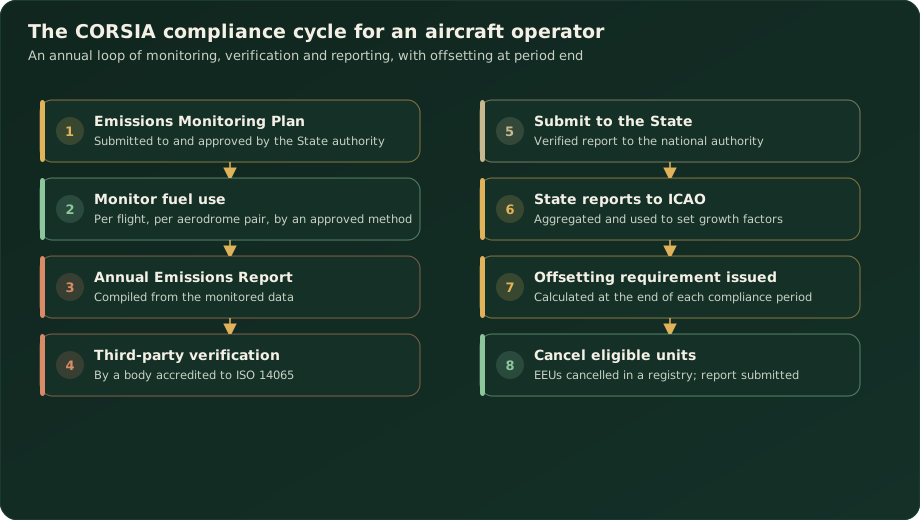
CORSIA compliance is a sequence, and the sequence matters. Steps taken out of order — most commonly, thinking about credit purchasing before the emissions data is sound — produce work that has to be redone.
This is the sequence, with the specific failure points at each stage.
Step 1: Establish Scope and Threshold
What to do: Determine whether you are in scope, and for which flights.
CORSIA applies to aeroplane operators on international flights, above 10,000 tonnes of annual international CO2, using aeroplanes above 5,700 kg maximum certificated take-off mass. Offsetting obligations attach only to routes where both origin and destination States participate.
Failure point: Operating structure ambiguity. Wet leases, code shares, franchise arrangements and multiple air operator certificates within a group all raise the question of which legal entity is the operator for CORSIA purposes. Getting this wrong means reporting under the wrong entity, which is not a trivial correction.
Output: A documented determination of in-scope entity, in-scope flights, and current route coverage.
Step 2: Build the Emissions Monitoring Plan
What to do: Develop the plan and submit it to your national authority — in India, the DGCA.
The plan specifies the fuel use monitoring method, data sources, systems, responsibilities and quality controls. ICAO permits several methods, each with different data requirements.
Failure point: Choosing a method your systems cannot actually support. The method is selected on paper, the plan is approved, and then a year later at verification it emerges that the required data was never captured at the necessary granularity. By then the reporting year is closed and the gap cannot be filled retrospectively.
How to avoid it: Look at your actual data before choosing. Pull a sample month and test whether you can produce the figures the method demands, from the systems you have, without manual reconstruction.
Output: An approved monitoring plan and a tested data process.
Step 3: Get the Data Pipeline Working
What to do: Establish the annual process for collecting, reconciling and quality-checking fuel and flight data.
Failure point: Sources disagree. Fuel uplift dockets, flight operations records, aircraft systems and finance records rarely produce identical numbers. Reconciling them is the bulk of the annual effort, and doing it manually each year is both expensive and error-prone.
How to avoid it: Treat it as a data engineering task. Define the authoritative source for each field, build the reconciliation logic once, document the rules for handling discrepancies, and automate what can be automated. The rules must be documented because a verifier will ask why a particular discrepancy was resolved the way it was.
Output: A repeatable pipeline producing a defensible dataset with an audit trail.
Step 4: Prepare the Annual Emissions Report
What to do: Assemble the report for the preceding calendar year and submit it to the authority.
Failure point: Late assembly. Operators who begin in the reporting window rather than maintaining data through the year find gaps at exactly the point where there is no time to resolve them.
Output: A complete report, with supporting evidence organised and accessible.
Step 5: Verification
What to do: Engage an accredited verification body to verify the report against ICAO Annex 16 Volume IV.
Failure point: Two, actually. First, verifier availability — accredited bodies are limited and demand is concentrated in the same window. Engage early. Second, independence: the body verifying your report cannot have advised on it, so if a consultant wrote your monitoring plan, they cannot verify.
How to smooth it: Anticipate what the verifier will test — sampling of fuel records, reconciliation logic, treatment of exceptions, completeness of flight lists — and have that evidence ready rather than assembling it under time pressure.
Output: A verified emissions report and a resolved findings log.
Step 6: Calculate the Offsetting Requirement
What to do: Once ICAO publishes the growth factors, apply them to your verified emissions on covered routes, adjusting for any CORSIA Eligible Fuels claims.
Failure point: Waiting for someone else to hand you the number. Operators who do not model their obligation in advance discover its size when it is too late to spread the purchasing.
How to avoid it: Estimate annually using published sector data, refine when factors are confirmed, and budget against the estimate. See offsetting requirement calculation for the mechanics.
Output: A documented requirement figure with the calculation reproducible.
Step 7: Open and Test Registry Accounts
What to do: Establish accounts in the registries where your intended supply sits.
Failure point: Assuming this is quick. Account opening involves know-your-customer processes and can take weeks. Operators who leave it until they have agreed a purchase find the transfer blocked by their own onboarding.
Output: Live, tested accounts, ahead of need.
Step 8: Source Units
What to do: Identify and secure CORSIA Eligible Emissions Units.
Failure point: Buying against a description rather than evidence. "CORSIA-ready" and "eligible pending authorisation" describe units that are not eligible. See the due diligence checklist for what to verify.
Strategic point: Deferring purchase to the end of the compliance period means competing with the entire sector for thin supply in the same window. Progressive acquisition through the period reduces that exposure, at the cost of committing before the final number is confirmed.
Output: Contracted supply with a complete documentation package.
Step 9: Cancel and Report
What to do: Cancel the units in the registry and submit the Emissions Unit Cancellation Report to your authority.
Failure point: Confusing purchase with compliance. Holding units discharges nothing. Cancellation is the act that counts, and it must be reported.
Output: Cancellation records and an accepted report.
Step 10: Maintain the Evidence
What to do: Retain the complete package — monitoring plan versions, data, reconciliation logic, reports, verification statements, unit documentation, authorisations, transfer and cancellation records.
Failure point: Staff turnover and system migration. The person who understood the reconciliation logic leaves; the system holding the source data is replaced; three years later nobody can reconstruct why a figure was what it was.
Output: A durable, indexed record.
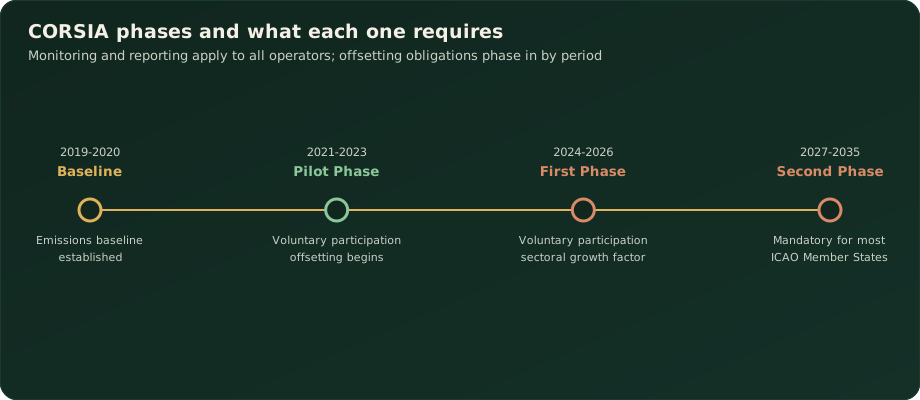
Planning Ahead: The 2027 Change
Second-phase participation becomes mandatory for States above defined activity thresholds from 2027, expanding route coverage substantially. For operators with significant traffic to States not currently participating, the obligation increase can be large.
Model it now against your actual network rather than applying a generic uplift. The analysis needs your route data and a view on which States will fall within the mandatory scope. See the phase breakdown.
From 2030, the individual growth factor gains weight, so operators growing faster than the sector carry proportionally more. Fleet and network plans therefore have a CORSIA cost attached that is worth surfacing in those decisions rather than discovering afterwards.
Where the Money Actually Goes
Operators budgeting for CORSIA for the first time tend to think of it as a credit purchase with some paperwork attached. The proportions are usually different from that.
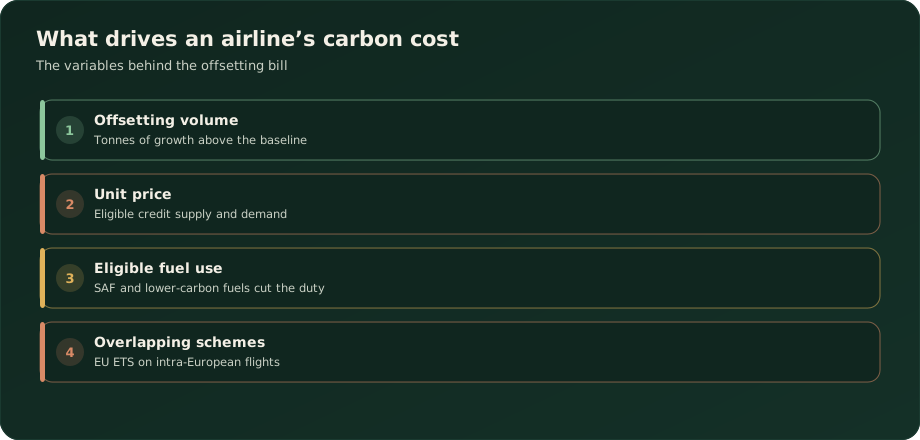
Unit purchase is the largest line once obligations become material, and it is the one most exposed to market conditions. It is also the most visible, which is why it gets the attention.
Data work is the largest hidden line. Building a reconciliation process that produces defensible figures from systems that were never designed to produce them takes real effort in year one and ongoing maintenance afterwards. Operators who under-resource this pay for it at verification.
Verification is a fixed annual cost, and one that rises if findings have to be resolved and work re-performed.
Internal time is almost always underestimated. Flight operations, fuel procurement, finance and sustainability functions all contribute data, and coordinating them is a job someone has to own.
Advisory is typically the smallest line and the one most likely to reduce the others, provided it is bought in the right sequence — assessment and build before recurring support.
The failure pattern worth naming: an operator minimises spend on data work and advisory, then absorbs a much larger cost at verification, in a rushed end-of-period unit purchase, or in an obligation calculated on figures that do not stand up.
A Compact Checklist
- Scope and threshold determined and documented
- Monitoring plan approved, and tested against real data
- Data pipeline repeatable, with documented reconciliation rules
- Emissions report assembled on a maintained basis, not in a rush
- Verifier engaged early, independence confirmed
- Requirement modelled annually, not awaited
- Registry accounts open and tested ahead of need
- Units sourced against evidence, progressively rather than at the deadline
- Cancellation completed and reported
- Evidence package durable and indexed
- Second-phase impact modelled on actual network
Frequently Asked Questions
What if we are just below the threshold? Reporting obligations may still apply even without offsetting. Confirm your position rather than assuming exemption.
Can we change monitoring method later? Changes require authority approval and are disruptive. Choosing correctly first is much cheaper.
What if our verifier raises a material finding? Resolve it and re-verify. Build time for this into the schedule rather than assuming a clean first pass.
Do we have to buy every year? Obligations are settled per three-year compliance period, but accruing annually and acquiring progressively reduces exposure to end-of-period supply squeezes.
Who is legally responsible? The operator. A consultant can prepare, a verifier can check, but accountability sits with you.
What if we cannot find eligible supply? Escalate early to your authority and consultant. This is a foreseeable risk, which is exactly why late purchasing is a poor strategy.
Ready to act on CORSIA? DSTechnoverse provides specialist CORSIA carbon credit services for aircraft operators, project developers and traders — eligibility screening, offsetting requirement calculation, unit sourcing and due diligence, corresponding adjustment support and registry execution. We are based in Indore, Madhya Pradesh and work with clients across India and internationally.
Apply as a CORSIA buyer or seller
Talk to our carbon markets team about your specific position.