Aviation is awkward for climate policy. A flight from Delhi to Frankfurt burns fuel over three or four national jurisdictions and the high seas, so no single country can straightforwardly tax or cap its emissions. International aviation was left out of the Kyoto Protocol and the Paris Agreement's national targets for exactly this reason. CORSIA is the world's attempt to fill that gap with a market rather than a tax.
What CORSIA Is
CORSIA stands for the Carbon Offsetting and Reduction Scheme for International Aviation. It was agreed in 2016 by the International Civil Aviation Organization (ICAO), the United Nations body for aviation, and it applies to CO2 from international flights — not domestic ones, which stay under each country's own policies.
The core idea is deliberately narrow. CORSIA does not cap aviation emissions and it does not force airlines to fly less. It sets a line, measures how far emissions rise above that line, and requires airlines to offset the growth by buying and cancelling carbon credits. It is a growth-management instrument, not an absolute cap.
The Three Moving Parts
Everything in CORSIA reduces to three quantities.
The baseline
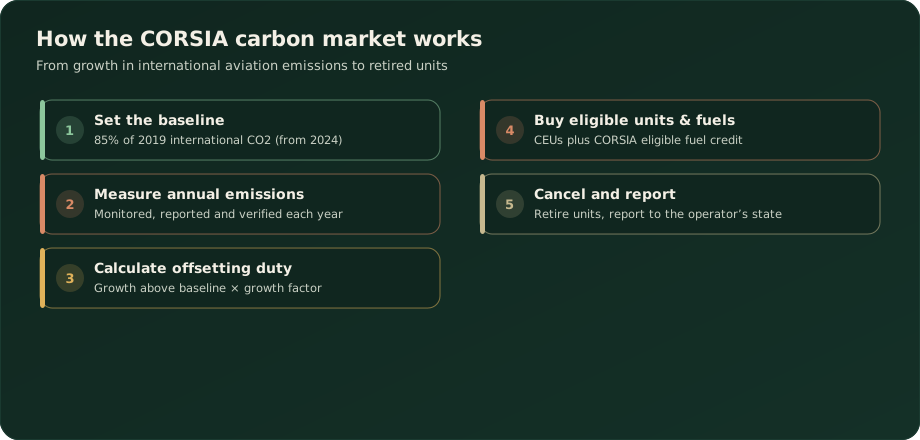
This is the reference level that "growth" is measured against. For the 2021–2023 pilot phase the baseline was 2019 emissions (2020 was excluded because the pandemic distorted it). From 2024, ICAO set the baseline at 85% of 2019 emissions — a deliberately tighter line that increases the offsetting obligation.
Measured emissions
Every covered operator monitors fuel burn on covered routes, reports it, and has it verified. That verified figure is what the scheme runs on.
The offsetting requirement
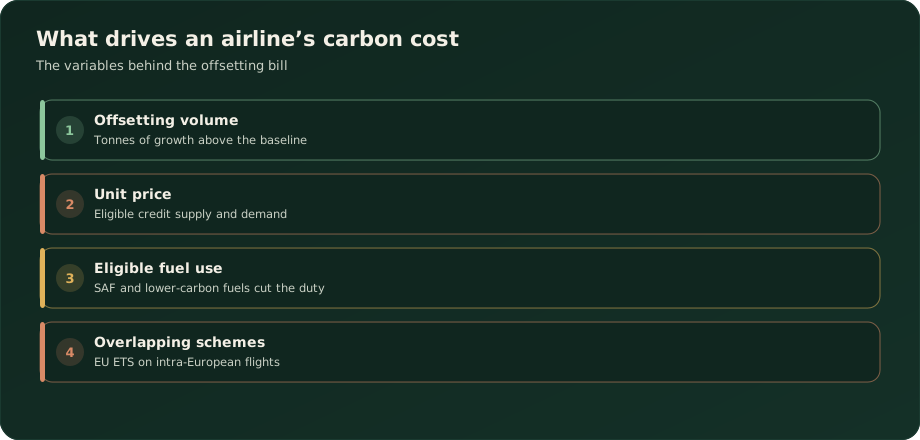
The amount an airline must offset is its share of the sector's growth above the baseline, scaled by a growth factor. In the early years this factor is almost entirely sectoral — based on how the whole industry grew — which shields fast-growing carriers from carrying the full cost of their own expansion. Over time the formula shifts weight toward each operator's individual growth.
Which Flights Are Covered
CORSIA uses a "route-based" rule that trips people up. A route's emissions are only subject to offsetting when both the departure and arrival countries are participating in the scheme. If either end is a non-participating state, that route is monitored but not charged. This "clean cut" design was a political compromise to bring reluctant states in gradually.
| Route | Both states participating? | Offsetting applies? |
|---|---|---|
| Participating → Participating | Yes | Yes |
| Participating → Non-participating | No | No (monitored only) |
| Domestic flight | N/A | No — outside CORSIA entirely |
The Two Ways to Comply
An airline meets its obligation in two ways, and most use both.
The first is buying CORSIA Eligible Emissions Units — carbon credits from crediting programmes ICAO has approved — and cancelling them so they cannot be used again. The second is using CORSIA Eligible Fuels, mainly sustainable aviation fuel, which reduces the offsetting requirement directly because those fuels count as lower-emission at the point of use.
A Simple Worked Example
Imagine a carrier whose covered international flights emitted 1,000,000 tonnes of CO2 in the baseline year. Say the applicable baseline is 850,000 tonnes (85% of a 2019 figure) and this year the airline emitted 1,050,000 tonnes. The growth above baseline is 200,000 tonnes. If the applicable sectoral growth factor translates that into, say, a 180,000-tonne offsetting requirement, the airline must acquire and cancel 180,000 eligible units — unless it used eligible fuel, in which case the SAF-related reduction is subtracted first. The exact factors are published by ICAO each period; the mechanics are what matter here.
What CORSIA Does Well — and Doesn't
Its strength is coverage: it is the only global instrument that puts any price on international aviation carbon, across almost all of the world's airlines, through a single set of rules. That is genuinely hard to achieve.
Its limits are equally real. Offsetting is not the same as cutting aviation's own emissions — a credit pays for a reduction somewhere else. The scheme's environmental value therefore depends entirely on the quality of the units airlines buy, which is why so much attention goes to eligibility and offset integrity. And because the baseline manages growth rather than capping totals, CORSIA is a bridge to real decarbonization, not the destination.
Where It Sits Among Other Tools
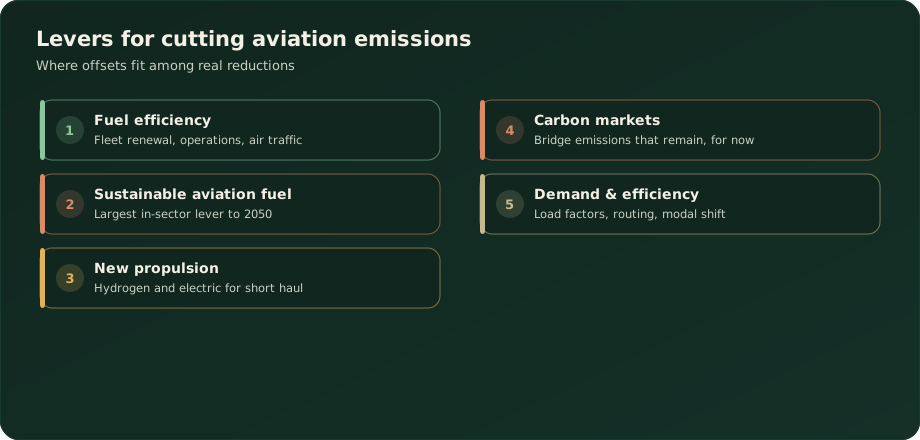
CORSIA is one lever, not the whole strategy. Fuel efficiency, sustainable fuels and new propulsion do the in-sector work; markets cover the gap in the meantime. For the bigger picture of how these fit together, see the role of carbon markets in reducing aviation emissions.
Frequently Asked Questions
Is CORSIA a tax on flying? No. It is an offsetting obligation. Airlines pay for carbon credits equal to their emissions growth, rather than paying a per-tonne tax to a government.
Does CORSIA cover domestic flights? No. Only international flights between participating states. Domestic aviation stays under national policy, such as a country's own carbon pricing.
Who has to comply? Aeroplane operators on covered international routes above a small emissions threshold. Very small operators and certain flight types are exempted.
Is CORSIA mandatory? It becomes mandatory for most states from 2027. The 2021–2026 phases are voluntary, though a large majority of international traffic is already covered by volunteering states.
How is this different from the EU ETS? The EU Emissions Trading System caps emissions on flights within Europe; CORSIA offsets growth on international flights. The EU broadly applies its ETS to intra-European flights and CORSIA to the rest.
Working on aviation emissions, CORSIA compliance or carbon credit due diligence? DSTechnoverse handles the data side of carbon and environmental compliance — monitoring design, emissions reconciliation, verification support and defensible reporting. See our CORSIA carbon credit services and data analytics. We are based in Indore, Madhya Pradesh and work across India and internationally.
Apply as a CORSIA buyer or seller
Talk to our team, or start with the complete carbon credits guide.