At the premium end of the carbon-removal spectrum sits the most futuristic option: machines that pull carbon dioxide directly out of the open air and lock it away underground. Direct air capture (DAC) offers the most durable removal money can buy — and, today, the most expensive. Here is how it works and why it matters even at small scale.
How Direct Air Capture Works
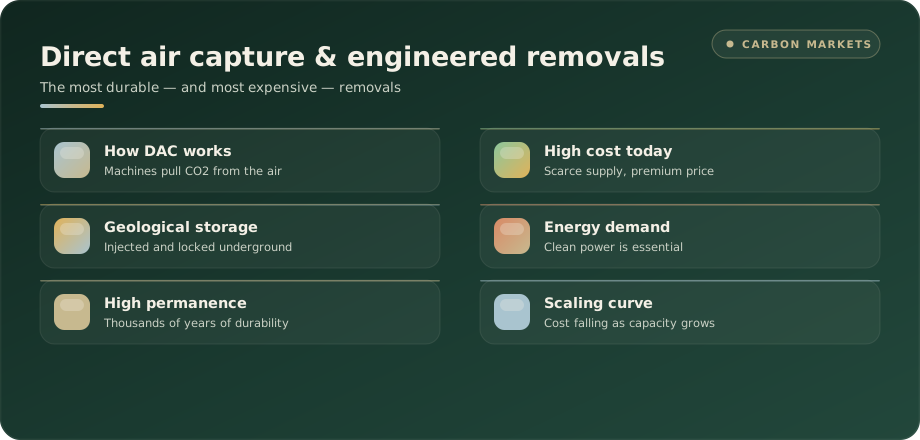
DAC uses large installations of fans and chemical sorbents to capture CO2 from ambient air. The captured CO2 is then concentrated and either used in products or, for a removal credit, injected into deep geological formations where it is mineralised or trapped permanently. The credit represents a tonne of CO2 physically taken from the atmosphere and stored — a true removal, not an avoidance.
Why It Is the Gold Standard for Permanence
The whole spectrum of removals can be ranked by how long the carbon stays stored, and DAC with geological storage sits at the top:
| Removal | Durability | Cost today |
|---|---|---|
| Nature-based (forests) | Decades, reversible | Low |
| Biochar | Centuries | Mid |
| DAC + geological storage | Millennia | High |
For a buyer who needs a removal that will not reverse — no fire, no clearance, no drought risk — DAC is the most defensible option available. That permanence is precisely why it costs what it does.
Why It Is So Expensive
DAC is energy-intensive: pulling CO2 from air, where it is highly dilute, takes far more energy than capturing it from a concentrated flue gas. That energy must itself be low-carbon, or the whole exercise is self-defeating. Combine high energy demand, early-stage technology and scarce capacity, and you get today's premium price — orders of magnitude above a cheap avoidance credit. This is the trade-off at the heart of the removal market: the more durable and defensible the removal, the more it costs, as the biochar and forestry comparisons show.
Where the Price Is Heading
DAC follows a classic technology cost curve. As deployment scales, engineering improves and clean-energy costs fall, the price per tonne is expected to decline substantially — the same trajectory solar and batteries followed. Early corporate buyers are effectively funding that scale-up, paying a premium now to help bring a permanent-removal industry down the cost curve. That is why DAC appears in serious net-zero portfolios today despite the price: it is a bet on the removals the world will need for its hardest-to-abate residual emissions.
DAC in a Removal Strategy
Few buyers build a portfolio only from DAC — it is too expensive at volume. Instead it tends to anchor the most durable slice of a mixed removal portfolio, alongside biochar and nature-based removals, matched to the durability and budget a credible net-zero claim requires.
Frequently Asked Questions
What is direct air capture? Technology that captures CO2 directly from ambient air; for a removal credit, the captured CO2 is stored permanently underground.
Why is direct air capture so expensive? CO2 is very dilute in open air, so capturing it is energy-intensive, and the technology is still early-stage with limited capacity — all of which raise the cost per tonne.
Is DAC a removal or an avoidance credit? A removal — it physically takes CO2 out of the atmosphere, rather than preventing a future emission.
How permanent is DAC storage? With geological storage, on the order of millennia, making it the most durable removal type available.
Will DAC get cheaper? Most analysts expect costs to fall substantially as capacity scales and clean-energy costs decline, following a technology cost curve.
Navigating carbon credits and climate claims? DSTechnoverse works on the data and integrity side of carbon — project screening, registry and eligibility verification, MRV and monitoring-data analysis, reconciliation and defensible reporting. See our CORSIA carbon credit services and data analytics. We are based in Indore, Madhya Pradesh and work across India and internationally.
Apply as a carbon credit buyer or seller
Talk to our team, or start with the complete carbon credits guide.