Buying credits is the easy part. Saying something accurate about them afterwards, in a disclosure that will be read by investors, auditors and increasingly regulators, is where organisations create problems for themselves.
The Rule Every Framework Shares
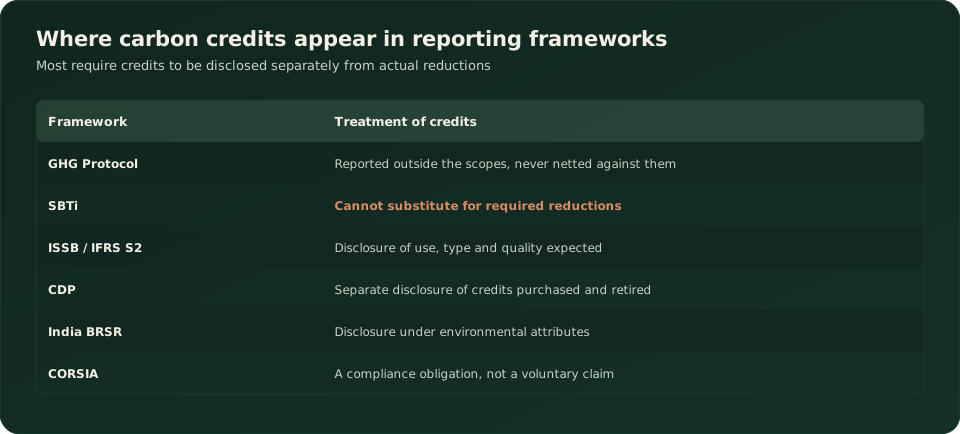
| Framework | Treatment of credits |
|---|---|
| GHG Protocol | Reported outside the scopes, never netted against them |
| SBTi | Cannot substitute for required reductions |
| ISSB / IFRS S2 | Disclosure of use, type and quality expected |
| CDP | Separate disclosure of credits purchased and retired |
| India BRSR | Disclosed under environmental attributes |
| CORSIA | A compliance obligation, not a voluntary claim |
The common thread: credits are disclosed alongside emissions, never subtracted from them.
An organisation reporting a "net" figure after offsets is misreporting under the GHG Protocol, and the reason is that netting destroys information. A reader cannot distinguish an organisation that cut emissions from one that bought credits, and those represent very different positions.
Credits Cannot Replace Reductions
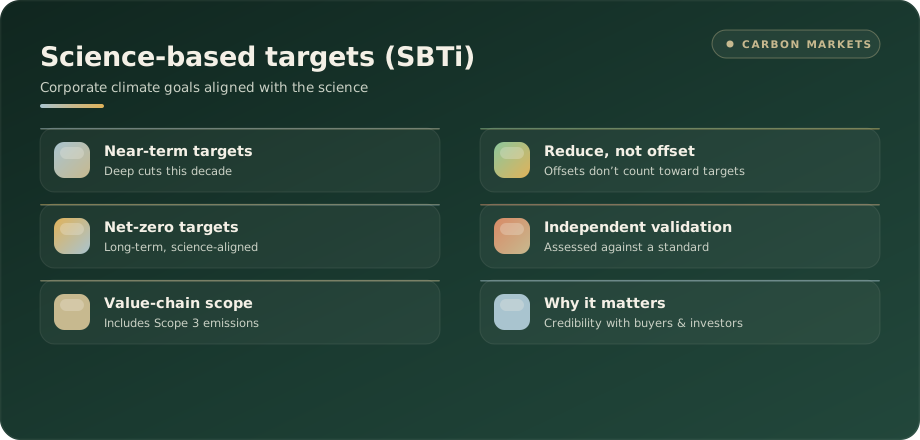
The Science Based Targets initiative is the most explicit, and the position has become the mainstream expectation rather than a strict outlier.
The framing that most frameworks now use:
Reduce first. Deep, absolute emissions reduction across scopes 1, 2 and 3, on a trajectory consistent with the target.
Then address residuals. Only the emissions that genuinely cannot be eliminated are addressed with credits — and for net zero claims specifically, with removals rather than avoidance.
Beyond value chain mitigation is the term for credits bought in addition to, rather than instead of, a reduction pathway. It is encouraged; it is not counted toward the target.
The practical consequence for an organisation: a credit purchase does not move you toward a science-based target. If you are buying credits in place of reductions, no credible framework will recognise it, and disclosing it as progress invites challenge.
What a Defensible Disclosure Contains
Specificity is what makes a disclosure hard to attack. At minimum:
| Element | Why |
|---|---|
| Quantity retired, in tonnes | The basic fact |
| Project type and location | Lets a reader assess quality |
| Standard and methodology | Establishes the rules applied |
| Vintage | Recency matters for credibility |
| Removal or avoidance | Determines what claim is supportable |
| Corresponding adjustment status | The strongest double-counting protection |
| Retirement serial numbers or registry reference | Makes it checkable |
| The claim being made | Stated precisely rather than by label |
Compare two disclosures:
"We achieved carbon neutrality in 2026."
"We reduced absolute scope 1 and 2 emissions by 18% against our 2019 baseline. For residual emissions of 4,200 tCO2e we retired 4,200 removal credits from an afforestation project in Madhya Pradesh, verified under [standard], vintage 2025, registry serials available on request."
The second is longer, harder to write, and considerably harder to attack. It is also the direction disclosure requirements are moving.
Claim Language Under Scrutiny
Consumer protection and advertising regulators in several jurisdictions have taken action over carbon neutrality claims, and the pattern in those cases is consistent.
What attracts attention:
- "Carbon neutral" based on avoidance credits, where a reader would understand it as emissions eliminated
- Claims where the credits' quality is weak and the organisation did not check
- Claims made instead of reduction rather than alongside it
- Product-level neutrality claims where the accounting boundary is unclear
- Vague terms — "climate positive", "net zero product" — without a stated methodology
What is more defensible:
- Describing what was actually done, in quantities and types
- Distinguishing reduction from compensation explicitly
- Stating the standard, vintage and project
- Making claims proportionate to the evidence
The general principle: the more specific the disclosure, the more robust it is. Vagueness reads as concealment even when it is only brevity.
Assurance
External assurance over sustainability information is increasingly expected and in some jurisdictions required.
Limited assurance is the common starting point — the assurer states that nothing came to their attention suggesting the information is materially misstated.
Reasonable assurance is a higher bar, closer to a financial audit opinion, and the direction of travel in several regimes.
For carbon credits specifically, an assurer will typically want the retirement evidence from the registry, the basis for the quantity claimed, and evidence supporting any quality assertions made. An organisation that cannot produce the retirement serials and the underlying due diligence has a disclosure it cannot support.
This is the same discipline as compliance verification: capture the evidence at the time, because reconstructing it later does not work.
The Indian Position
BRSR — the Business Responsibility and Sustainability Report — applies to listed entities above defined thresholds, with BRSR Core requiring assurance over specified attributes.
Carbon credits appear under environmental disclosure, and the same principles hold: report emissions gross, disclose credits separately, and be specific about type and standard.
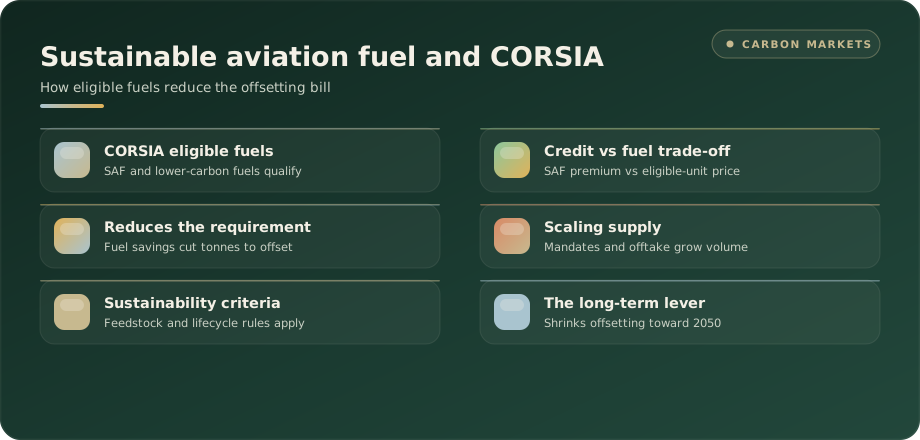
For organisations also subject to CORSIA, the two are distinct. CORSIA cancellation discharges a legal obligation and should be reported as compliance, not presented as a voluntary sustainability achievement. Reporting the same units in both places is a double claim.
Sequencing a Credible Programme
Organisations that end up with defensible disclosures generally follow the same order, and the order matters more than the individual steps.
1. Measure first. A complete inventory with a documented boundary, before any target is set. Targets set on incomplete inventories get revised, and revisions read badly.
2. Set a target grounded in the inventory. Absolute reduction across the scopes that matter, on a stated trajectory and against a stated base year.
3. Build a reduction pathway. Named interventions with expected contributions, not a straight line to zero. A pathway that cannot be decomposed into actions is an aspiration.
4. Reduce. This is the part that takes years and cannot be accelerated by purchasing.
5. Address residuals with credits, once the pathway is delivering and what remains is genuinely hard to abate. Removals for net zero claims.
6. Disclose specifically, distinguishing reduction from compensation, with the credit detail set out.
7. Retain the evidence — retirement records, due diligence, boundary documentation — because assurance will ask.
The failure pattern is doing step 5 first, because it is the only step that can be completed with a purchase order. An organisation that buys credits before measuring properly has bought something it cannot describe accurately, and the disclosure problem follows from that rather than from the credits themselves.
Common Disclosure Errors
| Error | Why it is a problem |
|---|---|
| Netting credits against scope emissions | Misreporting under every major framework |
| Presenting credits as progress toward a science-based target | Not recognised; invites challenge |
| "Carbon neutral" with no methodology stated | Increasingly attracts regulatory attention |
| Claiming CORSIA units as a voluntary achievement | Double claim |
| No project detail | Reader cannot assess quality; assurer cannot verify |
| Retiring in one year, claiming in another | Timing mismatch between claim and retirement |
| No retirement evidence retained | Cannot support the disclosure under assurance |
Preparing for Questions
Whatever you disclose will be read by people whose job is to test it. Anticipating the questions is cheaper than answering them under pressure.
From an assurer: show me the retirement evidence. How did you establish the quantity? What due diligence did you do on quality? Which boundary applies and did it change? Where are the emission factors from?
From an investor: how much of your progress is reduction and how much is compensation? What is the trajectory on absolute emissions, not intensity? What proportion of scope 3 is measured rather than estimated?
From a journalist: which projects, and have they been criticised? Are these removals or avoidance? Did you check the additionality argument?
From a regulator: what does your claim mean precisely, and what evidence supports it? Would a reasonable consumer understand it the way you intend?
Each of these is answerable if the work was done and the evidence retained. None is answerable retrospectively from a summary figure.
The organisations that handle scrutiny well are not necessarily the ones with the best numbers. They are the ones that can explain their numbers — including the parts that are estimated, uncertain or unflattering. Disclosed weakness is far more robust than discovered weakness.
Frequently Asked Questions
Can I subtract carbon credits from my reported emissions? No. Report gross emissions and disclose credits separately.
Do credits count toward a science-based target? No. SBTi and comparable frameworks require reductions, with credits addressing residuals only.
Is "carbon neutral" still safe to claim? It carries regulatory risk in several jurisdictions, particularly when based on avoidance credits without a clear methodology. Describing what you did is safer than using the label.
What is beyond value chain mitigation? Credits purchased in addition to a reduction pathway rather than instead of it. Encouraged, but not counted toward targets.
Do I need assurance over credit disclosures? Increasingly expected, and required in some regimes. Retain retirement evidence and due diligence regardless.
How do CORSIA units appear in ESG reporting? As a compliance obligation discharged, not as a voluntary claim. They are not available for both.
What should I disclose about credit quality? Type, standard, methodology, vintage, removal or avoidance, corresponding adjustment status, and retirement reference. See carbon credit quality assessment.
Measuring, reporting or disclosing emissions and credits? DSTechnoverse works on the data side of carbon and environmental compliance — monitoring design, reconciliation, verification support and defensible reporting. See our CORSIA carbon credit services and data analytics. We are based in Indore, Madhya Pradesh and work across India and internationally.
Apply as a CORSIA buyer or seller
Talk to our team, or start with the complete carbon credits guide.