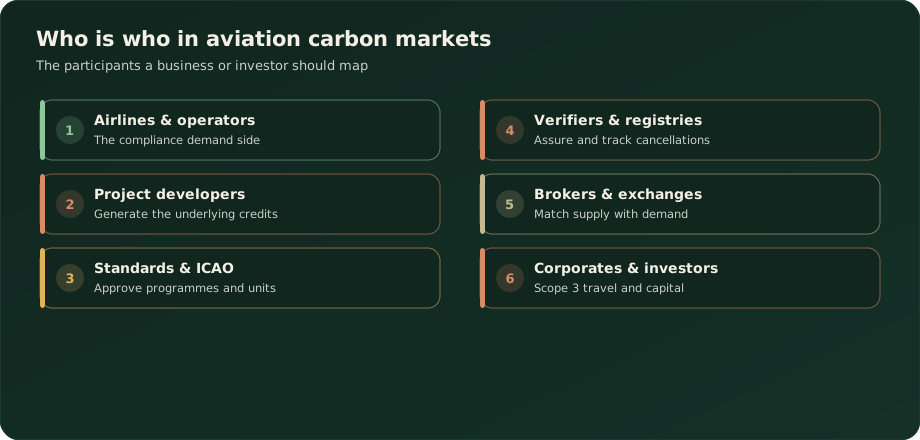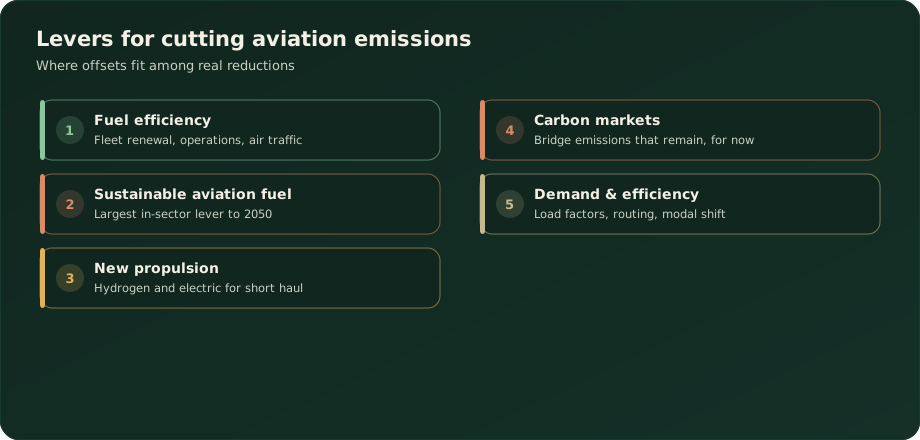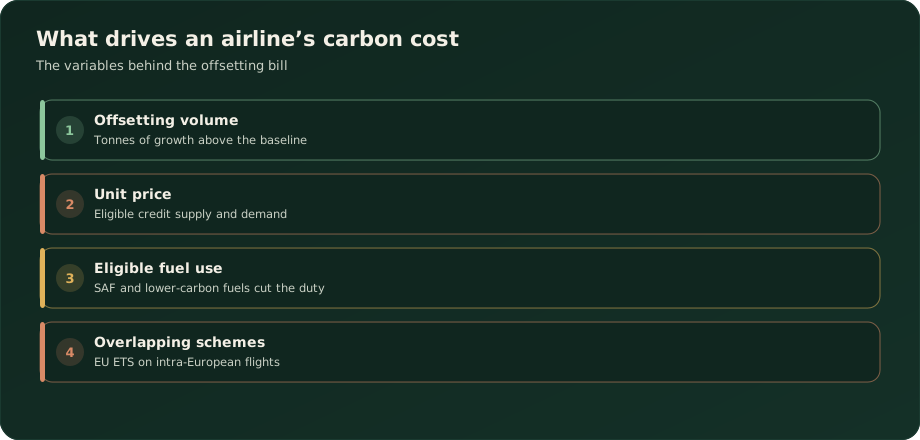
A compliance obligation with real money attached and a shortage of genuine expertise is a combination that attracts opportunists. The CORSIA advisory market has both. These twelve questions are designed to establish, in a single conversation, whether a prospective consultant has actually done this work.
1. Which side of the market do you work?
Operator-side compliance and developer-side project work are different practices. A firm doing only one is not disqualified, but you should know which you are hiring.
Listen for: A clear answer, and awareness of what the other side looks like. A consultant advising you on purchasing who cannot describe the authorisation process a seller goes through does not understand why supply is scarce.
2. How many monitoring plans have you had approved, and by which authorities?
The Emissions Monitoring Plan is the foundation. Approval practice varies by national authority, and experience with yours specifically has value.
Listen for: Numbers and named authorities. Worry about: "We're very familiar with the requirements." Familiarity with a document is not experience with a regulator.
3. What happens if my operational data cannot support the monitoring method we choose?
This is the most common expensive failure — a method selected on paper that the operator's actual systems cannot feed, discovered at verification a year later.
Listen for: A consultant who wants to see your data before recommending a method. Worry about: A recommendation offered before anyone has looked at what you actually record.
4. Are you ICAO certified?
A trick question. The correct answer is that no such certification exists.
Listen for: A clear no, with an explanation of what does exist — ISO 14065 accreditation for verification bodies, ICAO approval for crediting programmes, national authority approval for monitoring plans.
End the conversation if: They say yes, or produce a certificate. Either they are misrepresenting a credential or they do not understand the scheme's governance. Both are disqualifying.
5. Can you also verify our emissions report?
Another test. Verification requires independence from the party being verified.
Listen for: No, with an explanation of why. A consultant offering both is either unaware of the independence requirement or willing to ignore it.
6. How do you establish that a unit carries a corresponding adjustment?
The corresponding adjustment is the criterion that eliminates most supply. How a consultant verifies it tells you how rigorous their due diligence actually is.
Listen for: A specific evidence chain — a host-State authorisation document naming the units, the designated national authority that issued it, and how the adjustment appears in national reporting.
Worry about: "The seller confirms it is adjusted", or reliance on a marketing description. Seller assurance is not evidence.
7. What do you do about "CORSIA-ready" or "eligible pending authorisation" supply?
These phrases describe units that are not currently eligible.
Listen for: Clear recognition that these are not standards and that buying against them transfers authorisation risk to you. A good consultant will explain how to structure a forward agreement if you choose to take that risk deliberately.
8. What is our exposure if a programme's approval lapses or a vintage window moves?
Both have happened.
Listen for: An acknowledgement that these are live risks, and specific mitigations — diversifying across programmes, avoiding concentration near a vintage boundary, contractual protection.
Worry about: Reassurance that the rules are settled. They are not.
9. Model our second-phase obligation against our actual network.
From 2027, mandatory participation expands route coverage substantially. The change in obligation is operator-specific and depends on where you fly.
Listen for: Willingness to do the analysis with your route data, and clarity about what is assumption versus known. See the phase structure for what drives this.
Worry about: A generic percentage applied to your current number.
10. Who does the work, and will we meet them?
Sold by a partner, delivered by a junior, is a familiar pattern.
Listen for: Named individuals, their actual experience, and their availability. Worry about: Team capability described only in aggregate.
11. What does the deliverable look like, and who owns it?
You need documentation that survives staff turnover and defends decisions to a verifier years later.
Listen for: Documented reasoning, not just outputs. A calculation you cannot reconstruct is a liability. Confirm you own the working, not just a PDF summary.
12. Tell me about an engagement that did not go well.
The most revealing question in any procurement.
Listen for: A real answer with a specific lesson. Anyone with genuine CORSIA experience has hit an authority that rejected a plan, a verifier finding, an authorisation that stalled, or a supply deal that fell through.
Worry about: Nothing has ever gone wrong. Either they have not done enough work, or they are not being straight with you.
Claims That Should End the Conversation
- "ICAO certified" or "CORSIA certified." No such credential exists.
- "Guaranteed eligible supply at a fixed price." In a supply-constrained market with regulatory risk, this is not a guarantee anyone can honestly make.
- "We can convert your voluntary credits to CORSIA credits." Conversion is a host-State decision, not a service.
- "CORSIA is straightforward, we handle everything." The parts that are hard are hard for everyone.
- Voluntary market prices quoted as CORSIA prices. Either they do not understand the two-tier market or they are hoping you do not.
Red Flags in the Written Proposal
The conversation tells you a lot; the document tells you the rest.
Scope described only in verbs. "Support", "assist", "advise" and "manage" are not deliverables. An approved monitoring plan, a verified emissions report, a documented requirement calculation and a completed cancellation are.
No mention of your data. A proposal for monitoring work that does not ask to examine your actual fuel and flight records before recommending a method has been written from a template.
Boilerplate risk sections. Generic language about market volatility, with no reference to vintage windows, programme approval status, authorisation risk or participation change, indicates the risks specific to this scheme have not been considered.
Prices with no basis. A CORSIA unit price quoted in a proposal, without stating the source, the vintage, the programme and whether the corresponding adjustment is in place, is a number with nothing behind it.
Timelines that ignore third parties. Verifier availability, registry account opening, authority review periods and host-State authorisation all sit outside the consultant's control. A schedule that treats them as instantaneous has not been thought through.
No named team. See question ten.
Ownership of working papers unaddressed. You need the reasoning, not just the conclusion. If the contract is silent, ask.
Structuring the Engagement
Once you have chosen, the contract matters:
Phase it. Start with an assessment — scope, data readiness, feasibility. A consultant confident in their value will accept a small first phase.
Define deliverables concretely. "Compliance support" is not a deliverable. An approved monitoring plan, a verified emissions report, a documented requirement calculation, a completed cancellation are.
Allocate risk explicitly. If they source units, who bears the loss if eligibility fails? Silence defaults it to you.
Require documentation standards. Specify that working papers, sources and reasoning are delivered, and that you own them.
Keep internal capability. Someone in your organisation must be able to explain your own data. Outsourcing that is how organisations become permanently dependent.
A Note on Cost
Cheap CORSIA advice is usually expensive. The failure modes — a monitoring method your data cannot support, units that turn out ineligible, an obligation discovered late — cost far more than the fee difference between a competent firm and a cheap one.
That said, high fees are not evidence of competence either. Ask for scope-based pricing tied to defined deliverables, and be sceptical of open-ended retainers with vague scope.
Frequently Asked Questions
Should I use a big consultancy or a specialist? Specialists usually know the scheme better; large firms bring process and scale. What matters is who does the work, so ask question ten.
Can my verification body recommend a consultant? They may, but check for conflicts. The verifier must remain independent of the advisory work.
How do I check references usefully? Ask referees what went wrong and how it was handled, not whether they were satisfied.
Is a local consultant better? For monitoring plan approval, familiarity with your national authority helps. For unit sourcing, the market is international.
What if I have already started with a consultant I now doubt? Get a second opinion on the monitoring plan specifically. It is the document everything else depends on, and correcting it early is far cheaper than at verification.
Where do I start if I have not engaged anyone? Establish your scope and threshold position first — see the CORSIA compliance roadmap.
Should the same firm handle both compliance and unit purchasing? It can work well, because the requirement calculation and the procurement decision are connected. But the risk allocation on sourcing should be written down separately from the compliance scope, so that a failure in one does not become ambiguous in the other.
How do I judge a consultant who is new to CORSIA but strong in adjacent work? Adjacent depth — emissions accounting, Article 6, verification, aviation operations data — transfers well, and the scheme is young enough that nobody has twenty years in it. What does not transfer is familiarity with your national authority's practice and with what buyers currently reject. Ask specifically about those two gaps and how they intend to close them.
Ready to act on CORSIA? DSTechnoverse provides specialist CORSIA carbon credit services for aircraft operators, project developers and traders — eligibility screening, offsetting requirement calculation, unit sourcing and due diligence, corresponding adjustment support and registry execution. We are based in Indore, Madhya Pradesh and work with clients across India and internationally.
Apply as a CORSIA buyer or seller
Talk to our carbon markets team about your specific position.