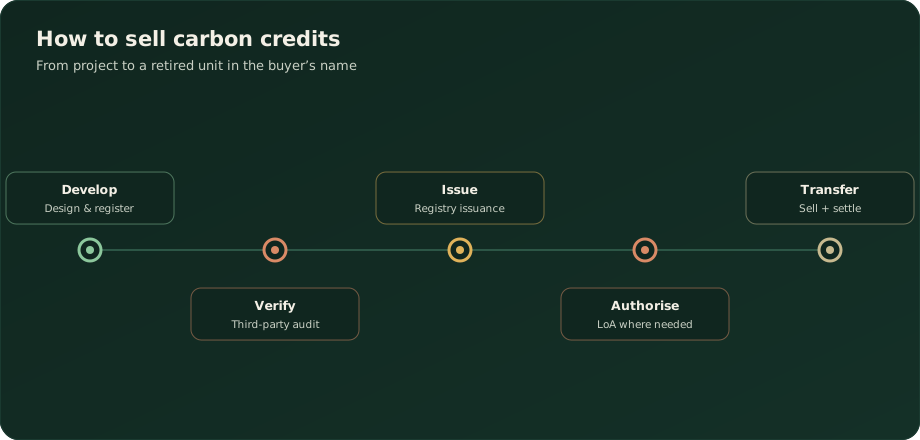
On the other side of every purchase is a project developer who turned a real climate outcome into a tradable unit. That journey is longer and more technical than buyers usually realise, and each stage is where value is either created or lost. This is how a carbon credit gets made and sold.
Step 1: Design and Register the Project
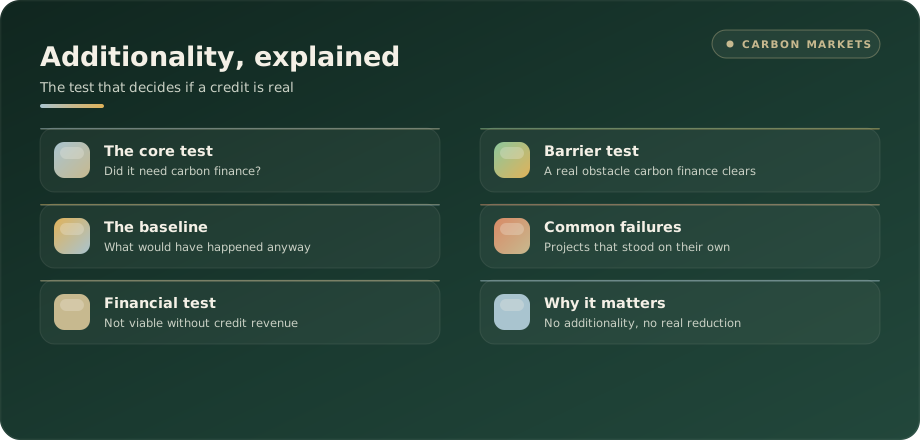
A sellable credit starts with a project designed to a methodology — the accounting recipe a standard such as Verra, Gold Standard or ACR requires for that activity. The developer selects the standard and methodology, sets a conservative baseline (what would have happened anyway), and demonstrates additionality (that carbon revenue is decisive). The project is then registered with the standard. Get the baseline and additionality right here and everything downstream is easier; get them wrong and the credits will struggle to sell at any price.
Step 2: Monitor and Verify
Once running, the project monitors its results — fuel saved, hectares protected, tonnes removed — following the methodology's MRV rules. An accredited, independent verification body then audits that data. This third-party verification is what makes the resulting credits credible; a developer's own numbers, unverified, are not sellable to a serious buyer.
Step 3: Issue the Credits
On a successful verification, the standard issues credits into the developer's registry account, each with a unique serial number and a vintage tied to the year of the reduction. At this point the credits exist as tradable units — but existing is not the same as being usable for every buyer.
Step 4: Secure Authorisation (Where It Adds Value)
For the highest-value buyers — compliance schemes such as CORSIA, and serious corporates avoiding double counting — the credit needs a host-country Letter of Authorisation and a corresponding adjustment under Article 6. Securing this is often the hardest step, because it depends on the host government, which may prefer to keep the reduction for its own national target. But an authorised unit is worth materially more than an unauthorised one from the same project, so it is usually worth pursuing where the government is willing.
Step 5: Market, Sell and Transfer
With issued (and ideally authorised) credits, the developer goes to market — directly, through brokers or exchanges, or via forward and offtake agreements signed even before issuance to fund the project. Terms are captured in a sale agreement or ERPA. On settlement, credits move by registry transfer to the buyer, who ultimately retires them in their own name. The developer's job is done when the units are transferred and settled; the buyer's, when they are retired.
What Makes Credits Sell Well
| Factor | Why buyers pay for it |
|---|---|
| Strong additionality & baseline | Survives scrutiny and ratings |
| A durable, well-monitored outcome | Higher-integrity, higher-value type |
| Corresponding adjustment | Unlocks compliance buyers |
| Recent vintage | Preferred by buyers and schemes |
| Clean registry record | Frictionless transfer |
The mirror image of this, from the buyer's chair, is in how to buy carbon credits.
Frequently Asked Questions
How do project developers sell carbon credits? By designing a project to a methodology, registering it, monitoring and verifying results, having credits issued, and then selling them directly or through brokers, exchanges or offtake agreements.
How long does it take to issue carbon credits? It varies widely by project type and methodology — from months to years — because design, registration, monitoring and third-party verification all take time.
Do I need a corresponding adjustment to sell credits? Not for all buyers, but authorised units with a corresponding adjustment sell for more and unlock compliance demand such as CORSIA.
What is an offtake agreement? A commitment by a buyer to purchase a project's future credits, often signed early to help finance the project.
Which standard should a developer choose? The one whose methodologies fit the activity and whose credits the target buyers accept — commonly Verra, Gold Standard or ACR, and ART-TREES for jurisdictional forestry.
Buying, selling or evaluating carbon credits? DSTechnoverse works on the data and integrity side of carbon procurement — project screening, registry and eligibility verification, MRV and monitoring-data analysis, reconciliation and defensible reporting. See our CORSIA carbon credit services and data analytics. We are based in Indore, Madhya Pradesh and work across India and internationally.
Apply as a carbon credit buyer or seller
Talk to our team, or start with the complete carbon credits guide.