Buying carbon credits sounds simple — pick a project, pay, done. That version is exactly how companies end up with credits they cannot use or cannot defend when a journalist or auditor asks. A credible purchase is a short, disciplined sequence. Here is the whole thing, in the order it should happen.
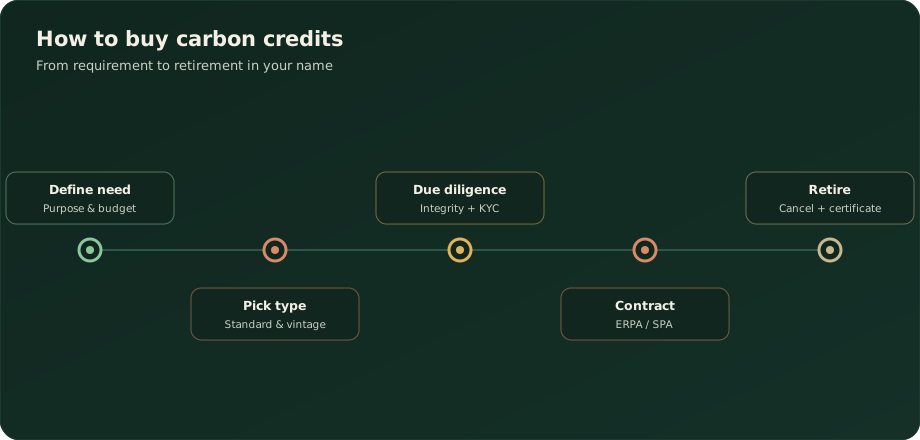
Step 1: Define What You Actually Need
Before looking at a single project, answer three questions.
- Purpose. Is this for a voluntary "carbon neutral" claim, a compliance obligation such as CORSIA, or an ESG disclosure? Each demands a different level of integrity and authorisation.
- Volume and budget. How many tonnes, and what price band is realistic for the quality you need? (See what drives carbon credit prices.)
- What you will not buy. A short exclusion list — project types, standards or vintages you will not touch — keeps the process disciplined once offers start arriving.
Getting this right up front prevents the most common mistake: buying on price and discovering later the credits do not fit the claim.
Step 2: Choose the Project Type and Standard
Match the credit to the purpose. A durable removal (ARR or engineered) supports a stronger claim than an avoidance credit; a compliance use narrows you to approved standards and authorised units. Decide the acceptable standards — Verra, Gold Standard, ACR and others — and the vintage window before you shortlist.
Step 3: Run Due Diligence
This is where a good purchase is protected. For each candidate, check:
- Integrity — additionality, a conservative baseline, permanence and independent verification, appropriate to the project type.
- Registry — issuance, vintage and live, un-retired serial numbers, verified against the registry of record.
- Authorisation — where you need it, the Letter of Authorisation and corresponding adjustment, verified against the published source, not the seller's claim.
- Counterparty — KYC and sanctions screening on the seller.
Never skip diligence to move faster; it just moves the cost to the audit later. The full framework is in how to evaluate carbon offset quality.
Step 4: Contract
Capture the commercial and technical terms in a sale agreement or ERPA (Emission Reduction Purchase Agreement), with conditions precedent that make settlement contingent on the diligence outcomes. Decide the delivery type — spot for ready credits, forward or offtake for future delivery — with eyes open to the risk each carries.
Step 5: Retire and Report
The purchase is not finished when the credits land in your account — it is finished when they are retired. Cancelling the units in the registry, in your name, is the act that actually discharges the claim; an un-retired credit achieves nothing. Keep the retirement certificate and serial records as your evidence, and reflect the retirement accurately in any public claim.
A Simple Buyer's Checklist
| Step | The question it answers |
|---|---|
| Define need | What are these credits for, and at what quality? |
| Choose type/standard | Which credits can support that claim? |
| Due diligence | Are the units real, eligible and clean? |
| Contract | Are the terms and delivery risk right? |
| Retire & report | Has the claim actually been discharged? |
Frequently Asked Questions
How do businesses buy carbon credits? Through brokers, exchanges, standards' marketplaces or directly from project developers — after defining the need, choosing a project type and standard, and running due diligence.
What does it mean to retire a carbon credit? Permanently cancelling it in the registry in your name, so it cannot be resold or reused. This is the step that actually meets your claim.
How do I avoid buying low-quality carbon credits? Define your purpose first, buy within the matching quality band, and run integrity, registry and authorisation checks before contracting.
What is an ERPA? An Emission Reduction Purchase Agreement — the contract governing a carbon-credit purchase, covering price, delivery and conditions.
Should small businesses buy carbon credits? They can, but should still follow the same steps at a smaller scale; quality and proper retirement matter regardless of volume.
Buying, selling or evaluating carbon credits? DSTechnoverse works on the data and integrity side of carbon procurement — project screening, registry and eligibility verification, MRV and monitoring-data analysis, reconciliation and defensible reporting. See our CORSIA carbon credit services and data analytics. We are based in Indore, Madhya Pradesh and work across India and internationally.
Apply as a carbon credit buyer or seller
Talk to our team, or start with the complete carbon credits guide.