For years, "high-quality carbon credit" meant whatever a seller said it meant. The Integrity Council for the Voluntary Carbon Market (ICVCM) set out to fix that with the Core Carbon Principles (CCPs) — a common benchmark for what integrity actually requires. If you buy or sell credits, the CCPs are quickly becoming the reference everyone points to.
What the ICVCM Is Trying to Do
The problem the CCPs address is fragmentation. Dozens of standards, hundreds of methodologies, and no shared definition of "good" left buyers unable to compare credits and exposed to greenwashing. The ICVCM's answer is not another registry; it is a quality threshold that programmes and methodologies can be assessed against, so a buyer can ask a single question — "is it CCP-approved?" — instead of re-litigating integrity from scratch every time.
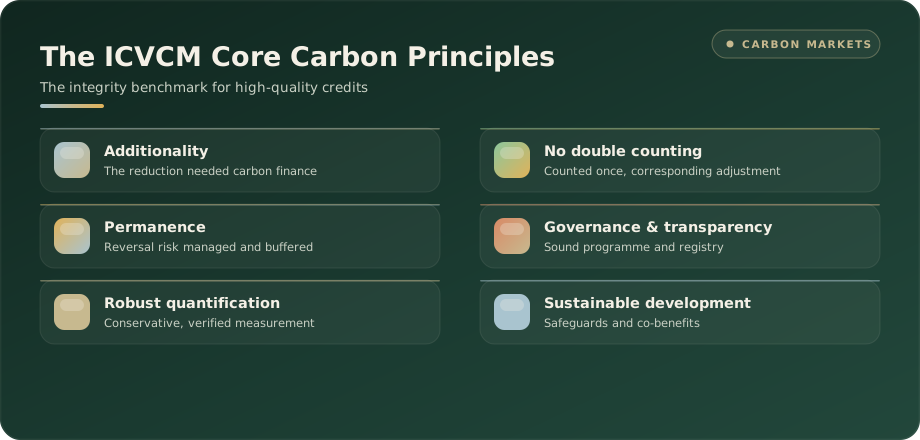
What the Core Carbon Principles Cover
The CCPs group into three areas.
Governance
Sound programme governance, transparency, and robust registry and tracking systems — the institutional foundation that makes a credit auditable.
Emissions impact
The heart of it, and the same questions that recur across every project type:
- Additionality — the reduction depended on carbon finance.
- Permanence — storage is durable, with reversal risk managed and buffered.
- Robust quantification — conservative, independently verified measurement.
- No double counting — counted once, with a corresponding adjustment where required.
Sustainable development
Safeguards against social and environmental harm, and, ideally, positive co-benefits for communities.
How the CCP Label Works
The ICVCM assesses programmes and methodologies against the CCPs and approves those that qualify, allowing eligible credits to carry a CCP label. It is a category-level and methodology-level judgement, not a blanket blessing of every credit from a registry — which matters, because a standard can have some CCP-approved methodologies and others that are not. The label is a strong signal, but it does not replace project-level due diligence.
Why It Matters to Buyers and Sellers
For buyers, the CCP label is a shortcut through the integrity question: a credit that clears the CCPs has already passed the checks that matter, which is why the label increasingly commands a premium and why serious buyers ask for it. It overlaps heavily with what compliance schemes require — a CCP-aligned, corresponding-adjusted credit is close to what CORSIA's eligible emissions units demand.
For sellers and developers, CCP approval is becoming a market-access question. A methodology that fails to meet the CCPs produces credits that a growing share of buyers will not touch — so integrity is shifting from a differentiator to a baseline expectation.
Frequently Asked Questions
What are the Core Carbon Principles? A set of integrity criteria from the ICVCM defining what a high-quality carbon credit should meet, covering governance, emissions impact and sustainable development.
What is the CCP label? A mark that credits from ICVCM-approved programmes and methodologies can carry, signalling they meet the Core Carbon Principles.
Does a CCP label guarantee a credit is good? It is a strong, category-level signal, but buyers should still run project-level due diligence, since approval is at the programme and methodology level.
Who runs the ICVCM? The Integrity Council for the Voluntary Carbon Market, an independent governance body created to set and uphold a high-integrity threshold for the market.
How do the CCPs relate to CORSIA? They overlap heavily; a CCP-aligned credit with a corresponding adjustment is close to what CORSIA's eligibility criteria require.
Navigating carbon credits and climate claims? DSTechnoverse works on the data and integrity side of carbon — project screening, registry and eligibility verification, MRV and monitoring-data analysis, reconciliation and defensible reporting. See our CORSIA carbon credit services and data analytics. We are based in Indore, Madhya Pradesh and work across India and internationally.
Apply as a carbon credit buyer or seller
Talk to our team, or start with the complete carbon credits guide.