Forest carbon is where the voluntary market's largest volumes and its largest controversies meet. Understanding the mechanics — and the specific failure modes — is necessary whether you are buying, developing or simply trying to read the coverage critically.
Two Different Things
The category is frequently discussed as one and contains two distinct propositions.
REDD+ — avoided deforestation. Credits are generated by preventing forest loss that would otherwise have occurred. The reduction is an avoidance: carbon that stays in existing trees rather than being released.
A/R — afforestation and reforestation. Credits are generated by growing new forest that absorbs CO2. The reduction is a removal: carbon taken out of the atmosphere.
They face different difficulties. REDD+ depends heavily on the credibility of a projected counterfactual. A/R depends on trees actually growing and surviving for decades. Both face permanence risk, but for different reasons.
That distinction increasingly matters commercially too, as buyers with net zero claims pay more for removals than for avoidance.
The Baseline Problem in REDD+
To credit avoided deforestation you must state how much deforestation would have happened without the project. That figure is unobservable by construction.
Project-level baselines were the original approach: estimate the deforestation rate for the project area, typically from historic rates in a comparable reference region. The criticism is straightforward — the choice of reference region and period substantially determines the answer, and there was scope to choose favourably.
Independent analyses have concluded that some project baselines projected deforestation well above what materialised, producing more credits than the intervention justified. This has been the sharpest and most sustained criticism of the voluntary market.
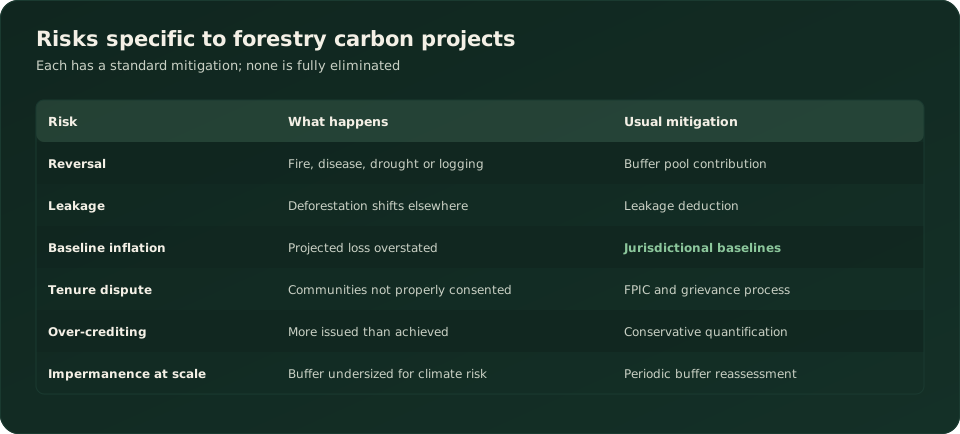
Jurisdictional baselines are the structural response. Rather than crediting against a project-specific projection, the baseline is set for a whole state or country. This removes much of the discretion and, importantly, addresses leakage — because deforestation displaced from one part of the jurisdiction to another is captured within the accounting boundary rather than escaping it.
ART TREES works this way, and the shift toward jurisdictional accounting is the most significant methodological development in forest carbon.
Leakage
If a project prevents logging in one area and the logging simply moves next door, the atmosphere sees no benefit.
Project-level crediting handles this with a leakage deduction — an estimated percentage subtracted from the credited volume. The estimate is exactly that, and its accuracy is difficult to establish.
Jurisdictional approaches handle it structurally by widening the boundary. This is the strongest argument for the jurisdictional shift, and it is worth understanding when comparing a project-level REDD+ credit against a jurisdictional one — they are not equivalent products.
Permanence and Buffer Pools
Carbon in a tree can be released. Fire, drought, disease, illegal logging, a change of ownership or a change of government policy can all reverse a reduction that was credited as permanent.
The standard mechanism is a buffer pool: a percentage of every issuance is held back in a shared reserve. If a project suffers a reversal, credits are cancelled from the buffer to compensate.
Three questions worth asking about any buffer:
What percentage is contributed, and how was it determined? Risk-based assessment produces a project-specific figure; a flat rate does not distinguish a fire-prone eucalyptus plantation from a protected wetland.
When was the sizing last reassessed? Buffers sized against historic fire risk may be inadequate against current climate-driven risk. Losses in fire-prone regions have accumulated faster than historic rates implied.
Is the buffer pooled across projects? Usually yes, which spreads risk but also means a correlated event — a regional fire season — draws on the same pool from many projects at once.
Buffer adequacy is a live methodological question, not a settled one. A buyer should treat it as a risk to assess rather than as a solved problem.
Land Tenure — The Most Common Safeguards Failure
Forest carbon projects sit on land that people use, and the most frequent serious failure in this category is not carbon accounting at all.
Agreement from a government or a large landholder is not the same as consent from the communities actually using the land. Projects have been disrupted, suspended and publicly criticised where communities discovered a carbon project had been established over land they depend on, without meaningful consultation.
What to check:
- Is tenure clear and documented, including customary rights?
- Was free, prior and informed consent obtained from affected communities, evidenced rather than asserted?
- Is there a functioning grievance mechanism, and has it been used?
- How are benefits shared, and is that arrangement documented and honoured?
- Are there public disputes about this project?
That last check costs nothing and is frequently informative. Contested projects are usually documented publicly before the dispute reaches the registry.
What to Check Before Buying
| Risk | What to ask |
|---|---|
| Reversal | Buffer percentage, sizing basis, last reassessment |
| Leakage | Project-level deduction or jurisdictional boundary |
| Baseline | How set, when revised, project or jurisdictional |
| Tenure | Documented rights, FPIC evidence, grievance mechanism |
| Over-crediting | Whether quantification is conservative |
| Monitoring | Remote sensing frequency and ground verification |
| Methodology version | Current, or registered under an older revision |
Monitoring Forest Carbon
How a forest project measures what it claims has improved substantially, and the approach used is a reasonable proxy for project quality.
Remote sensing is the backbone. Satellite imagery at increasing resolution and frequency allows forest cover change to be detected without a site visit, and historic imagery allows baselines to be checked against what actually happened rather than against what was projected. This is also what allows independent researchers to scrutinise projects, which is why the criticism of this category has been better evidenced than in others.
Ground plots calibrate the remote data. Satellite imagery shows cover, not carbon stock; measured plots convert one to the other for the specific forest type.
Allometric equations relate measurable tree dimensions to biomass and therefore carbon. They are species and region specific, and using an equation developed for a different forest type introduces error that is easy to miss.
LiDAR, where available, gives canopy structure and biomass estimates far more precisely than optical imagery, at higher cost.
Questions worth asking: how often is remote sensing updated, how many ground plots and how were they located, which allometric equations and were they developed for this forest type, and is the monitoring data available to the verifier in raw form rather than as a summary.
A project relying on infrequent imagery and few plots is not necessarily wrong. It is less checkable, and less checkable should mean a larger discount.
For Developers in India
India has substantial afforestation and forest management potential, and several structural considerations shape whether a project is viable.
Land tenure is complex, with overlapping statutory, customary and community forest rights. Establishing clear consent is genuinely difficult and genuinely necessary, and it is the step most likely to derail a project later if handled superficially.
Additionality requires care where afforestation is already occurring under government programmes. A project claiming credit for planting that would have happened anyway will not survive scrutiny.
Timelines are long. Forest carbon projects run over decades, with crediting periods to match. This is not a category where a developer should expect early revenue.
Host-State authorisation remains the gate for any international sale, including CORSIA. Establish the position before committing to a methodology — see corresponding adjustments.
Reading Criticism of a Project
Forest carbon attracts more public scrutiny than any other category, and a buyer needs to read that coverage without either dismissing it or over-reacting.
Distinguish methodology criticism from project criticism. An article finding that a class of baselines was inflated is a reason to check how your specific project set its baseline. It is not automatically a finding about that project.
Check the date and the methodology version. Much published criticism concerns projects registered under methodology versions since revised. A project registered under a current version has been designed against tighter rules.
Look for the project's response. Standards and developers respond to criticism publicly. A substantive response engaging with the analysis is informative; silence or a purely reputational response is also informative.
Weigh independent analysis over both. Peer-reviewed work and independent ratings carry more weight than either journalism or developer response, and where several independent sources converge that convergence matters.
Separate the carbon question from the community question. A project can have sound carbon accounting and a serious tenure problem, or the reverse. They are different risks with different consequences, and a single verdict on a project usually conflates them.
The practical use of all this: criticism should change your discount rate, not your binary decision. A well-documented project in a criticised category is a different proposition from a poorly documented one, and treating the category as uniformly disqualified discards the projects that responded to the criticism.
Frequently Asked Questions
What is REDD+? Reducing Emissions from Deforestation and forest Degradation, plus conservation, sustainable management and enhancement of forest carbon stocks. It credits avoided forest loss.
What is the difference between REDD+ and afforestation credits? REDD+ avoids emissions from existing forest; afforestation removes CO2 by growing new forest. Avoidance and removal respectively.
Why have REDD+ credits been criticised? Primarily for baselines that projected deforestation above what materialised, producing more credits than the intervention justified.
What is a buffer pool? A reserve of credits held back from issuance to compensate for reversals such as fire or logging. Its adequacy is under active scrutiny.
Are jurisdictional baselines better? They reduce discretion in baseline setting and address leakage structurally. That is a genuine improvement, though they bring their own governance complexity.
Can forestry credits be used for CORSIA? Potentially, subject to the usual tests — approved programme, eligible vintage, and host-State corresponding adjustment.
What is the biggest risk for a buyer? Reputationally, land tenure disputes. Environmentally, over-crediting from an inflated baseline. Both are checkable before purchase.
Developing a carbon project, or assessing one before you buy? DSTechnoverse provides CORSIA carbon credit services — eligibility screening, host-State authorisation assessment, methodology selection and buyer matching. We are based in Indore, Madhya Pradesh and work across India and internationally.
Apply as a CORSIA buyer or seller
Talk to our carbon markets team, or start with the complete carbon credits guide.