The carbon-credit scandals of recent years almost all trace back to one failure: buyers judged credits on price and project story rather than on whether the reduction was actually real. For an airline meeting a compliance duty — or a company making a public claim — that is an avoidable risk. Offset quality can be assessed methodically. Here is how.
Why Quality Varies So Much
A carbon credit is a promise: that one tonne of CO2 was reduced or removed because of the finance the credit represents. Whether that promise holds depends on judgement calls made when the project was designed — about what would have happened anyway, how long the carbon stays out of the atmosphere, and who else might claim the same tonne. Because those judgements vary in rigour, two credits with identical face value can differ enormously in real climate value. Quality is a property of the project's assumptions, not its marketing.
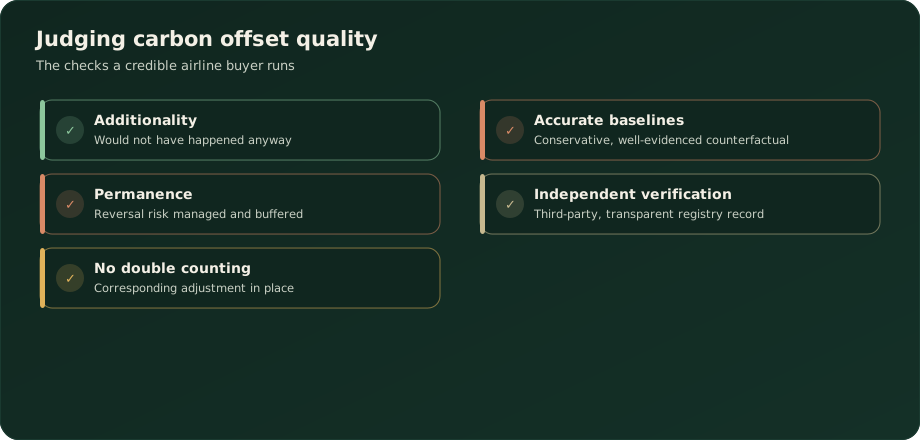
The Five Questions That Decide Quality
1. Additionality — would it have happened anyway?
The most important and most abused test. A credit is only additional if the reduction depended on carbon finance. A wind farm that was already the cheapest option, or a forest that was never going to be cleared, produces credits that represent no extra reduction. Ask what the credible counterfactual is and why revenue from credits changed the outcome.
2. Baseline — is the counterfactual honest?
Every credit is measured against a baseline of "what would otherwise have happened". Inflate that baseline and you manufacture phantom reductions. Look for conservative, well-evidenced baselines — especially in avoided-deforestation projects, where baseline setting has been the central controversy.
3. Permanence — will the carbon stay put?
A tonne stored in a forest that later burns has not been reduced. Removal and nature-based credits should have mechanisms for reversal risk — buffer pools, monitoring, and long crediting commitments. Engineered removals tend to score better on permanence but cost more.
4. Double counting — is it claimed only once?
If both the project's host country and the buyer count the same reduction, the tonne is counted twice and global accounting is wrong. This is exactly what corresponding adjustments fix, and why they are mandatory for CORSIA's first phase — see eligible emissions units. For voluntary buyers the adjustment is often optional, which makes double counting a live risk you must check.
5. Leakage and safeguards — no harm elsewhere?
A protected forest that simply pushes logging to the next valley has "leaked" its emissions. Good projects measure leakage and respect social and environmental safeguards, including the rights of local communities.
Frameworks That Do Some of the Work
You do not have to invent your own standard. Two references help:
The ICVCM Core Carbon Principles define what a high-integrity credit should look like and are used to label programmes and methodologies that qualify.
CORSIA's own eligibility criteria encode a similar bar for compliance use, with the added corresponding-adjustment requirement. If a credit is CORSIA-eligible for the first phase, it has already cleared several of these hurdles — which is one reason those units are treated as a higher-integrity segment.
Red Flags Checklist
Walk away, or dig much deeper, when you see:
- Baselines that assume aggressive business-as-usual emissions.
- Old vintages sold cheaply with little recent monitoring.
- No corresponding adjustment where the claim implies one is needed.
- Avoided-deforestation projects with opaque or self-serving baselines.
- Prices far below the credible market for that project type — cheapness is often the tell.
- Registries or programmes you cannot independently verify.
A Practical Process
For a real purchase, run a simple pipeline: confirm the programme and methodology, check the eligibility or integrity label (CORSIA, ICVCM), read the project documentation for additionality and baseline logic, confirm the corresponding-adjustment status, verify the registry record and vintage, and keep the evidence. It is the same discipline a verifier applies — and the same one that separates airlines that buy defensible credits from those that buy problems. The mechanics of actually retiring the units then follow the airline compliance workflow.
Frequently Asked Questions
What makes a carbon credit "high quality"? Real, additional and conservatively measured reductions that are permanent (or reversal-managed), independently verified, counted only once, and free of leakage or social harm.
What is additionality? The requirement that the reduction only happened because of carbon finance — if it would have occurred anyway, the credit is not additional.
How do I avoid double counting? Check for a corresponding adjustment (mandatory for CORSIA's first phase) and confirm no other party claims the same reduction.
Are nature-based credits lower quality? Not inherently, but they carry permanence and baseline risks that require careful buffers and conservative assumptions.
Do CORSIA-eligible credits pass these tests? They clear several of them by design, including the double-counting test via corresponding adjustments, which is why they sit in the higher-integrity segment.
Working on aviation emissions, CORSIA compliance or carbon credit due diligence? DSTechnoverse handles the data side of carbon and environmental compliance — monitoring design, emissions reconciliation, verification support and defensible reporting. See our CORSIA carbon credit services and data analytics. We are based in Indore, Madhya Pradesh and work across India and internationally.
Apply as a CORSIA buyer or seller
Talk to our team, or start with the complete carbon credits guide.