Grid-connected renewable energy was once the largest category in carbon crediting. It is now the hardest to credit credibly, and the reason is entirely good news for the climate: renewables got cheap.
The Additionality Problem
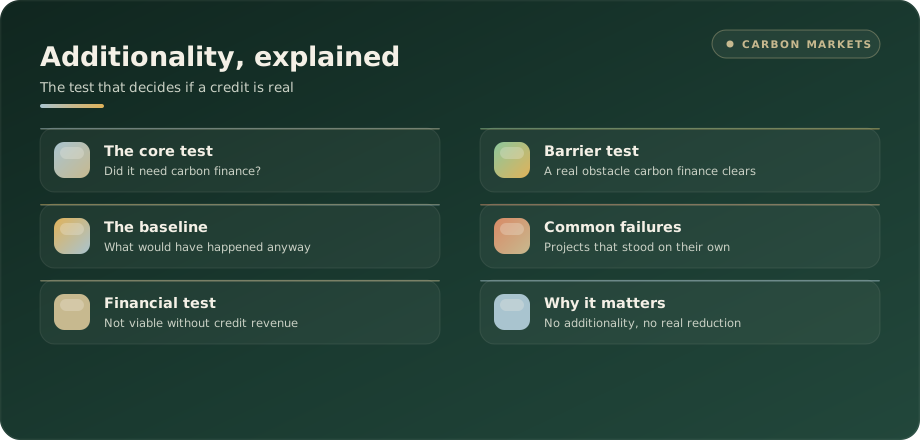
Additionality requires demonstrating that the project needed carbon revenue to proceed.
In 2010, a utility-scale solar farm in most markets did not compete with fossil generation on cost. Carbon revenue plausibly made the difference between built and not built, and the additionality argument was straightforward.
By the mid-2020s, solar and wind are frequently the least-cost generation option in the same markets. A project that would be built anyway on commercial grounds cannot claim that carbon revenue was decisive.
The consequence has been methodological rather than rhetorical. Standards have narrowed or retired methodologies for grid-connected renewables in markets where they are commercially viable, and several have restricted eligibility to specific country contexts or to projects facing documented barriers.
This is the market working as intended. Additionality is supposed to become harder to demonstrate as a technology becomes commercially normal.
Where Renewables Still Credit Credibly
The category is narrowed, not eliminated. Four contexts where the argument still holds:
Least developed country contexts, where financing costs, grid reliability and off-take risk mean renewables are not automatically the cheapest option despite falling equipment costs.
Genuinely early-stage technologies at a deployment stage where cost has not yet fallen — the position solar occupied fifteen years ago.
Projects facing documented barriers — regulatory, financing or grid access constraints that a specific project can evidence rather than assert generically.
Off-grid and distributed applications, where the counterfactual is not grid electricity at all but kerosene, diesel or no energy access. This is a genuinely different proposition and is discussed below.
The common thread: the argument has to be specific to the project's circumstances, not to renewables in general.
Off-Grid Is a Different Proposition
Solar lamps, solar home systems and mini-grids sit in a different analytical position from utility-scale generation, and it is worth separating them.
The counterfactual is different. A household using a solar lamp was previously using kerosene, candles or nothing. The displaced emission is kerosene combustion, not grid electricity, and kerosene lighting is both expensive per unit of light and locally polluting.
Commercial viability is genuinely constrained. Households at the relevant income level frequently cannot pay the upfront cost even where lifetime economics are favourable. Carbon finance closes a real gap.
The co-benefits are substantial — household air quality, safety, study hours, and displaced fuel expenditure.
But the same measurement problems appear as in cookstoves: distribution is not usage. A lamp distributed and not used, broken and not repaired, or resold produces no reduction. Credible projects measure usage rather than assuming it — see digital MRV.
The Grid Emission Factor
For grid-connected projects, the credited quantity depends on the grid emission factor — the emissions per unit of electricity the project displaces.
Two subtleties that materially affect the answer:
Operating margin versus build margin. The operating margin reflects what generation is displaced right now; the build margin reflects what new capacity is avoided over time. Methodologies typically combine them, and the weighting matters.
Grids decarbonise. As a grid's own generation mix cleans up, the emission factor falls, and a project displacing that grid displaces less. A crediting period spanning a decade of grid decarbonisation should reflect that, and methodologies increasingly require periodic revision rather than a fixed factor.
For a buyer, this means checking whether the emission factor used is current. A project crediting against a decade-old factor in a rapidly decarbonising grid is over-crediting relative to what it actually displaces.
Assessing a Renewable Project
| Question | What a good answer looks like |
|---|---|
| Is the methodology current? | Not registered under a revision since narrowed |
| What is the additionality argument? | Project-specific barriers, evidenced |
| Is it grid-connected or off-grid? | Different counterfactuals, assess accordingly |
| Which grid emission factor, from when? | Current, with a revision mechanism |
| What is the country context? | Renewables least-cost, or genuinely constrained |
| For off-grid, how is usage measured? | Sensor or verified sampling, not distribution counts |
| Was the investment analysis independently reviewed? | Yes, with the counterfactual stated |
The screening question for a buyer: would this project have been built without carbon revenue? If the honest answer is probably yes, the credit is weak regardless of how well documented it is.
What Replaced Renewables in the Market
As grid renewables narrowed, credit supply shifted toward categories where the additionality argument holds better. Understanding that shift helps a buyer read the current market.
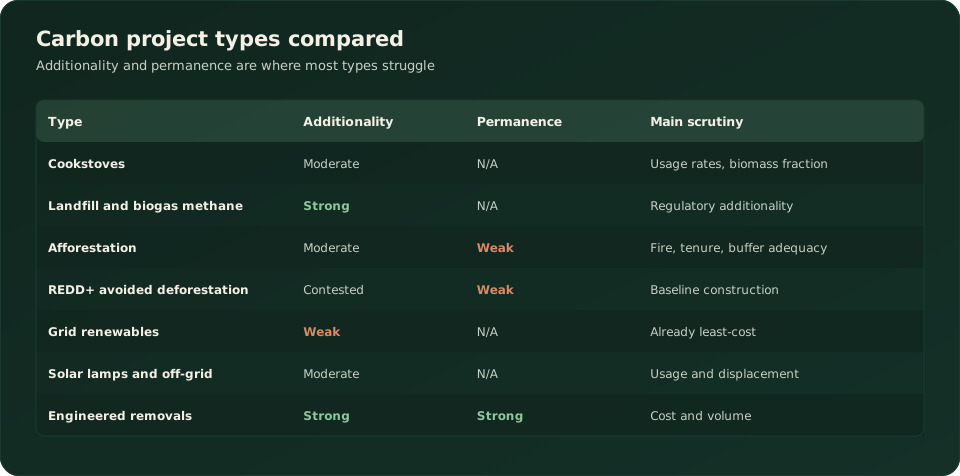
Methane avoidance — landfill gas, wastewater treatment, biogas, coal mine methane — has strengthened. The counterfactual is usually venting rather than a commercially attractive alternative, which makes additionality comparatively clean. Permanence is not an issue because avoided emissions do not reverse. The main test is regulatory additionality: whether capture was already legally required.
Engineered removals — direct air capture, biochar, enhanced weathering, bioenergy with carbon capture — have grown from a very small base. Additionality is rarely questioned because nobody does these without carbon revenue, and permanence is strong for geological storage. The constraints are cost and volume.
Waste and industrial gas destruction occupies a middle position, with additionality generally clean but methodology availability narrower after historic abuses in the category.
Household energy — cookstoves, solar lamps, water treatment — remains large by volume and carries the measurement difficulties discussed elsewhere in this cluster.
For a buyer, the practical implication: the categories with the cleanest additionality arguments are generally not the cheapest. A portfolio weighted toward the lowest price will be weighted toward the categories under most scrutiny, which is the opposite of what most buyers intend.
The Indian Context
India is the clearest illustration of why this category narrowed.
Utility-scale solar and wind are now among the cheapest generation available, supported by a mature auction mechanism and substantial deployment. A grid-connected solar project claiming that carbon revenue was decisive faces a difficult argument in that environment, and buyers should expect to see it made carefully rather than assumed.
Where Indian renewable crediting remains more defensible:
Off-grid and distributed applications in areas with limited grid reliability. Applications where the counterfactual is diesel generation rather than grid supply. Projects facing documented financing or land constraints that a comparable commercial project would not overcome.
Where it is difficult: a standard utility-scale solar farm in a state with an established auction pipeline. Approach with realistic expectations rather than assuming that past methodology availability transfers.
The Lesson for Other Categories
The renewable energy story is worth generalising, because the same trajectory will affect other categories.
Additionality erodes as a technology becomes commercially normal. This is not a flaw in the system — it is the system working. A methodology that credits a technology indefinitely, regardless of whether it needs support, is crediting business as usual.
The erosion is gradual and geographically uneven. Renewables became least-cost in different markets at different times, which is why methodologies narrowed by country context rather than being withdrawn globally.
Developers who plan on a decade-long crediting period should assume tightening. A methodology available today may be revised or restricted before a crediting period ends. Building a financial model that assumes today's rules hold for fifteen years is optimistic.
Buyers should treat older vintages in maturing categories with more caution, because they were credited under assumptions that have since been reconsidered.
Categories where this dynamic is worth watching: battery storage, electric vehicles, and efficiency measures in sectors where the technology is on a steep cost curve. Each is credible today in specific contexts and each will face the same question renewables faced as costs fall.
The practical instruction for a developer is to ask not only whether a methodology exists now, but whether the underlying additionality argument will still hold in year eight of the crediting period.
Frequently Asked Questions
Can solar projects still generate carbon credits? Some can, but grid-connected utility-scale solar in markets where it is least-cost faces a hard additionality test. Several methodologies have been narrowed or retired.
Why did renewable energy credits fall out of favour? Because renewables became commercially competitive, which undermines the claim that carbon revenue was necessary. This is the mechanism working correctly.
Are off-grid solar projects different? Yes, materially. The counterfactual is kerosene or no access rather than grid electricity, and commercial viability is genuinely constrained at the relevant income levels.
What is a grid emission factor? The emissions per unit of electricity a project displaces. It falls as a grid decarbonises, which reduces what a project can credibly claim over a long crediting period.
Can renewable credits be used for CORSIA? Subject to the usual tests. The practical constraint is more often methodology availability and additionality than the CORSIA criteria specifically.
Should I buy renewable energy credits? For voluntary claims, be prepared to defend the additionality argument. Many buyers now exclude the category or restrict it to off-grid and least-developed-country contexts.
What about renewable energy certificates? RECs and Guarantees of Origin certify the attributes of generated energy. They are not carbon credits and cannot be retired against an emissions obligation.
Developing a carbon project, or assessing one before you buy? DSTechnoverse provides CORSIA carbon credit services — eligibility screening, host-State authorisation assessment, methodology selection and buyer matching. We are based in Indore, Madhya Pradesh and work across India and internationally.
Apply as a CORSIA buyer or seller
Talk to our carbon markets team, or start with the complete carbon credits guide.