People talk about "the carbon market" as though it were one thing. It is at least two, and confusing them is why buyers end up with credits they cannot use for the purpose they bought them for.
The Core Distinction
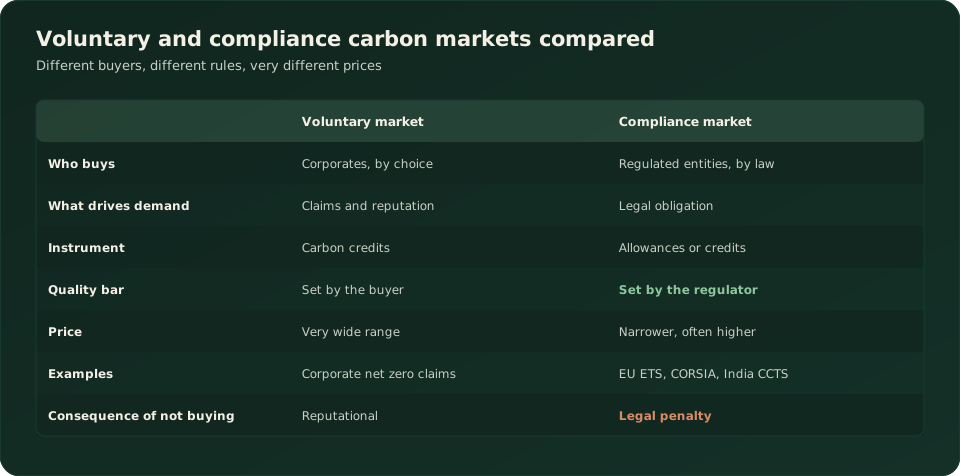
| Voluntary market | Compliance market | |
|---|---|---|
| Who buys | Corporates, by choice | Regulated entities, by law |
| What drives demand | Claims, reputation, investor pressure | Legal obligation |
| Instrument | Carbon credits | Allowances, or credits within defined rules |
| Quality bar | Set by the buyer | Set by the regulator |
| Price | Very wide range | Narrower, generally higher |
| Consequence of not buying | Reputational | Legal penalty |
| Examples | Corporate net zero claims | EU ETS, CORSIA, India's CCTS |
The operative difference is who sets the quality bar. In the voluntary market a buyer decides what it will accept, which produces enormous variation in both standards and prices. In a compliance market the regulator decides, and no amount of buyer preference changes it.
Why a Credit Can Be Valid in One and Useless in the Other
This is the practical consequence people run into.
Compliance eligibility is a strict subset of what exists. A credit accepted enthusiastically by a corporate voluntary buyer may fail a compliance test on any of several grounds:
- The issuing programme is not approved by the relevant regulator
- The vintage falls outside an eligible window
- No host-State corresponding adjustment has been applied
- The methodology is excluded under a conditional approval
The reverse rarely happens. A compliance-eligible unit will almost always satisfy a voluntary buyer — and increasingly commands a premium there too, for reasons below.
The practical rule: buy for the stricter of the two purposes if you might need either. Buying for voluntary use and later discovering you need compliance-grade units is an expensive discovery.
Inside the Compliance World
Compliance markets are not uniform either. Three structures, frequently conflated:
Cap-and-trade systems set a quantity limit and issue allowances within it. The EU ETS is the largest. Allowances are permits to emit, not credits representing reductions elsewhere. Most such systems restrict or exclude offset credits entirely.
Baseline-and-credit systems set an intensity benchmark and credit those who beat it. India's Carbon Credit Trading Scheme is structured this way for obligated entities.
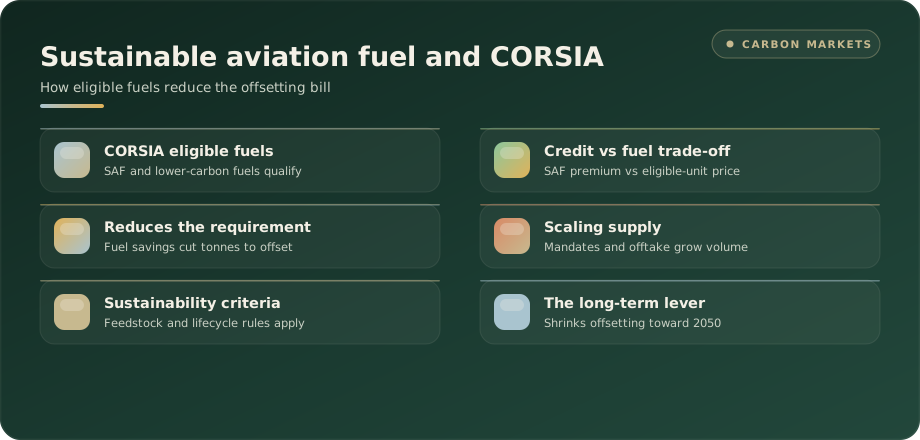
Offsetting mechanisms require the purchase and cancellation of credits against an obligation. CORSIA is the clearest example — it does not cap aviation emissions; it requires growth above a baseline to be offset.
The instrument differs in each, and so does what "compliance" actually requires of you.
Why Voluntary Prices Vary So Much
Published voluntary market averages are close to useless, because they blend fundamentally different products.
A 2014-vintage renewable energy credit with contested additionality and a verified engineered removal are both "carbon credits". They serve different purposes, satisfy different claims and price accordingly. Averaging them describes nothing you can buy.
What actually differentiates price:
| Factor | Effect |
|---|---|
| Project type | Removals highest, renewables lowest |
| Vintage | Recent generally preferred |
| Co-benefits | SDG-linked projects command more |
| Standard | Some carry a reputational premium |
| Corresponding adjustment | Substantial premium where present |
| Volume | Discounts, limited by illiquidity |
See carbon credit prices explained.
The Boundary Is Blurring
The most interesting development in this market is that the distinction is eroding from the voluntary side.
Corporate buyers have faced sustained criticism over the integrity of their claims, particularly on double counting. A corresponding-adjusted unit is the strongest available answer, because it means the host country has given up the reduction in its own accounting.
So a growing set of voluntary buyers now demand what was previously a compliance-only feature — and will pay for it, with no regulatory obligation at all.
Two consequences follow:
For sellers, the market for adjusted supply is wider than the compliance market alone, which supports pricing on both sides.
For compliance buyers, you are competing with corporate demand for the same scarce adjusted pool. This is routinely omitted from supply forecasts and it matters — see carbon credit supply and demand.
How the Two Markets Behave Differently
Beyond the rules, the markets have different mechanics, and a buyer moving between them finds the experience genuinely different.
Liquidity. Cap-and-trade allowance markets are exchange-traded with continuous public pricing and a visible forward curve. The voluntary market is largely bilateral. The corresponding-adjusted segment is thinner still — transactions are negotiated individually and there is no reliable public reference price.
Price discovery. In a liquid market you look up the price. In a bilateral one you talk to several sellers and work out what the documentation actually supports. That cost is real and it is why first-time buyers frequently overpay or, worse, buy cheaply and acquire risk they have not priced.
Standardisation. Allowances are fungible — one is identical to another. Credits are not, and cannot be made so without discarding the information a careful buyer needs.
Counterparty risk. Exchange-traded markets clear centrally. Bilateral credit transactions leave you exposed to the seller, which is why payment structure and security matter far more here.
Settlement. Allowance surrender is an administrative step in a regulated register. Credit retirement involves registry accounts you had to open, transfers that take days, and a purpose designation that is irreversible if wrong.
The practical consequence for anyone facing both: do not staff and budget them the same way. An ETS position can be managed by treasury against a screen price. A credit purchase is a procurement exercise with a due diligence workstream attached.
Which Market Are You Actually In?
A short diagnostic:
Do you have a legal obligation to offset? If yes, you are a compliance buyer and the regulator's rules bind you regardless of preference.
Are you making a public claim? Then voluntary market rules apply but reputational risk is real, and the integrity questions increasingly resemble compliance ones.
Are you doing both? Common for airlines with a CORSIA obligation and a corporate net zero commitment. Keep them separate. Units cancelled for CORSIA discharge a legal obligation; claiming them again as a voluntary achievement is a double claim of a different kind, and disclosure regulators are alert to it.
Are you a developer? Design for compliance eligibility where the host State makes it possible, and retain the option to sell voluntarily. That hedge costs little at design stage and is hard to retrofit.
Where the Markets Are Heading
Three developments are worth tracking, because each shifts the boundary between the two markets.
Article 6 is maturing. As more governments establish designated national authorities and authorisation processes, the pool of corresponding-adjusted supply should grow. How fast is the open question, and it depends on dozens of separate sovereign decisions rather than on any single policy.
Integrity initiatives are converging. Independent efforts on the supply side and on the claims side have pushed the voluntary market toward criteria that look increasingly like compliance criteria. The practical effect is that the quality gap between a good voluntary credit and a compliance-eligible one is narrowing on everything except the corresponding adjustment.
Disclosure regulation is tightening. Sustainability reporting standards increasingly require credits to be disclosed with their type, standard and quality attributes rather than as a single number. That transparency changes buyer behaviour, because a low-quality purchase becomes visible rather than aggregated away.
The direction of travel is toward a market where the voluntary and compliance segments are distinguished mainly by who is obliged to buy, rather than by what quality is acceptable. For a buyer today, the planning implication is straightforward: buying to the stricter standard is increasingly the low-regret choice, because the gap it costs you now is the gap that is closing anyway.
Frequently Asked Questions
What is the difference between voluntary and compliance carbon markets? Voluntary buyers choose to purchase and set their own quality bar; compliance buyers must purchase under law, and the regulator sets the bar.
Is one market larger? Compliance markets are far larger by value, driven by cap-and-trade allowance systems. The voluntary market is smaller and more varied.
Can I use a voluntary credit for compliance? Only if it independently meets the compliance rules — programme approval, vintage and, for CORSIA, a corresponding adjustment. Most do not.
Why are compliance credits more expensive? Scarcity created by the eligibility requirements, particularly host-State authorisation.
Is the voluntary market unregulated? Not formally, but it is increasingly shaped by standard-setters, ratings agencies, disclosure frameworks and consumer protection regulators policing claims.
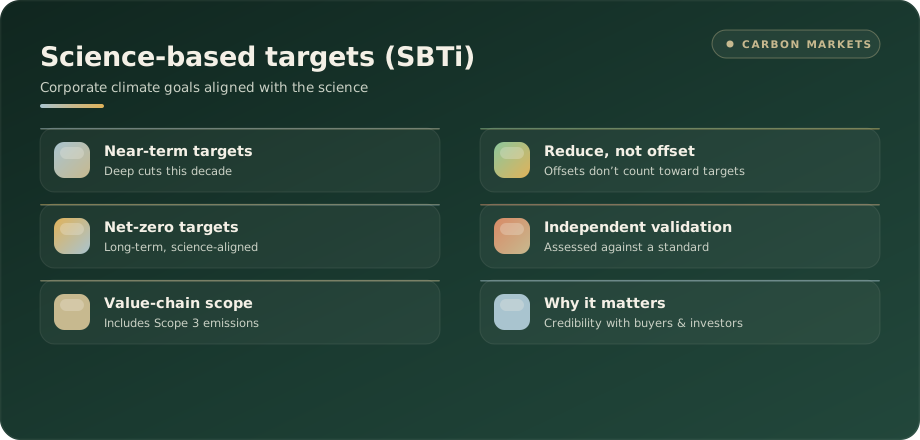
Should a company buy voluntary credits at all? Only alongside genuine reductions, never as a substitute. Most credible frameworks, including SBTi, are explicit that credits cannot replace required reductions.
Do the two markets ever trade with each other? Indirectly. A project can issue units that go to either market, and adjusted supply is increasingly contested by both compliance and voluntary buyers.
What is India's compliance market? The Carbon Credit Trading Scheme under the Energy Conservation Act framework, alongside CORSIA for international aviation.
Working out what to buy and what it should cost? DSTechnoverse provides CORSIA carbon credit services — requirement modelling, supply sourcing, pre-transaction due diligence and registry execution. We are based in Indore, Madhya Pradesh and work across India and internationally.
Apply as a CORSIA buyer or seller
Talk to our carbon markets team, or start with the complete carbon credits guide.