"How much does a carbon credit cost?" is the most common question buyers ask, and the honest answer frustrates them: it depends — and the range is enormous. The same one tonne of CO2 can cost a couple of dollars or well over a hundred, and the difference is not a discount you have found; it is a signal about what you are actually buying.
Why There Is No Single Price
A carbon credit is not a commodity like gold, where a tonne is a tonne. Each credit is a claim about a specific reduction, made by a specific project, under a specific standard, in a specific year. Those variables move the price far more than any market average. So a headline "carbon price" is close to meaningless for a buyer; what matters is what drives your credit's price.
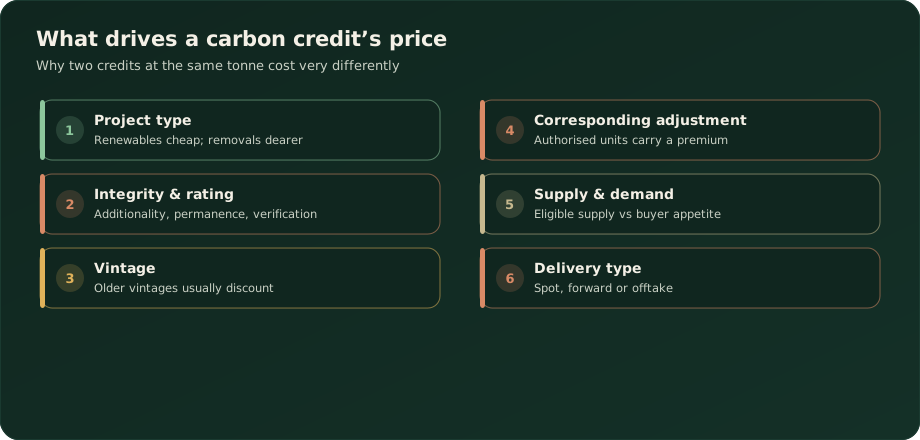
The Six Things That Set the Price
1. Project type
This is the single biggest driver. As a rough map:
| Project type | Typical position | Why |
|---|---|---|
| Grid renewables (solar, wind) | Lowest | Large supply, weak additionality |
| Cookstoves / clean cooking | Low–mid | Volume, but usage scrutiny |
| Forestry (REDD+, IFM) | Mid | Real story, permanence and baseline risk |
| Afforestation / reforestation (ARR) | Mid–high | A removal, not just avoidance |
| Engineered removals | Highest | Durable removal, scarce supply |
The pattern is simple: avoidance is cheap, durable removal is expensive, and quality sits in between.
2. Integrity and rating
Two credits of the same type can price very differently on integrity — additionality, a conservative baseline, permanence and independent verification. Independent ratings now exist precisely because buyers will pay more for a credit that survives scrutiny. Cheapness, in this market, is frequently the tell of low integrity rather than a bargain.
3. Vintage
The vintage is the year the reduction occurred. Older vintages usually trade at a discount because buyers and schemes prefer recent reductions, and some uses restrict how old a vintage can be. A very cheap credit is often simply a very old one.
4. Corresponding adjustment and authorisation
A unit that carries a host-country Letter of Authorisation and a corresponding adjustment under Article 6 commands a clear premium, because it can be used for compliance (such as CORSIA) and cannot be double-counted. An otherwise identical unit without that authorisation is cheaper — and unusable for those purposes. We cover this in CORSIA eligible emissions units.
5. Supply and demand
Within each segment, ordinary market forces apply. When eligibility rules tightened the pool of qualifying units, high-integrity, adjusted credits re-priced upward against generic voluntary supply. Scarcity of the good stuff, not total supply, moves serious prices.
6. Delivery type
Finally, how you buy affects price. A spot purchase of issued, ready credits differs from a forward contract for future delivery or an offtake agreement over a project's output. Forward and offtake structures can lower the unit price in exchange for taking on delivery risk.
How to Read a Price
A useful mental test: if a credit looks unusually cheap for its type, ask why. Nine times out of ten the answer is one of the above — an old vintage, no corresponding adjustment, a weak-additionality renewable, or thin verification. A fair price is one that matches the credit's type, vintage, integrity and authorisation. A suspiciously low one is usually a credit you would not want to stand behind.
What This Means for Buyers
Do not shop on headline price. Decide first what the credits are for — a voluntary claim, a compliance obligation, an ESG report — because that dictates the integrity and authorisation you need, and therefore the price band you should be in. Then compare within that band. Paying more for a credit that survives an audit is almost always cheaper than paying less for one that does not. For the full quality checklist, see how to evaluate carbon offset quality.
Frequently Asked Questions
How much does a carbon credit cost? Anywhere from a couple of dollars to well over a hundred per tonne, depending mainly on project type, integrity, vintage and whether it carries a corresponding adjustment.
Why are some carbon credits so cheap? Usually low additionality (grid renewables), an old vintage, or the absence of a corresponding adjustment — cheapness often reflects lower quality rather than a deal.
Are removal credits more expensive than avoidance credits? Yes. Durable removals — engineered removals and, to a degree, ARR — cost more than avoidance credits because they physically draw down carbon and are scarcer.
What is a fair price for a carbon credit? One that matches the credit's type, vintage, integrity and authorisation status. Compare within a segment, not across the whole market.
Do carbon credit prices change over time? Yes — they move with supply, demand, integrity scrutiny and policy. High-integrity, authorised credits have generally firmed as demand has grown.
Buying, selling or evaluating carbon credits? DSTechnoverse works on the data and integrity side of carbon procurement — project screening, registry and eligibility verification, MRV and monitoring-data analysis, reconciliation and defensible reporting. See our CORSIA carbon credit services and data analytics. We are based in Indore, Madhya Pradesh and work across India and internationally.
Apply as a carbon credit buyer or seller
Talk to our team, or start with the complete carbon credits guide.