Speed has a carbon price, and nowhere is it steeper than in air freight. Moving a tonne of goods by air can emit many times what the same journey by sea would — and increasingly, the companies whose goods are flying, not just the airlines, are being asked to account for it. If your supply chain uses air cargo, these emissions are partly yours.
Whose Emissions Are They?
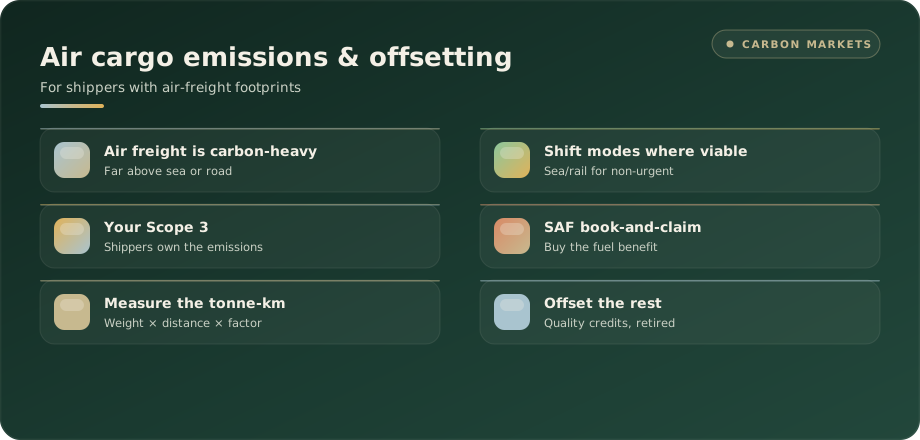
This is the point shippers often miss. The airline owns the flight, but the shipper owns the demand — and under greenhouse-gas accounting, the emissions from freighting your goods fall into your Scope 3. A retailer air-freighting stock, a manufacturer expediting components, an e-commerce firm promising next-day delivery — all carry the carbon of that choice in their value-chain footprint. Customers and regulators are starting to ask about it.
Why Air Freight Is So Carbon-Intensive
The comparison is stark:
| Mode | Relative carbon per tonne-km |
|---|---|
| Sea freight | Lowest |
| Rail | Low |
| Road | Moderate |
| Air freight | Highest by far |
Air's intensity is why a small share of freight moved by air can dominate a logistics footprint. That also makes it a high-leverage place to act.
Step 1: Measure the Tonne-Kilometres
Freight emissions are driven by weight × distance, converted with an emission factor for air transport. Capturing shipment weight and route data across your air-freight activity gives you a defensible number to manage — the freight equivalent of measuring a flight's footprint.
Step 2: Shift Modes Where You Can
The single biggest reduction is often to move less by air. Not everything needs to fly. Reviewing which shipments genuinely require air speed — and shifting the rest to sea or rail — can cut the freight footprint dramatically, usually while saving money too.
Step 3: Buy the Fuel Benefit (SAF Book-and-Claim)
For freight that must fly, sustainable aviation fuel via book-and-claim lets a shipper pay for the emissions reduction of SAF used in the network, even though that specific fuel is not in your specific plane. It is a way to cut the actual aviation emission rather than only compensating for it — see SAF and CORSIA.
Step 4: Offset the Remainder
For the residual you cannot yet reduce, high-integrity carbon credits, retired in your name, close the gap — subject to the same quality checks as any purchase. As always, a smaller volume of credible credits beats a large volume of cheap ones.
Frequently Asked Questions
Are air cargo emissions the shipper's responsibility? Under greenhouse-gas accounting, the emissions from freighting your goods are part of your Scope 3 footprint, even though the airline operates the flight.
How much more carbon does air freight emit than sea? Far more per tonne-kilometre — air is the most carbon-intensive freight mode by a wide margin, which is why shifting modes has a big impact.
How do I measure air freight emissions? From shipment weight and distance (tonne-kilometres), converted with an air-transport emission factor.
What is SAF book-and-claim for freight? A mechanism to pay for the emissions benefit of sustainable aviation fuel used in the network, attributing the reduction to your shipments without the fuel being physically in your flight.
Can I offset air cargo emissions? Yes — after measuring and reducing, buy and retire high-integrity credits for the residual, with proper due diligence.
Buying carbon credits or measuring travel and freight emissions? DSTechnoverse works on the data and integrity side of carbon — footprint measurement, project screening, registry and eligibility verification, and defensible reporting. See our CORSIA carbon credit services and data analytics. We are based in Indore, Madhya Pradesh and work across India and internationally.
Apply as a carbon credit buyer or seller
Talk to our team, or start with the complete carbon credits guide.