For a lot of companies — consultancies, tech firms, anyone with a sales team on planes — business travel is the emissions line everyone can see. It shows up in ESG reports, in client questionnaires, and in employees' own expectations. Handling it well is less about buying offsets and more about doing four things in the right order.
Business Travel Is Scope 3
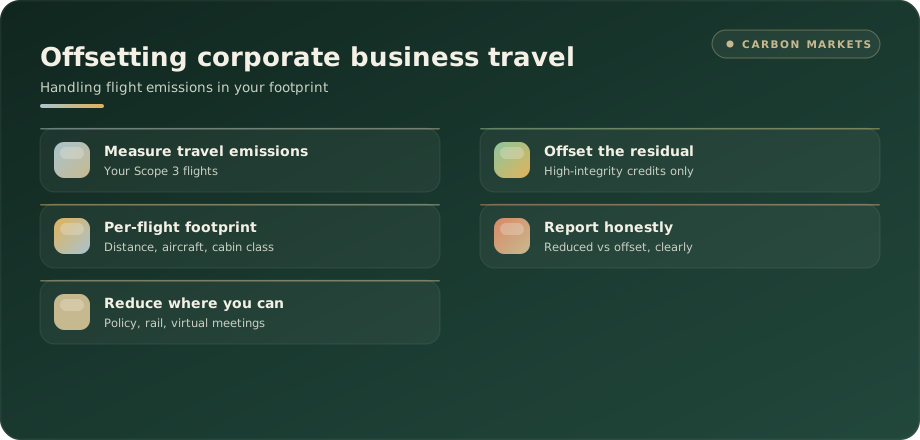
First, place it correctly. Flights your staff take are part of your Scope 3 emissions — the emissions of your value chain rather than your own buildings or vehicles. That matters because Scope 3 is where most companies' footprints actually sit, and where customers with science-based targets will increasingly ask you to act. You cannot manage travel emissions until you count them as yours.
Step 1: Measure
You cannot reduce or offset what you have not measured. Estimate the emissions of your travel from flight data — routes, distances, cabin class — expressed in CO2e. The footprint of a single flight depends on distance, the aircraft, how full it is and the cabin class, but even a reasonable estimate across your travel gives you a number to manage.
Step 2: Reduce Before You Offset
Reduction is cheaper and more credible than offsetting. The biggest levers for corporate travel:
- A travel policy that requires trips to be justified, not automatic.
- Virtual-first for meetings that do not need a room.
- Rail over short-haul where the route allows.
- Direct flights and economy — fewer legs and more passengers per tonne of fuel.
A visible reduction in trips does more for your footprint and your credibility than any volume of offsets, as covered in reducing business travel emissions.
Step 3: Offset the Residual — With Quality
For the travel you cannot avoid, buy high-integrity carbon credits. The temptation is to buy the cheapest available to make the number go away; that is exactly how companies end up with offsets that damage their reputation. A smaller volume of credible, well-rated credits — or increasingly, sustainable aviation fuel via book-and-claim — is worth far more than a pile of dubious ones. Use the offset-quality checks before you buy.
Step 4: Report Honestly
Finally, say exactly what you did: how much you reduced, how much you offset, and with which credits. Do not fold offsets into your emissions total as if you had cut them — that blurs the carbon neutral vs net zero line and invites scrutiny. An honest, specific report is a business asset; an inflated claim is a liability.
Frequently Asked Questions
Are business travel emissions Scope 1, 2 or 3? Scope 3 — they are part of your value-chain emissions, not your direct operations or purchased energy.
How do companies offset business travel? By measuring flight emissions, reducing where possible, then buying and retiring high-integrity carbon credits (or SAF via book-and-claim) for the residual.
Should we reduce travel or just offset it? Reduce first — it is cheaper and more credible; offset only the emissions you cannot avoid.
What is book-and-claim for sustainable aviation fuel? A way to pay for the emissions benefit of SAF used in the network without the fuel physically being in your specific flight.
How should we report travel offsets? Separately from reductions — state what was cut versus compensated, and with which credits, to avoid greenwashing claims.
Buying carbon credits or measuring travel and freight emissions? DSTechnoverse works on the data and integrity side of carbon — footprint measurement, project screening, registry and eligibility verification, and defensible reporting. See our CORSIA carbon credit services and data analytics. We are based in Indore, Madhya Pradesh and work across India and internationally.
Apply as a carbon credit buyer or seller
Talk to our team, or start with the complete carbon credits guide.