You have seen it at the end of a flight booking: a tick-box offering to "offset your flight" for a few dollars. Millions of travellers click it without knowing where the money goes or whether it does anything. This is how airline carbon offset programs actually work — and how to tell a real one from a feel-good gesture.
What a Passenger Offset Actually Is
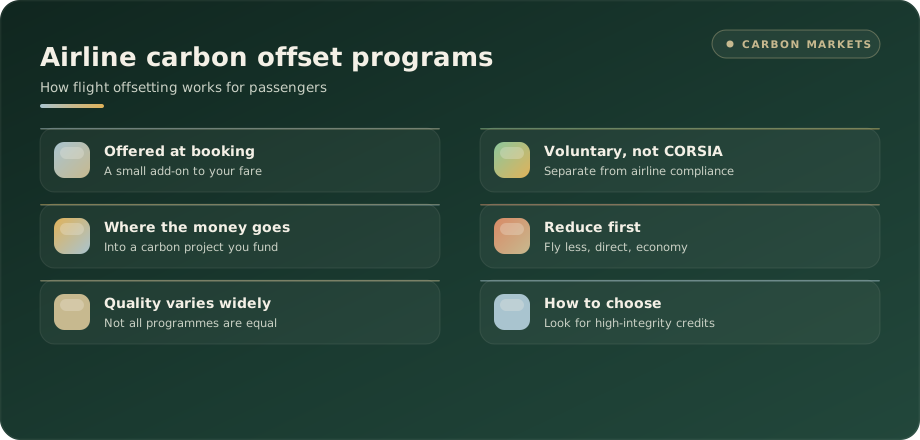
When you offset a flight at checkout, you are making a small voluntary purchase of carbon credits equal to the estimated emissions of your seat. The airline (or its partner) uses that money to buy and retire credits from a carbon project — a forest, a cookstove programme, a renewable installation. You are not making your flight cleaner; you are funding a reduction elsewhere to compensate for it. That is the honest description of every passenger offset, however it is marketed.
This Is Not CORSIA
A common confusion: passenger offsets are voluntary and completely separate from CORSIA, the compliance scheme that obligates airlines themselves to offset their emissions growth. CORSIA is the airline's legal obligation at the operator level; the checkout offset is your personal, optional purchase. The two do not overlap — buying a passenger offset does not contribute to the airline's CORSIA compliance, and vice versa. For the operator side, see how airlines use carbon credits under CORSIA.
Why Quality Varies So Much
Here is the uncomfortable part. Because these programmes are voluntary and buyers rarely check, the credits behind them range from excellent to close to worthless. Many older airline offset schemes leaned on cheap credits with weak additionality — the reductions might have happened anyway — which is exactly the pattern that drew greenwashing criticism. A $3 offset backed by a low-integrity credit is not equivalent to a $30 one backed by a durable removal.
How to Tell a Good Program From Greenwashing
If you want your offset to mean something, look for:
| Good sign | Red flag |
|---|---|
| Names the projects and standards | Vague "we plant trees" claims |
| Uses recognised registries (Verra, Gold Standard) | No traceable credit or registry |
| Mentions credit ratings or high-integrity criteria | Suspiciously cheap, no detail |
| Distinguishes reduction from offsetting | Implies the flight is "clean" |
The full checklist is in carbon credit greenwashing red flags.
The Honest Order of Operations
Offsetting a flight is better than doing nothing, but it is the last step, not the first. The bigger lever is flying less where you can, choosing direct routes (take-off and landing burn the most fuel), and travelling economy (more passengers per tonne of fuel). Offsetting should compensate the emissions you could not avoid — with a credit you would be comfortable explaining.
Frequently Asked Questions
Do airline carbon offsets actually work? They can, if the money buys high-integrity credits that are genuinely additional — but many programmes have used low-quality credits, so the effect varies widely.
Are flight offsets the same as CORSIA? No. Passenger offsets are voluntary and separate from CORSIA, which is the airline operator's own compliance obligation.
Where does my offset money go? Into buying and retiring carbon credits from a project such as forestry, clean cooking or renewables — the quality of which determines the real benefit.
Is it better to offset or fly less? Reducing flights has a bigger, more certain impact; offsetting is best for the emissions you cannot avoid, using credible credits.
How do I choose a good flight offset? Look for programmes that name their projects and standards, use recognised registries, and reference credit integrity — and be wary of very cheap, vague options.
Buying carbon credits or measuring travel and freight emissions? DSTechnoverse works on the data and integrity side of carbon — footprint measurement, project screening, registry and eligibility verification, and defensible reporting. See our CORSIA carbon credit services and data analytics. We are based in Indore, Madhya Pradesh and work across India and internationally.
Apply as a carbon credit buyer or seller
Talk to our team, or start with the complete carbon credits guide.