Type "flight carbon footprint calculator" into two different tools for the same trip and you will often get two different numbers. That is not because one is wrong — it is because a flight's footprint depends on several variables, and different calculators weight them differently. Here is what actually goes into the number, so you can read any estimate critically.
It Starts With Fuel, So It Starts With Distance
A flight's CO2 comes from the fuel it burns, and fuel burn scales — roughly — with distance. Longer flights burn more fuel and emit more CO2 in total. But per kilometre the picture is subtler: take-off and climb are the most fuel-hungry phases, so very short flights are surprisingly inefficient per kilometre, while the cruise phase of a long flight is more efficient per kilometre even though the total is large.
The Variables That Change the Number
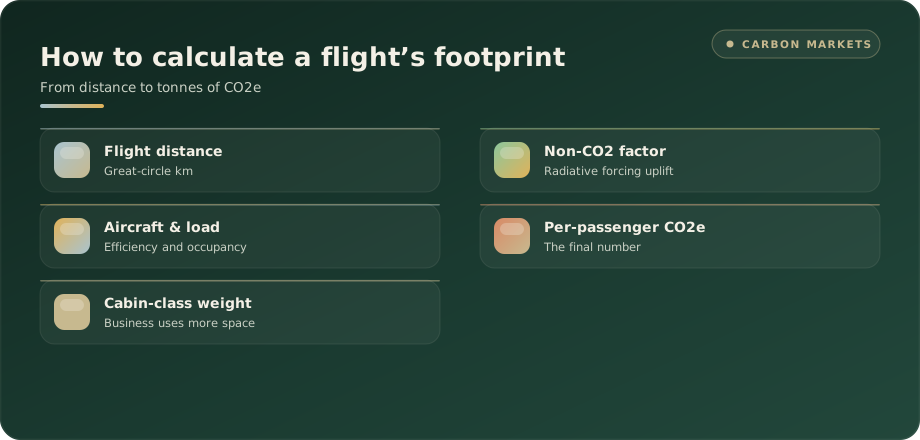
Beyond distance, four factors move a per-passenger footprint:
| Factor | Effect on the footprint |
|---|---|
| Aircraft type & age | Newer, efficient aircraft burn less |
| Load factor (how full) | More passengers share the emissions |
| Cabin class | Premium seats take more space and weight |
| Non-CO2 uplift | An optional multiplier for altitude effects |
Cabin class matters more than people expect: a business-class seat can be allocated several times the emissions of an economy seat on the same flight, because it occupies far more of the cabin.
The Non-CO2 Question
Here is the biggest reason calculators diverge. As covered in aviation emissions explained, flying's warming impact is not only CO2 — contrails and NOx at altitude add substantially. Some calculators apply a radiative forcing multiplier (often around 1.7–2×) to reflect this; others report CO2 only. That single choice can nearly double the result, which is why comparing calculators means checking whether they include non-CO2 effects.
From Fuel to CO2e
Once fuel burn is estimated, it is converted to CO2 using standard factors, allocated per passenger by cabin class, and — if the tool includes it — uplifted for non-CO2 effects, giving a final figure in CO2e. That per-passenger CO2e is what a passenger offset, or a company's business-travel footprint, is based on.
A Practical Takeaway
You do not need to compute this by hand — reputable calculators exist. What matters is reading their output critically: does it account for cabin class, and does it include non-CO2 effects? Two honest estimates can differ by a factor of two purely on that last choice, so know which one you are looking at before you offset against it.
Frequently Asked Questions
How is a flight's carbon footprint calculated? From the fuel burned (driven by distance, aircraft and load), converted to CO2, allocated per passenger by cabin class, and often uplifted for non-CO2 effects to give CO2e.
Why do flight calculators give different results? Mainly because some include a non-CO2 (radiative forcing) multiplier and others report CO2 only, and they make different assumptions about aircraft and load.
Does business class have a bigger footprint than economy? Yes — premium seats are allocated more emissions because they occupy more of the cabin's space and weight per passenger.
What is the non-CO2 multiplier? An uplift (often around 1.7–2×) applied to reflect the extra warming from contrails and nitrogen oxides at altitude, beyond CO2.
Are short flights worse per kilometre? Often yes — take-off and climb are the most fuel-intensive phases, so short hops can be inefficient per kilometre despite a smaller total.
Buying carbon credits or measuring travel and freight emissions? DSTechnoverse works on the data and integrity side of carbon — footprint measurement, project screening, registry and eligibility verification, and defensible reporting. See our CORSIA carbon credit services and data analytics. We are based in Indore, Madhya Pradesh and work across India and internationally.
Apply as a carbon credit buyer or seller
Talk to our team, or start with the complete carbon credits guide.