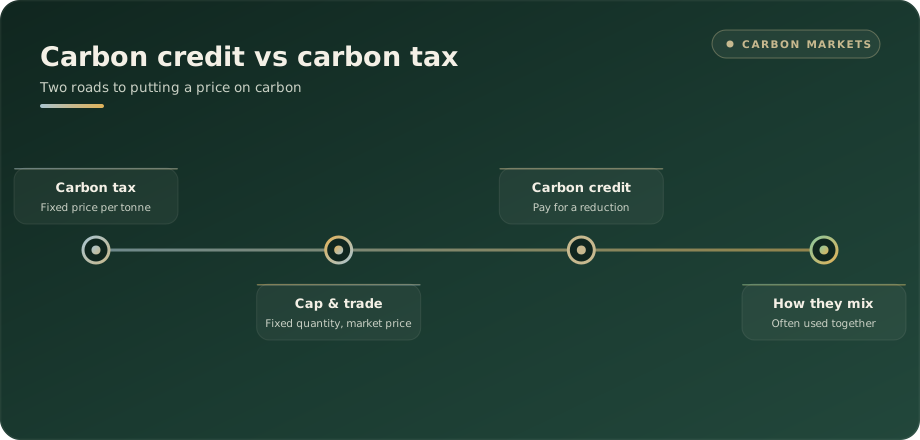
Put a price on carbon and you change behaviour. But there are two very different ways to do it, and they are constantly confused. A carbon tax fixes the price and lets emissions settle wherever they will. A carbon market fixes the quantity and lets the price move. Understanding which is which — and where carbon credits fit — clears up a lot of policy noise.
The Fundamental Choice: Price or Quantity
This is the whole distinction in one idea. A government can control one of two things, not both:
- Set the price (a carbon tax): everyone pays a fixed amount per tonne, and total emissions land wherever that price drives them.
- Set the quantity (cap-and-trade): the government caps total emissions and issues that many allowances; the market then discovers the price.
| Carbon tax | Cap-and-trade | Carbon credit | |
|---|---|---|---|
| What is fixed | Price per tonne | Total quantity | Neither — it funds a reduction |
| Who sets the level | Government | Market, under a cap | Project + buyer |
| Certainty you get | Price certainty | Emissions certainty | A specific reduction |
| Revenue goes to | Government | Government / market | Project developer |
Where Carbon Credits Are Different
A carbon credit is not really a third type of tax — it is a different instrument altogether. A tax and a cap both make emitting cost something. A credit is a positive instrument: you pay a project to reduce or remove a tonne, and you receive a tradable unit for it. Credits show up inside both systems — a compliance scheme may let firms use credits to meet part of an obligation — and outside them, in the voluntary carbon market where buyers act by choice.
How They Work Together
In practice, real-world carbon pricing is a mix. CORSIA, for instance, is neither a tax nor a classic cap — it is an offsetting obligation on emissions growth, met largely with credits, sitting alongside emissions-trading schemes like the EU ETS that cap other flights. A single airline can face a cap-and-trade cost on some routes and a credit-based obligation on others, as covered in carbon pricing and its impact on airlines. The instruments are complementary tools, not rivals: taxes and caps price the emissions that remain, while credits channel finance to reductions elsewhere.
Which Is "Better"?
Economists argue this endlessly, and the honest answer is it depends on what you want to be certain about. A tax gives businesses price certainty to plan around but no guarantee on total emissions. A cap gives an emissions guarantee but a volatile price. Credits give you a specific reduction to point to, but their value depends entirely on integrity. Most effective systems use more than one, matched to the outcome that matters most.
Frequently Asked Questions
What is the difference between a carbon credit and a carbon tax? A carbon tax charges a fixed price per tonne emitted; a carbon credit is a tradable unit representing a tonne reduced or removed, which you buy to fund or claim a reduction.
What is cap-and-trade? A system that caps total emissions, issues that many allowances, and lets the market trade them — fixing the quantity while the price moves.
Is a carbon tax better than a carbon market? Neither is simply better: a tax gives price certainty, a cap gives emissions certainty, and many systems combine both.
Where do carbon credits fit in? Inside compliance schemes (to meet part of an obligation) and outside them in the voluntary market, funding reductions rather than taxing emissions.
Is CORSIA a carbon tax? No — CORSIA is an offsetting obligation on emissions growth, met largely with carbon credits, not a per-tonne tax.
Navigating carbon credits and climate claims? DSTechnoverse works on the data and integrity side of carbon — project screening, registry and eligibility verification, MRV and monitoring-data analysis, reconciliation and defensible reporting. See our CORSIA carbon credit services and data analytics. We are based in Indore, Madhya Pradesh and work across India and internationally.
Apply as a carbon credit buyer or seller
Talk to our team, or start with the complete carbon credits guide.