Every time a company says it is offsetting its footprint, it is acting in the voluntary carbon market (VCM) — the part of the carbon world where buyers act by choice rather than because a law compels them. It is large, fast-moving, occasionally controversial, and widely misunderstood. Here is how it actually works.
Voluntary vs Compliance
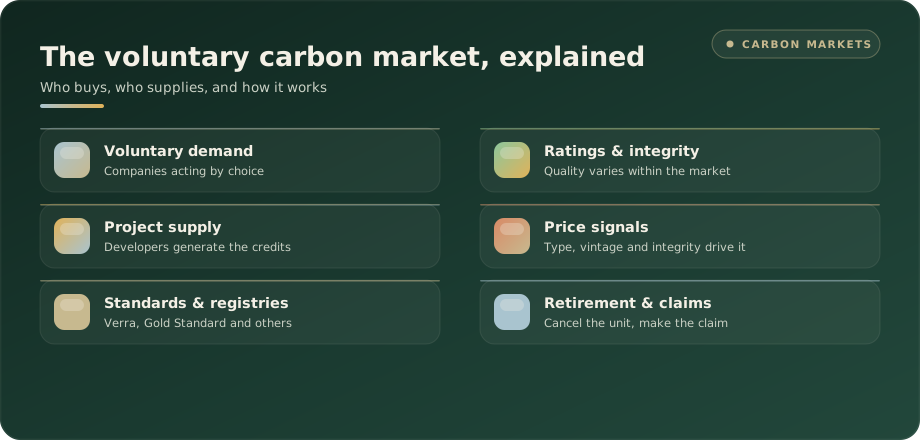
The first thing to place the VCM against is the compliance market, where a rule forces someone to surrender credits — an airline under CORSIA, or a factory under an emissions-trading scheme. The VCM is the opposite: a company offsetting business travel, a brand funding forest protection, an individual neutralising a flight. Nobody forces the purchase, and the buyer sets its own standard for what counts. That single fact — choice versus obligation — shapes everything else. For a direct comparison, see CORSIA vs the voluntary carbon market.
Who Is in the Market
The VCM has a recognisable cast:
- Buyers — companies and, in smaller numbers, individuals acting voluntarily.
- Project developers — the people who build the cookstove, forest or removal projects that generate credits.
- Standards and registries — bodies such as Verra, Gold Standard and ACR that set the rules and record issuance and retirement (compared in carbon credit registries compared).
- Verifiers — independent auditors who check that claimed reductions are real.
- Brokers, exchanges and rating agencies — the plumbing that matches supply with demand and grades quality.
How a Credit Moves Through It
A credit's life is a chain: a project is designed to a methodology, registered, monitored and independently verified; credits are issued with a vintage and serial number; they are traded to a buyer; and finally the buyer retires them — cancels them in the registry — to make a claim. Until retirement, nothing has been discharged. The full buyer and seller journeys are in how to buy and how to sell carbon credits.
Why Quality Varies So Much
This is the VCM's defining feature and its biggest weakness. Because buyers set their own bar, the market contains both excellent and poor credits, and the price gap between them is enormous. Quality turns on the same handful of questions — additionality, baseline, permanence, double counting — that recur across every project type. It is why independent ratings and integrity frameworks like the ICVCM Core Carbon Principles have emerged, and why buying on headline price is the classic VCM mistake.
Where the Market Is Heading
The VCM is professionalising. Integrity frameworks are raising the floor, corresponding adjustments are separating compliance-grade supply from the rest, and buyers are shifting toward higher-integrity credits and durable removals. The direction of travel is fewer, better credits at firmer prices — a market that rewards substance over volume.
Frequently Asked Questions
What is the voluntary carbon market? The market where companies and individuals buy carbon credits by choice — to meet their own climate goals — rather than because a regulation requires it.
How is the VCM different from a compliance market? In the VCM buyers act voluntarily and set their own standards; in a compliance market a law requires specific units to be surrendered.
Who sets the rules in the voluntary market? Independent standards and registries such as Verra, Gold Standard and ACR, supported by verifiers and, increasingly, integrity frameworks and rating agencies.
Why do voluntary carbon credits vary so much in quality? Because buyers set their own bar, the market contains credits of very different integrity; quality depends on additionality, baselines, permanence and double-counting controls.
Is the voluntary carbon market growing? It has grown substantially and is professionalising, with a shift toward higher-integrity credits and durable removals.
Navigating carbon credits and climate claims? DSTechnoverse works on the data and integrity side of carbon — project screening, registry and eligibility verification, MRV and monitoring-data analysis, reconciliation and defensible reporting. See our CORSIA carbon credit services and data analytics. We are based in Indore, Madhya Pradesh and work across India and internationally.
Apply as a carbon credit buyer or seller
Talk to our team, or start with the complete carbon credits guide.