CORSIA is often described as if it were finished. It is not — it is a scheme designed to tighten in stages, and the most consequential of those stages is still ahead. Where it goes next matters not only to airlines but to project developers, fuel producers and anyone trading aviation carbon. Here is the trajectory and the questions that will decide whether it works.
Where CORSIA Is Today
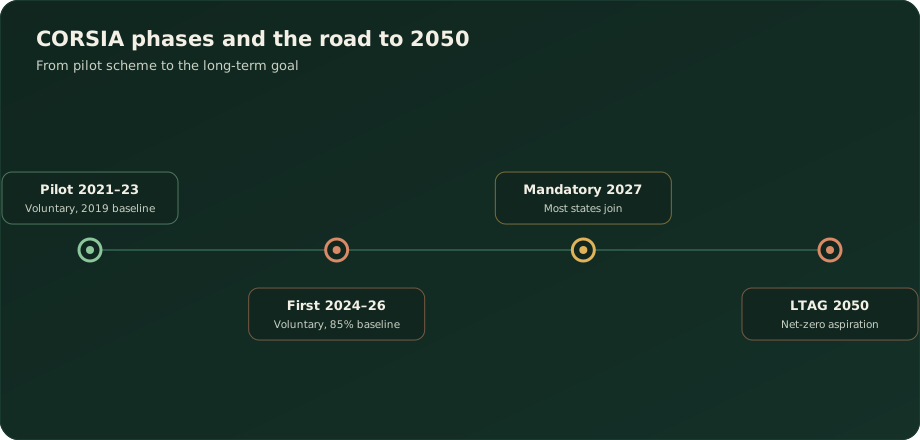
The scheme rolled out in phases: a pilot phase (2021–2023) and a first phase (2024–2026), both with voluntary state participation, though a large majority of international traffic is already covered because most major aviation states volunteered. The baseline tightened from 2019 emissions in the pilot to 85% of 2019 emissions from 2024, raising the offsetting bar. So far, so gradual.
What Changes Next
Three developments will shape the scheme from here.
The 2027 Turning Point
The pivotal change is the second phase from 2027, when participation becomes mandatory for most states — with carve-outs for least-developed countries, small island developing states, landlocked developing countries and states with very small shares of international aviation, unless they choose to join. Mandatory participation widens the set of covered routes (remember the two-ends rule from how the market works) and therefore expands total offsetting demand. Airlines that treated CORSIA as a light obligation during the voluntary years will feel it more from 2027.
The Long-Term Goal Above It
CORSIA does not sit alone. In 2022, ICAO's Assembly adopted a Long-Term Aspirational Goal (LTAG) of net-zero carbon emissions for international aviation by 2050. CORSIA is the near-term market mechanism; the LTAG is the destination. The tension between them is the whole story of aviation decarbonization: offsetting compensates today's emissions, but net zero requires the sector's own emissions to fall to near zero, which offsetting cannot deliver. Over time, the scheme's job is to shrink the residual, not to grow indefinitely.
The Supply Question
The biggest practical uncertainty is not demand — mandatory participation makes demand fairly predictable — but supply of eligible units. As covered in eligible emissions units, first-phase eligibility requires corresponding adjustments, and not every host country will authorise them. If eligible, adjusted supply grows more slowly than airline demand, prices rise and airlines face a tighter, more expensive market. Whether enough high-integrity, corresponding-adjusted credits reach the market in time is the question that will most shape CORSIA's cost and credibility.
Sustainable Fuel Changes the Mix
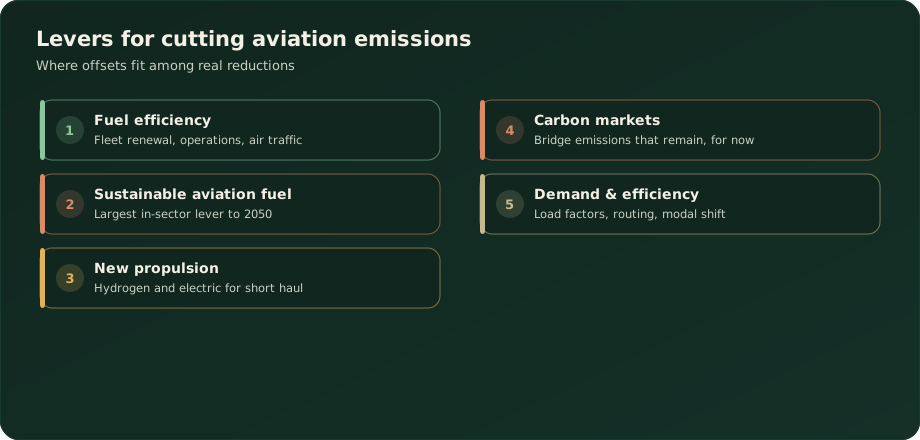
The other structural shift is sustainable aviation fuel. Because eligible fuels reduce the offsetting requirement directly, every tonne of SAF used is a tonne of offsetting avoided. As SAF supply scales and its cost premium narrows — helped by fuel mandates and incentives in several regions — the balance of compliance should tilt from buying units toward using cleaner fuel. In the long run, that is exactly the intended direction: markets covering a shrinking gap while the sector's own emissions come down.
Open Questions and Risks
Several things could go differently:
- Integrity scrutiny could tighten eligibility further, shrinking supply again.
- Non-CO2 effects (contrails, NOx) are outside CORSIA today but rising up the policy agenda.
- Overlap with regional schemes like the EU ETS will keep evolving and could expand.
- SAF scale-up may run ahead of or behind expectations, swinging the credit-versus-fuel balance.
None of these break the scheme, but each shapes how expensive and how effective it turns out to be.
The Honest Outlook
CORSIA in 2027 and beyond is a broader, firmer, more expensive obligation than the voluntary years suggested — a real cost centre for airlines and a real demand signal for high-integrity credits and SAF. It is not, and was never meant to be, the thing that decarbonizes flying. It is the bridge that prices and compensates emissions while in-sector levers do the structural work toward 2050. Judged as a bridge, its future is significant; judged as a destination, it was always going to fall short.
Frequently Asked Questions
When does CORSIA become mandatory? For most states from 2027, with exemptions for certain developing and low-traffic states unless they opt in.
What is the LTAG? ICAO's Long-Term Aspirational Goal of net-zero carbon emissions for international aviation by 2050, adopted in 2022.
Will CORSIA credits get more expensive? Likely, if eligible corresponding-adjusted supply grows more slowly than the rising, mandatory demand from 2027.
Does sustainable fuel replace offsetting over time? It reduces the offsetting requirement directly, so as SAF scales it should shrink the credit share of compliance.
Can CORSIA deliver net-zero aviation on its own? No. It compensates emissions through offsetting; net zero requires the sector's own emissions to fall through fuels and technology.
Working on aviation emissions, CORSIA compliance or carbon credit due diligence? DSTechnoverse handles the data side of carbon and environmental compliance — monitoring design, emissions reconciliation, verification support and defensible reporting. See our CORSIA carbon credit services and data analytics. We are based in Indore, Madhya Pradesh and work across India and internationally.
Apply as a CORSIA buyer or seller
Talk to our team, or start with the complete carbon credits guide.