Project developers who succeed in the voluntary market often assume CORSIA is the same market with a different buyer. It is not. The buyer is different in what it wants, the eligibility bar is set by a body neither party controls, and the gating requirement is a decision made by a government rather than by anyone in the transaction.
This guide covers what actually determines whether you can sell into CORSIA, and how to position when you can.
The Question That Decides Everything
Before methodology, before validation, before buyer conversations: will your host State authorise these units and apply a corresponding adjustment?
Under Article 6 of the Paris Agreement, a State authorising credits for international use — including CORSIA — must add those tonnes back into its own national accounting, forgoing them against its Nationally Determined Contribution. It is a real cost to the government, and governments respond to it differently.
Some authorise readily, sometimes with fees or benefit-sharing conditions. Some authorise for specific project types and decline others. Some have no designated authority, no process and no precedent, which functionally means no. Some have signalled a preference for retaining mitigation outcomes domestically.
The practical consequence is stark: a fully registered, independently verified, high-quality project can be entirely unable to supply CORSIA. This is not a judgement on the project. It is a sovereignty and accounting constraint operating above it.
Developers who discover this after spending a validation budget have made an expensive and completely avoidable mistake. See corresponding adjustments explained for the mechanics.
What the CORSIA Buyer Actually Wants
An airline buying CORSIA units is not buying a story. It is buying regulatory discharge — a unit that, when cancelled and reported, reduces its obligation by one tonne in the eyes of its national authority.
This changes what sells.
Irrelevant or nearly so: project photographs, community narrative, co-benefit branding, geographic resonance with the buyer's customer base, SDG mapping presented as marketing.
Decisive: the host-State authorisation document, programme approval status, vintage, registry serialisation, verification report, and the completeness of the documentation package.
Sellers who lead with the voluntary market pitch frequently lose deals to sellers with weaker projects and stronger paperwork. That is a rational buyer response — the airline will be verified and possibly audited years later, and it needs evidence, not narrative.
Note the caveat: co-benefits are not worthless. They matter for voluntary buyers competing for the same adjusted supply, and they can matter to an airline's own sustainability communications as a secondary consideration. But they do not substitute for eligibility.
The Seller Pathway
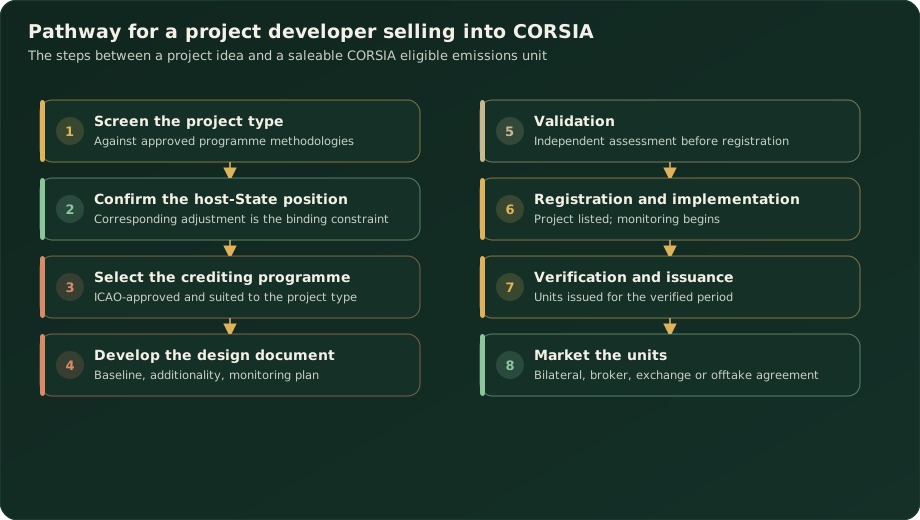
1. Authorisation feasibility. Engage the host State's designated national authority, or establish that none exists. Understand the policy position for your project type, any fees or conditions, and the realistic timeline. Do this first.
2. Programme selection. Choose an ICAO-approved crediting programme with a methodology that fits your activity. Check whether the approval is full or conditional, and when it is next reviewed. Programme approval has lapsed before.
3. Project design. Baseline, additionality, monitoring plan — designed against the eligibility criteria explicitly rather than hoping they are met incidentally.
4. Validation. An accredited body validates the design. Capacity is a real constraint; queues form.
5. Registration. The project is registered with the programme.
6. Implementation and monitoring. The activity runs and data is collected per the monitoring plan.
7. Verification. An accredited body verifies the reductions for a monitoring period.
8. Issuance. Units are issued into the registry.
9. Authorisation and adjustment. The host State authorises the specific units and the corresponding adjustment is applied.
10. Sale and transfer. The units reach a buyer, who cancels them.
Realistic elapsed time for a new project: eighteen months to three years to first issuance, with step one the least predictable element in the whole sequence.
Pricing Your Supply
CORSIA-eligible units carry a substantial premium over comparable non-eligible supply from the same project type. That premium is the value created by the authorisation, and it should be understood as such rather than as a general uplift.
Things that raise your price:
- Authorisation confirmed and documented, rather than pending
- Vintage comfortably inside the window for buyers' current compliance period
- Volume sufficient to be worth a buyer's diligence effort
- A complete, audit-ready documentation package
- A project type with clean additionality and low permanence risk
- Willingness to warrant eligibility contractually
Things that lower it:
- Authorisation pending, or conditional on something outside your control
- Vintage near a window boundary
- Small parcels that carry the same diligence cost as large ones
- Documentation offered as summaries rather than underlying evidence
- A project type under methodological scrutiny
- Refusal to warrant, or a warranty with no meaningful remedy
See the price guide for the buyer's view of the same drivers.
Structuring Offtake
Forward agreements are common, and they allocate risk that would otherwise sit somewhere by default.
Authorisation risk. If the host State does not authorise by an agreed date, what happens? Termination, price adjustment, substitution with other supply, or the buyer accepts non-eligible delivery at a reduced price. Silence here is dangerous for both sides.
Delivery risk. Late issuance relative to the buyer's cancellation deadline is a real failure mode. Define remedies.
Vintage risk. If the eligible window moves between contracting and delivery, who absorbs it?
Volume risk. Projects under-deliver against projections routinely. Define tolerance bands rather than a fixed number.
Documentation. Make delivery of the full evidence package a contractual obligation, not a courtesy.
A well-structured forward is genuinely valuable to a developer: it de-risks the financing and provides an anchor buyer. A poorly structured one transfers all the uncertainty to whichever party did not read carefully.
Keeping a Fallback
Building a financial model that only works with CORSIA placement, in a jurisdiction where authorisation is uncertain, is a concentrated bet on a government decision.
The sensible hedge is to design for CORSIA eligibility while retaining the option to sell into the voluntary market without an adjustment. If authorisation arrives, you capture the premium. If it does not, the project still has a route to market. This costs little at the design stage and is very hard to retrofit later.
There is also a genuine and growing voluntary demand for adjusted units — corporate buyers who want the strongest available protection against double-counting criticism will pay for the adjustment even with no CORSIA obligation at all. That competition supports your price on both sides.
Finding Buyers
Supply does not sell itself, even when it is genuinely eligible, because buyers cannot easily find it. There is no exchange and no listing service that reliably covers the adjusted segment.
Direct approach to operators. Slow but valuable. The relevant contact is usually in sustainability or a dedicated carbon function rather than procurement, and the first conversation should establish eligibility credentials rather than pitch the project. An operator that has been offered "CORSIA-ready" supply repeatedly will pay attention to a seller who leads with an actual authorisation document.
Intermediaries and brokers. Faster reach at a margin. Assess whether the intermediary actually understands eligibility before letting them represent your supply — one who cannot explain corresponding adjustments will misrepresent your project to buyers who can.
Programme and platform matching. Some crediting programmes and platforms facilitate introductions. Useful for discovery.
Advisers working operator-side. Consultants managing compliance for airlines know exactly what their clients need and when. Being known to them is a low-cost channel that sellers frequently overlook.
Aggregators. Where your volume is small, aggregating with other projects makes the parcel worth a large buyer's diligence effort.
The practical point: what buyers are screening for is a short list of documents. A seller who can send the authorisation document, the programme approval evidence, the vintage confirmation and the verification report in a single reply is doing something most sellers cannot, and it moves conversations forward faster than any amount of project narrative.
Common Seller Mistakes
Assuming authorisation. The most expensive error in this market.
Leading with the voluntary pitch. Photographs and narrative do not answer the buyer's actual question.
Describing units as "CORSIA-ready." Sophisticated buyers read this as "not eligible", correctly, and it damages credibility.
Reconstructing documentation retrospectively. Build the package as you go. Rebuilding it years later, to a standard that survives someone else's audit, is painful and sometimes impossible.
Ignoring programme approval risk. Approval can lapse under you. Monitor it.
Pricing from voluntary market averages. They describe a different product.
Selling small parcels to large buyers. The diligence cost per tonne is prohibitive. Aggregate, or target buyers whose volume matches yours.
Frequently Asked Questions
Can I sell existing voluntary credits into CORSIA? Only if the issuing programme is ICAO approved, the vintage is eligible, and the host State authorises those specific units with a corresponding adjustment. The last is a governmental decision, not a market transaction.
How long does authorisation take? Highly variable. Weeks in jurisdictions with an established process; indefinite where none exists. Treat an unclear answer as a material risk.
Do I need my own registry account? Yes, with the issuing programme, to hold and transfer units.
Should I sell direct or through an intermediary? Direct gives better pricing and control but requires you to reach buyers. Intermediaries provide access at a margin. Assess their actual understanding of eligibility before relying on them to represent your supply.
What volume is worth a buyer's time? There is no fixed threshold, but very small parcels carry the same diligence cost as large ones, which makes them unattractive. Aggregation helps.
Can DSTechnoverse help place supply? Yes — eligibility screening, authorisation support, documentation and buyer matching. Start with becoming a CORSIA supplier.
Buying or selling CORSIA units? DSTechnoverse provides specialist CORSIA carbon credit services — offsetting requirement calculation and unit sourcing for operators, and eligibility screening, host-State authorisation support and buyer matching for project developers. We are based in Indore, Madhya Pradesh and work with clients across India and internationally.
Apply as a CORSIA buyer or seller
Talk to our carbon markets team about your position.