People use "carbon credit" as if it means one thing. It doesn't. A credit's rules, price and credibility depend on the market it was created for — and the two markets most often confused are CORSIA, a compliance scheme, and the voluntary carbon market that companies use for their own climate claims. Understanding the difference stops a lot of expensive mistakes.
Compliance vs Voluntary: The Core Split
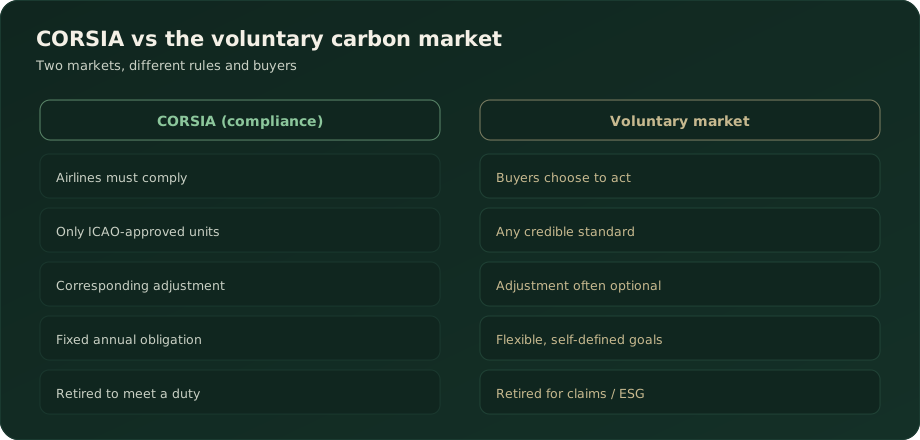
A compliance market exists because a rule requires someone to surrender credits. CORSIA is compliance: airlines must offset their emissions growth, and only specific units are accepted. A voluntary market exists because a buyer chooses to act — a company offsetting business travel or claiming carbon neutrality. Nobody forces the purchase, and the buyer sets its own standard for what counts.
That single difference — obligation versus choice — cascades into almost everything else.
| Dimension | CORSIA | Voluntary market |
|---|---|---|
| Why buyers act | Legal/scheme obligation | Own targets, ESG, marketing |
| Who accepts the credit | ICAO, via approved programmes | The buyer decides |
| Eligible supply | Narrow, ICAO-approved units | Broad, many standards |
| Double-counting rule | Corresponding adjustment required (first phase) | Often not required |
| Price behaviour | Driven by scheme demand | Driven by sentiment and claims |
| Typical use | Cancelled to meet a duty | Retired for a public claim |
Where the Rules Diverge
Three structural differences do most of the work of separating the two markets.
Eligibility Is the Big One
Any credible standard — Verra, Gold Standard, ACR, Climate Action Reserve, ART and others — can issue voluntary credits. CORSIA accepts a subset: only credits from programmes ICAO's Technical Advisory Body has assessed and the ICAO Council has approved, and only vintages within the scheme's timing rules. A project can be perfectly legitimate in the voluntary market and still fail CORSIA eligibility. This is why "it's a Verra credit" tells you nothing about CORSIA acceptance on its own.
The Double-Counting Divide
This is the difference most buyers underestimate. Under CORSIA's first phase (from 2024), an eligible unit must carry a corresponding adjustment — the host country formally deducts that reduction from its own national total so it cannot be counted twice under the Paris Agreement. Many voluntary credits do not carry a corresponding adjustment, which is acceptable for some voluntary claims but disqualifies the credit for CORSIA. The same tonne of reduction, in other words, can be CORSIA-eligible or not depending purely on this accounting step. We cover the mechanics in CORSIA eligible emissions units.
Price Tells the Same Story
Because the two markets draw on different (though overlapping) supply, they price differently. Voluntary prices swing on corporate sentiment, media scrutiny and the perceived quality of a project type. CORSIA prices respond to a more mechanical driver: how much airlines must offset versus how many eligible, corresponding-adjusted units exist. When eligibility tightened, the pool of qualifying units shrank and CORSIA-eligible credits commanded a premium over generic voluntary units. For how this feeds into airline economics, see carbon pricing and its impact on airlines.
Where the Two Markets Touch
They are not sealed off. A project developer may register a project once and then decide, credit by credit, whether to sell into CORSIA (if it can secure a corresponding adjustment) or the voluntary market (if it cannot or if voluntary prices are better). Buyers, too, sometimes hold both: an airline meets its CORSIA duty with eligible units and separately buys voluntary credits for corporate-level "net zero" claims that go beyond the scheme.
A Practical Example
Suppose a cookstove project in East Africa issues 100,000 credits. If the host country agrees to a corresponding adjustment and the crediting programme is CORSIA-approved, those units can be sold to an airline for compliance. If the host country will not authorise the adjustment — perhaps it wants the reduction for its own Paris target — the same credits can still be sold voluntarily to a company for a general offset claim, but not into CORSIA. One project, two very different products, decided by paperwork rather than tonnes.
Choosing the Right Frame
If you are an airline, only the compliance frame matters: does the unit qualify, right now, for the phase you are covering? If you are a company acting voluntarily, you have more freedom but also more responsibility, because no regulator is filtering your supply for you — so offset quality due diligence becomes your job.
Frequently Asked Questions
Are CORSIA credits better quality than voluntary ones? Not automatically, but they pass an extra filter — approval by ICAO and, in the first phase, a corresponding adjustment — that many voluntary credits skip.
Can I use a voluntary credit for CORSIA? Only if it also meets CORSIA's eligibility rules. Most generic voluntary credits do not, usually because they lack a corresponding adjustment.
Why is the voluntary market cheaper on average? It has broader supply and looser requirements, so low-cost credits are available — though the credible, adjusted end of the voluntary market is priced much closer to CORSIA units.
Which market is bigger? The voluntary market has far more registered supply and diversity; CORSIA is a large, concentrated block of compliance demand concentrated among airlines.
Do the two markets compete for the same credits? Increasingly, yes — high-integrity, corresponding-adjusted units are in demand from both airlines and serious corporate buyers, which supports their price.
Working on aviation emissions, CORSIA compliance or carbon credit due diligence? DSTechnoverse handles the data side of carbon and environmental compliance — monitoring design, emissions reconciliation, verification support and defensible reporting. See our CORSIA carbon credit services and data analytics. We are based in Indore, Madhya Pradesh and work across India and internationally.
Apply as a CORSIA buyer or seller
Talk to our team, or start with the complete carbon credits guide.