Most organisations buying carbon credits for the first time start by asking who sells them. That is the fourth question, not the first, and starting there is why so many end up with credits that do not serve the purpose they were bought for.
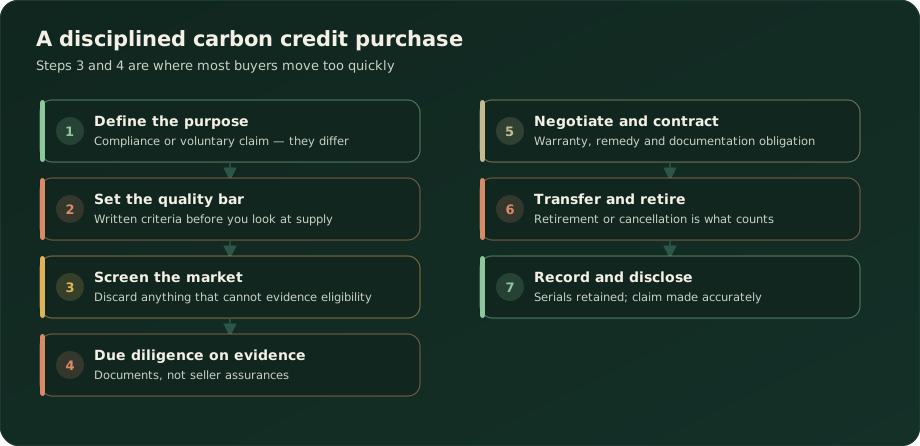
Step 1: Define the Purpose
Compliance or voluntary claim? They have different eligibility requirements and different price points, and buying for the wrong one is expensive.
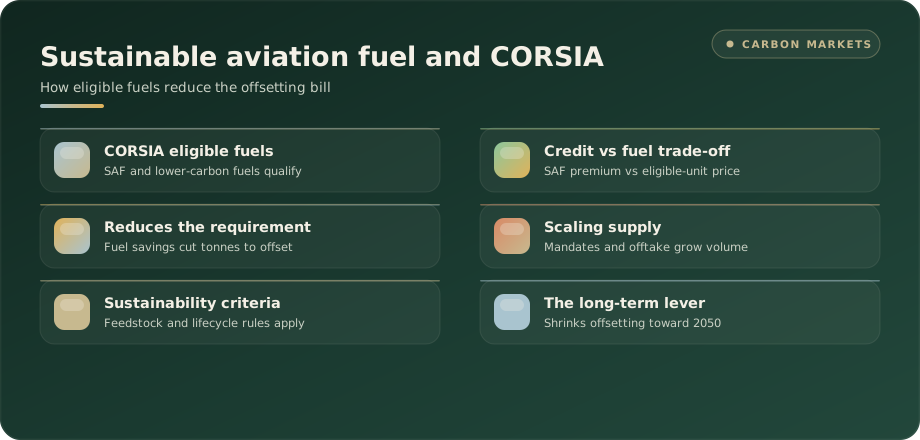
Compliance means a legal obligation — CORSIA for an aircraft operator, or a domestic scheme. The regulator's rules bind you regardless of preference, and units must satisfy them exactly.
Voluntary means a claim you have chosen to make. You set the bar, which means you also carry the reputational risk of setting it badly.
Both? Keep them separate. Units cancelled for compliance discharge a legal obligation and are not available again for a voluntary claim.
Write the purpose down before anything else. Everything downstream is judged against it.
Step 2: Set the Quality Bar — Before Looking at Supply
This is the step that most affects the outcome and the one most often skipped.
If you look at available supply first, the supply sets your standard. You will find yourself justifying what is available rather than assessing it against what you decided you needed.
Write down, in advance:
- Which standards you accept
- Whether a corresponding adjustment is mandatory
- Project types included and excluded
- Vintage limits
- Removal versus avoidance mix, if you have a target
- The evidence required before purchase
- Who may approve an exception, and how it is recorded
That last line matters. Exceptions will arise. A policy with no exception route gets ignored entirely; one with a documented route gets followed.
Step 3: Screen the Market
Discard anything that cannot evidence eligibility before spending diligence effort on it.
For CORSIA, screening on language alone removes a large share of what gets offered. "CORSIA-ready", "CORSIA-aligned" and "eligible pending authorisation" all mean the same thing: not currently eligible. None is a standard.
Routes to supply:
| Route | Advantage | Cost |
|---|---|---|
| Direct from developers | Best pricing and documentation access | Full diligence and counterparty risk on you |
| Brokers and intermediaries | Faster access, aggregation of small parcels | Margin; understanding varies widely |
| Exchanges and platforms | Price transparency where they exist | Limited coverage of the adjusted segment |
| Forward agreements | Secures supply, often better pricing | Delivery and authorisation risk |
Assessing an intermediary: ask how they establish that a unit carries a corresponding adjustment. An answer naming the designated national authority, the authorisation document and the unit identifiers shows command of the market. "The project confirms it" does not.
Step 4: Due Diligence on Evidence
Documents, not assurances. The core checks:
- Is the issuing programme currently approved for your purpose, and is the approval full or conditional?
- Is the vintage inside the window for your compliance period?
- Is there a host-State authorisation document naming these specific units?
- Is there evidence the corresponding adjustment has been or will be applied?
- Is the verification report from an accredited body, and does it carry qualifications?
- Does the registry record show a clean chain of custody with no prior retirement?
- Does the seller actually hold the units?
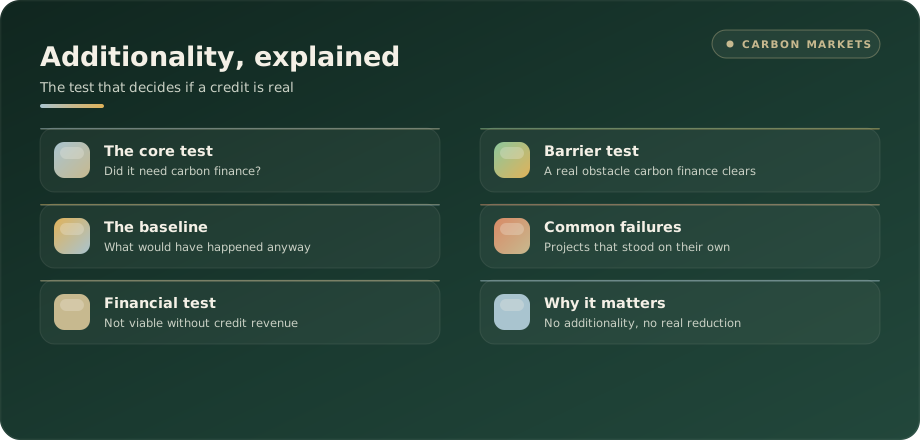
- Is the additionality argument credible for this project, in this market, now?
Capture the evidence into your own files rather than linking to it. Programme approval status changes; a URL is not proof of what a page said on the transaction date.
Full method in carbon credit quality assessment.
Step 5: Negotiate and Contract
The terms that matter more than price:
| Term | The question it must answer |
|---|---|
| Eligibility warranty | What is warranted, and the remedy if it fails |
| Authorisation risk | Who bears the loss if the host State does not authorise |
| Vintage protection | What happens if the eligible window moves |
| Delivery | What if units arrive after your retirement deadline |
| Volume tolerance | What band applies to under-delivery |
| Documentation | Is the full evidence pack a contractual obligation |
| Payment | Escrow, staged, or against delivery |
Silence on any of these allocates the risk to you. A purchase order with a price and a volume is not adequate for anything material.
Step 6: Transfer and Retire
Open registry accounts ahead of need — onboarding involves know-your-customer checks and takes four to eight weeks. An organisation that agrees a purchase and then starts onboarding finds its own compliance blocking delivery.
Then: payment, transfer into your account, and retirement or cancellation.
Holding credits achieves nothing. Retirement is what makes the claim, and for compliance use the cancellation must carry the correct purpose designation. It is irreversible.
Record serial numbers, the retirement reference, date, quantity and purpose designation.
Step 7: Record and Disclose
Retain the full package: contract, diligence file, authorisation document, verification report, registry records, transfer and retirement confirmations.
Disclose accurately. Credits are reported outside your scope 1, 2 and 3 inventory and are never netted against it. Describing what you did — "we retired X credits of type Y from project Z" — is far more defensible than a summary label like "carbon neutral", which has attracted regulatory attention in several jurisdictions.
See ESG reporting and carbon credits.
A Realistic Timeline
For a first purchase:
| Step | Allow |
|---|---|
| Purpose and quality bar | 1-2 weeks |
| Registry account opening | 4-8 weeks |
| Market screening | 2-6 weeks |
| Due diligence per tranche | 1-3 weeks |
| Contract negotiation | 2-6 weeks |
| Payment and transfer | 1-3 weeks |
| Retirement and reporting | 1-2 weeks |
Three to six months, assuming nothing goes wrong. Subsequent cycles compress once accounts and processes exist — but diligence does not compress much, because it is evidence gathering rather than administration.
Buying for a Voluntary Claim Specifically
Where the purchase supports a public claim rather than a legal obligation, three additional considerations apply that compliance buyers can skip.
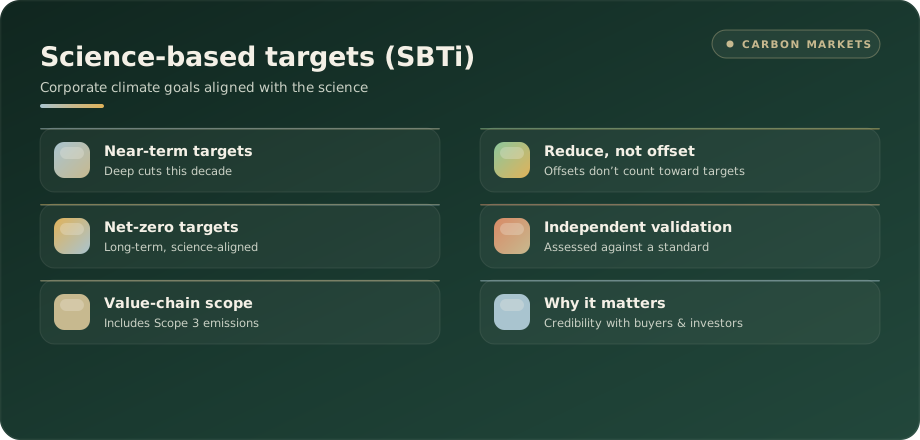
Reduce first, then buy. Every credible framework — SBTi most explicitly — treats credits as addressing residual emissions after genuine reduction, not as a substitute for it. A purchase made instead of reductions is the one most likely to attract criticism, and increasingly the one most likely to attract a regulator.
Match the credit to the claim. A net zero claim rests more comfortably on removals than on avoidance, because the framing is that residual emissions are balanced by removals. An avoidance credit supports a "we funded a reduction elsewhere" statement, which is a different and more modest claim. Buying avoidance credits and making a removal-shaped claim is where most greenwashing findings originate.
Say what you actually did. "We retired 4,200 credits from an improved cookstove project in Madhya Pradesh, verified under [standard], vintage 2024" is defensible and checkable. "Carbon neutral" is a summary label that has attracted regulatory attention in several jurisdictions, and it invites a challenge the detailed version does not.
The pattern: the more specific the disclosure, the harder it is to attack. Vagueness reads as concealment even when it is only brevity.
Who Should Own It
Carbon procurement falls between functions, and organisations that handle it badly usually do so because nobody clearly owns it.
Procurement brings contracting discipline and typically lacks the technical judgement to distinguish an eligible unit from one described as eligible. Sustainability brings the market understanding and often cannot negotiate a supply agreement. Finance owns the budget and cross-border payment.
The workable pattern is a single accountable owner with defined input from the others and — critically — the authority to decline a transaction. Diligence that cannot stop a deal is not diligence.
Frequently Asked Questions
Where do I buy carbon credits? Directly from project developers, through brokers, on platforms, or via forward agreements. The route affects price and how much diligence falls to you.
How much should I buy? Model the requirement first. For compliance, that means the obligation calculation; for voluntary, your residual emissions after genuine reductions.
Can I buy a small quantity? Yes, though transaction and diligence costs do not scale down, so cost per tonne is higher for small parcels.
What if a credit turns out to be ineligible after retirement? Your contract determines the remedy. After retirement the unit is consumed regardless — which is why the warranty matters more than the price.
Do I need a registry account? Yes, to hold and retire units. Open it before you need it.
Should I use a broker? They speed access to supply. They do not transfer your diligence obligation, and their understanding of eligibility varies considerably.
What is the most common first-time mistake? Looking at supply before setting a quality bar, and leaving registry account opening until after a purchase is agreed.
Working out what to buy and what it should cost? DSTechnoverse provides CORSIA carbon credit services — requirement modelling, supply sourcing, pre-transaction due diligence and registry execution. We are based in Indore, Madhya Pradesh and work across India and internationally.
Apply as a CORSIA buyer or seller
Talk to our carbon markets team, or start with the complete carbon credits guide.