Before you can offset, price or regulate flying's climate impact, it helps to understand what that impact actually is. Aviation emissions are simpler than the jargon suggests in one way, and more complicated in another — and both matter for how the sector is being decarbonised.
Where the Emissions Come From
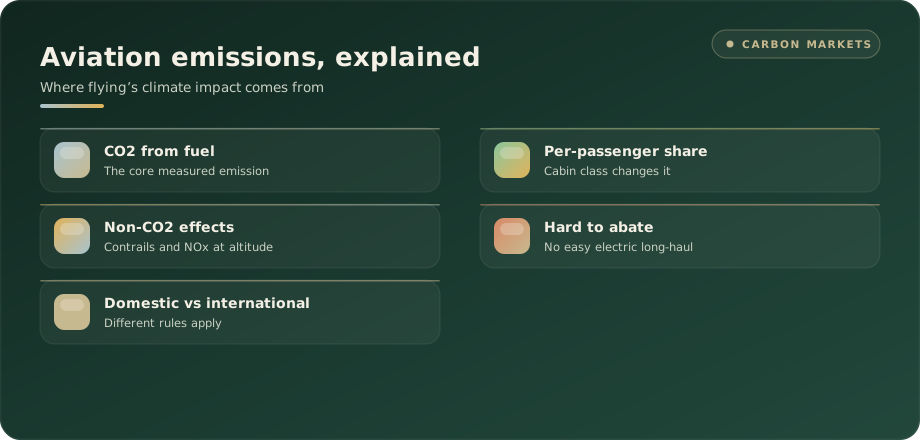
Almost all of aviation's direct climate impact comes from burning jet fuel. Kerosene combusts to CO2 and water vapour, and the CO2 is the core measured emission behind carbon accounting and schemes like CORSIA. The amount is driven by how much fuel a flight burns — which depends on distance, aircraft efficiency, weight and how full the plane is.
The Complication: Non-CO2 Effects
Here is where aviation is unusual. Flying's warming impact is not only CO2. At altitude, aircraft also produce:
- Contrails — the condensation trails that can form cirrus clouds and trap heat.
- Nitrogen oxides (NOx) — which affect atmospheric chemistry in warming ways.
These non-CO2 effects may roughly double aviation's warming impact beyond CO2 alone, according to current science. Crucially, most carbon accounting and CORSIA cover only CO2 — so the headline numbers understate the full climate effect. It is an active area of science and policy, and a reason offsetting alone does not fully "neutralise" a flight.
How Emissions Are Counted
For accounting, a flight's CO2 is estimated from fuel burn and expressed in CO2e. Two distinctions matter:
- Domestic vs international — international aviation sits under CORSIA, while domestic aviation falls under national policy.
- Per-passenger allocation — a flight's emissions are shared across passengers, and premium cabins are allocated more because they use more space and weight per person.
The mechanics of a single flight are in how to calculate a flight's carbon footprint.
Why Aviation Is So Hard to Decarbonise
Most sectors have a clear electric path. Aviation does not — yet. Batteries are far too heavy for long-haul, the energy density of jet fuel is hard to match, and the aircraft flying today will be in service for decades. That is why aviation leans on a stack of partial solutions — efficiency, sustainable aviation fuel, new propulsion for short-haul, and carbon markets as a bridge — rather than one silver bullet, as explored in can carbon markets cut aviation emissions.
Frequently Asked Questions
Where do aviation emissions come from? Overwhelmingly from burning jet fuel, which produces CO2 — the amount driven by distance, aircraft efficiency, weight and occupancy.
What are non-CO2 effects in aviation? Warming impacts beyond CO2 — mainly contrails and nitrogen oxides at altitude — which may roughly double aviation's climate effect but are not covered by most carbon accounting.
Does CORSIA cover non-CO2 effects? No — CORSIA accounts only for CO2; non-CO2 effects are a separate scientific and policy issue.
Why is aviation so hard to decarbonise? Batteries are too heavy for long-haul, jet fuel's energy density is hard to replace, and aircraft stay in service for decades, so there is no quick electric fix.
How are a flight's emissions allocated per passenger? By sharing the flight's emissions across passengers, with premium cabins allocated more because they take up more space and weight.
Buying carbon credits or measuring travel and freight emissions? DSTechnoverse works on the data and integrity side of carbon — footprint measurement, project screening, registry and eligibility verification, and defensible reporting. See our CORSIA carbon credit services and data analytics. We are based in Indore, Madhya Pradesh and work across India and internationally.
Apply as a carbon credit buyer or seller
Talk to our team, or start with the complete carbon credits guide.