How SAF Reduces Your CORSIA Offsetting Requirement
The arithmetic connecting a tonne of sustainable aviation fuel to a reduction in offsetting obligation, with worked examples, plus how to compare the cost of fuel against the cost of buying eligible units.
Sustainable aviation fuel reduces a CORSIA obligation directly rather than through offsets. This article sets out exactly how much, with the arithmetic, and how to compare fuel against units as competing uses of the same budget.
The Mechanism
Under the CORSIA framework, the emissions reduction from an eligible fuel is calculated from the difference between the conventional jet fuel lifecycle value and the fuel's own lifecycle value, applied to the mass of fuel used.
Conceptually:
Reduction (t CO2) = fuel mass (t) × (baseline lifecycle intensity − fuel lifecycle intensity) ÷ 1000
where lifecycle intensity is expressed in grams of CO2 equivalent per megajoule, converted using the fuel's energy content.
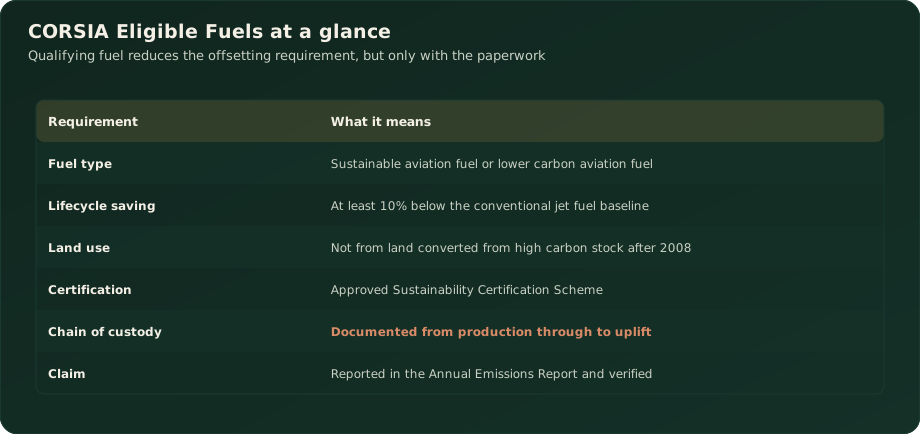
The conventional jet fuel baseline is defined by ICAO for this purpose. A fuel must beat it by at least 10% to qualify at all.
The reduction is subtracted from the gross offsetting requirement.
Worked Example
Illustrative figures, chosen to show the mechanics rather than to quote real prices or intensities.
An operator has a gross offsetting requirement of 19,200 tonnes for a year, from 320,000 tonnes of covered emissions at a 6% growth factor.
It uplifts 2,000 tonnes of certified SAF with a lifecycle intensity 80% below the conventional baseline.
| Step | Value |
|---|---|
| SAF uplifted | 2,000 t |
| CO2 from that fuel if it were conventional | 2,000 × 3.16 = 6,320 t |
| Lifecycle saving at 80% | 6,320 × 0.80 = 5,056 t |
| Gross offsetting requirement | 19,200 t |
| Less CEF reduction | −5,056 t |
| Net offsetting requirement | 14,144 t |
The 2,000 tonnes of SAF removed 5,056 tonnes from the obligation — a 26% reduction in units the operator must buy.
Why the Leverage Is High
Note what happened. The SAF represented a small fraction of total fuel burn, but it eliminated a quarter of the offsetting obligation.
The reason is that the obligation is only a percentage of covered emissions — 6% in this example — whereas the fuel reduction is a percentage of the fuel's own emissions, at close to 100%.
The general form of the leverage
Roughly, one tonne of SAF at an 80% lifecycle saving removes about 2.5 tonnes from the obligation. One tonne of conventional fuel adds about 3.16 tonnes to covered emissions, of which only the growth factor percentage — 6% here — becomes an obligation, or about 0.19 tonnes.
So the marginal effect of switching a tonne of fuel to SAF is roughly 13 times larger on the obligation than the marginal effect of burning one tonne less fuel overall, at a 6% growth factor.
This leverage grows as growth factors rise. It is the single strongest argument for running the SAF comparison on current numbers rather than remembered ones.
Comparing SAF Against Buying Units
The comparison is a cost-per-tonne-of-obligation-removed calculation.
For units: the cost per tonne removed is simply the price of an eligible unit.
For SAF: the cost per tonne removed is the premium over conventional fuel, divided by the tonnes of obligation the fuel removes.
Cost per tonne removed = (SAF price − conventional jet fuel price) × fuel mass ÷ obligation reduction
Using the example above, if SAF carried a premium of a given amount per tonne over conventional fuel, that premium × 2,000 tonnes, divided by 5,056 tonnes of obligation removed, gives the effective cost per tonne — directly comparable with an eligible unit price.
What the comparison leaves out
A pure cost-per-tonne comparison understates SAF, for several reasons worth naming:
SAF also reduces EU ETS and UK ETS exposure where the operator is subject to them, because it reduces the emissions requiring allowances. The same fuel purchase serves multiple schemes.
SAF supports voluntary and corporate claims that offsets increasingly cannot. Corporate customers and investors distinguish between reducing emissions and compensating for them.
SAF is not exposed to eligible-unit supply risk. The market for eligible units may not have the volume you need when you need it; a fuel contract is a different kind of exposure.
Mandates may require SAF regardless. Where a blending mandate applies, the fuel is being bought anyway, and the CORSIA claim is incremental value on a cost already incurred.
Against that, SAF has real constraints: availability is regional and thin, the documentation burden is genuine, and the premium is substantial.
Where the Crossover Sits
There is no general answer, and anyone offering one without your numbers is guessing.
What is true directionally:
- Eligible unit prices are under upward pressure as second-phase demand arrives against constrained supply. See supply and demand outlook.
- SAF production capacity is expanding, which should ease premiums over time, though from a small base.
- Growth factors rise, which increases the leverage of every tonne of SAF.
All three push the crossover in the same direction — toward SAF. An operator who ran this comparison three years ago and concluded units were cheaper may be carrying a stale conclusion.
Practical Requirements for the Claim
Recapping what must be in place, because the arithmetic is worthless without it:
- The fuel meets the CORSIA Eligible Fuels sustainability criteria
- It is certified under an approved Sustainability Certification Scheme
- Chain of custody is documented from production to uplift
- The claim appears in the Annual Emissions Report
- It survives independent verification
- The same fuel is not claimed under another scheme
See CORSIA Eligible Fuels for each in detail.
Modelling Advice
Model obtainable fuel, not target fuel. Base the reduction on volumes you can actually secure at airports you actually serve, with certification you can actually get.
Model it against all schemes at once. Assessed against CORSIA alone, SAF looks more expensive than it is for an operator also facing the EU ETS.
Re-run annually. Both sides of the comparison are moving, and in the same direction.
Include the documentation cost. Chain-of-custody administration is real effort, particularly on the first cycle.
Where to Go Next
- CORSIA Eligible Fuels — the qualification requirements
- The requirement calculation — where the reduction applies
- CORSIA credit pricing — the other side of the comparison
- CORSIA vs EU ETS — why the fuel serves several schemes
DSTechnoverse builds SAF-versus-units comparisons on current pricing and your actual network. Talk to our carbon markets team.
Need this applied to your position?
We assess operators’ obligations and developers’ eligibility pathways directly.