Carbon action used to feel like something only large corporates did. That has changed fast. Small and medium businesses are now being asked about their emissions — by customers, by larger companies whose supply chains they sit in, and in tender documents. The good news: an SME does not need a sustainability department to act credibly. It needs a sensible, budget-aware sequence. Here it is.
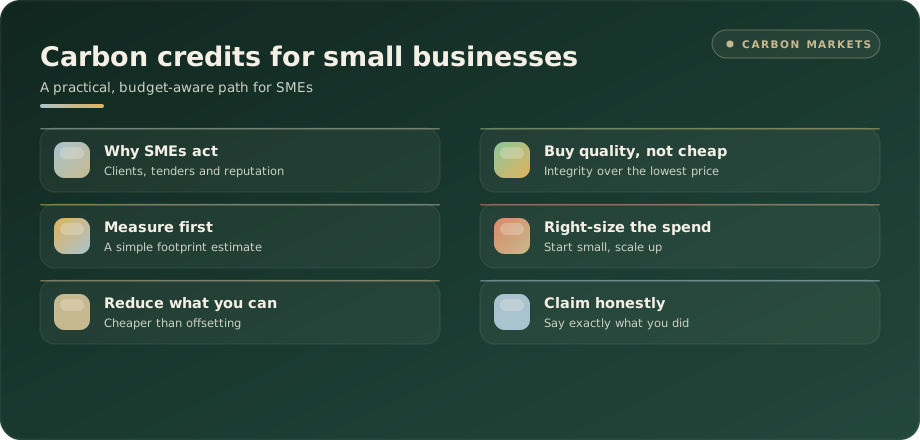
Why SMEs Are Being Pulled In
Three forces are bringing carbon to the SME's door:
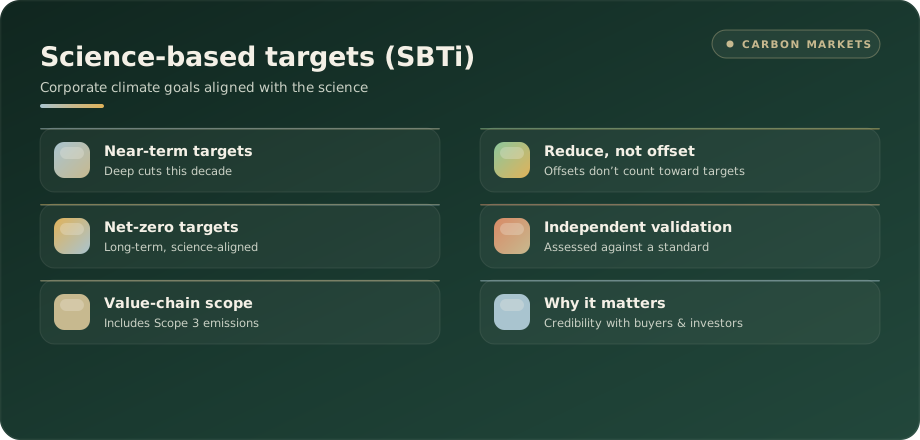
- Supply-chain pressure. Big customers with science-based targets must cut their Scope 3 emissions — which are their suppliers' emissions. If you supply them, they will increasingly ask about yours.
- Tenders and procurement. Public and corporate tenders now often include sustainability criteria.
- Reputation and talent. Customers and employees increasingly notice.
None of this requires an SME to become a climate leader — but it does reward businesses that can show they are doing something real.
Step 1: Measure (Roughly Is Fine to Start)
You cannot manage what you have not measured, but an SME does not need a perfect inventory on day one. Start with a simple footprint estimate: your energy use, fuel and vehicles, and the biggest obvious items in your supply chain and travel. Everything is expressed in CO2e. A rough, honest number you can improve beats a perfect one you never finish.
Step 2: Reduce What You Can
Reduction is almost always cheaper than offsetting, and it is what a credible claim rests on. For most SMEs the quick wins are ordinary: switch to efficient lighting and equipment, cut energy waste, choose greener electricity where available, rationalise travel, and lean on suppliers who are also acting. Do the cheap reductions first; offset only what is genuinely hard to cut.
Step 3: Offset the Rest — With Quality, Not Cheapness
For the emissions you cannot yet eliminate, high-integrity carbon credits are the tool. The temptation for a cost-conscious SME is to buy the cheapest credits available — which, as covered in greenwashing red flags, is exactly how businesses end up with offsets that damage their reputation. You do not need to buy a lot; you need to buy good. A smaller volume of credible, well-rated credits is worth far more than a large volume of dubious ones.
Step 4: Right-Size the Spend
An SME's carbon budget is finite, so treat it like any other investment. Start small, cover your most material emissions, and scale up as the business grows and as customers ask for more. Better to do a modest amount properly and build on it than to over-commit and cut corners.
Step 5: Claim Honestly
Finally, say exactly what you did. If you reduced emissions and offset a residual with quality credits, say so — specifically. Avoid vague "carbon neutral" badges with no detail; the carbon neutral vs net zero distinction applies to a ten-person firm as much as a multinational. An honest, modest claim you can back up is a business asset; an inflated one is a liability waiting for a customer to question it.
Frequently Asked Questions
Should a small business buy carbon credits? It can, but the credible order is measure, reduce, then offset only the residual with high-quality credits — offsetting alone is not a substitute for reduction.
How much does it cost for an SME to go carbon neutral? It varies with your footprint and the credit quality you choose; the sensible approach is to start small, cover your most material emissions, and scale up.
Why are SMEs being asked about emissions? Because large customers with climate targets must reduce their supply-chain (Scope 3) emissions, and tenders increasingly include sustainability criteria.
Do SMEs need to measure their carbon footprint perfectly? No — a rough, honest estimate of your main emissions is enough to start; you can refine it over time.
What is the biggest mistake SMEs make with carbon credits? Buying the cheapest credits and making a vague claim — a smaller volume of high-integrity credits with an honest, specific claim is far safer.
Working with carbon credits or a climate target? DSTechnoverse works on the data and integrity side of carbon — project screening, registry and eligibility verification, MRV and monitoring-data analysis, reconciliation and defensible reporting. See our CORSIA carbon credit services and data analytics. We are based in Indore, Madhya Pradesh and work across India and internationally.
Apply as a carbon credit buyer or seller
Talk to our team, or start with the complete carbon credits guide.