Buying CORSIA credits looks like a procurement exercise and is priced like one, but it behaves like a scarce-commodity negotiation in an illiquid market with regulatory risk attached. Operators who treat it as ordinary procurement — three quotes, lowest price, purchase order — generally get a bad outcome, and sometimes get units that turn out to be unusable.
This guide covers what buyers actually face and how to approach it.
What You Are Buying
You are not buying a carbon credit. You are buying regulatory discharge — a unit that, when cancelled and reported, reduces your offsetting obligation by one tonne in the eyes of your national authority.
That distinction drives everything. Project narrative, co-benefits, photographs and geography — the things that sell voluntary credits — are irrelevant to whether the unit works for you. What matters is whether it satisfies every element of the ICAO eligibility criteria, and whether you can prove that to a verifier in three years.
The Supply Picture
The honest summary: eligible supply is thinner than the market rhetoric suggests, and the constraint is not project availability.
The world has plenty of carbon projects. What it does not have in quantity is projects whose host States have authorised transfer and applied a corresponding adjustment under Article 6 of the Paris Agreement. Governments must give up the mitigation outcome from their own national accounting to authorise, and many decline for some or all project types, while others have no administrative process at all.
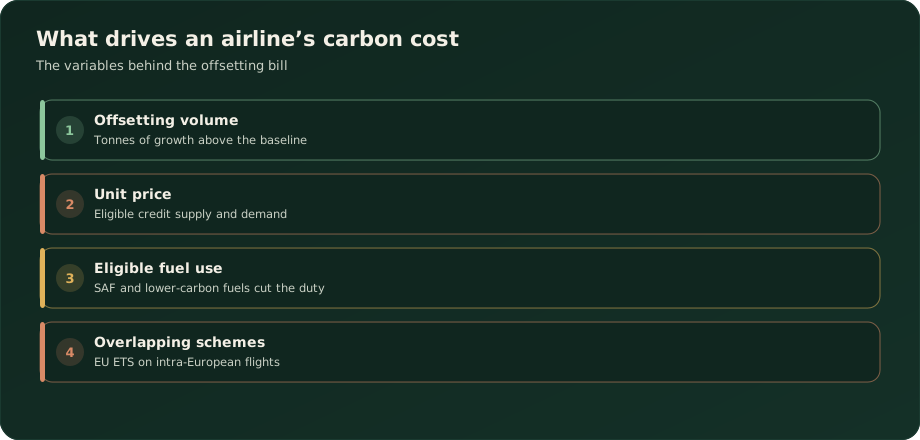
Analyses of CORSIA supply and demand have repeatedly projected a shortfall of adjusted units against obligations, particularly as second-phase demand arrives from 2027. Whether the shortfall materialises depends on government decisions nobody can currently predict.
For a buyer, the practical implications are:
- Deferring purchase to the end of a compliance period is a bet, and the whole sector is placing it in the same window.
- Price benchmarks from the voluntary market are misleading. Adjusted supply commands a substantial premium.
- Availability, not just price, is a live risk. Contracts should say what happens if supply cannot be sourced.
How the Market Actually Transacts
There is no screen price. Transactions are largely bilateral, negotiated, and documented individually.
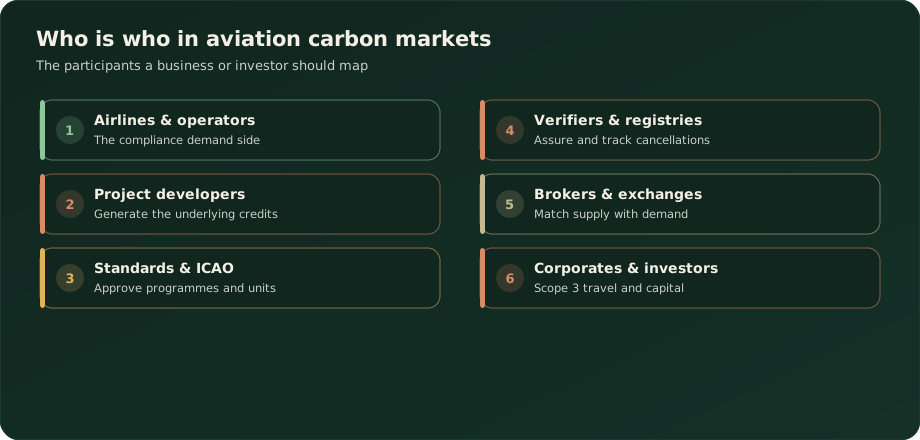
Supply reaches buyers through several routes:
Direct from developers. Best pricing and best documentation access, but requires the buyer to conduct full due diligence and manage counterparty risk with an entity that may be small and unfamiliar.
Through intermediaries and brokers. Faster access to supply and some aggregation of small volumes. Quality of understanding varies enormously — some intermediaries know the eligibility criteria in detail, others are repeating a seller's description.
Through programme or platform mechanisms. Some crediting programmes and platforms facilitate matching. Useful for discovery, though the buyer's diligence obligation does not transfer.
Through forward agreements. Contracting future issuance from a project in development. Secures supply and often better pricing, at the cost of taking delivery, authorisation and vintage risk. These risks should be allocated explicitly in the agreement, not left implicit.
Building a Procurement Strategy
Start from a modelled requirement, not a guess. You cannot buy sensibly without knowing roughly what you owe. Model your obligation annually using published sector data, refine as growth factors are confirmed, and re-model for second-phase route coverage. See requirement calculation.
Acquire progressively. Obligations settle per three-year compliance period, but nothing requires waiting until the end. Buying across the period averages price exposure and avoids competing with the entire sector in the final window. The cost is committing before the final number is confirmed, which argues for buying a conservative portion early and reconciling later.
Diversify. Concentration in a single programme, a single project, a single host State or a single vintage year is concentration of regulatory risk. Programme approvals have lapsed; vintage windows have moved.
Decide your spot-versus-forward mix deliberately. Forwards secure supply and price; spot preserves flexibility. Most operators want some of each, and the ratio should reflect how confident they are in their requirement forecast.
Contract for the risks that actually exist. What happens if the unit proves ineligible? If authorisation is withdrawn? If the programme's approval lapses? If delivery is late relative to your cancellation deadline? Silence on these points allocates them to you.
Due Diligence Before You Transact
Every unit needs evidence, not description. The short form:
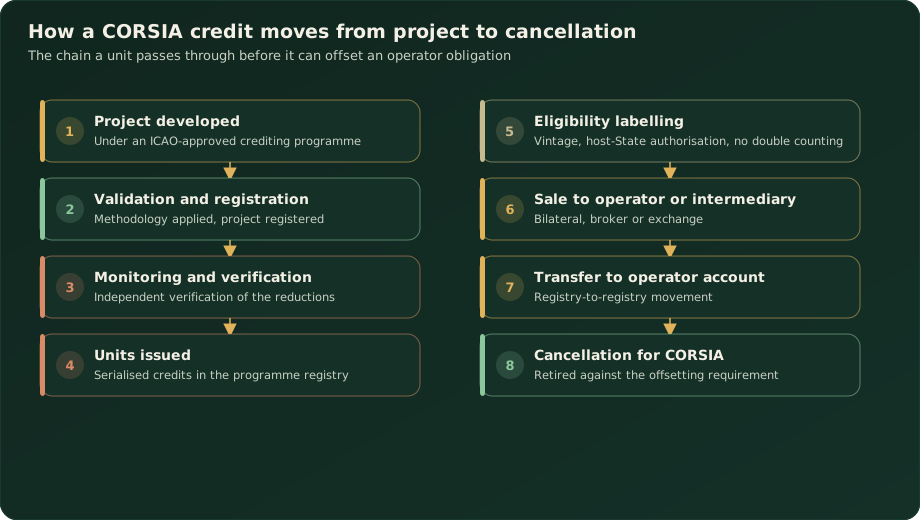
- Is the issuing programme currently ICAO approved, and is that approval full or conditional?
- If conditional, does the condition touch these units?
- Is the vintage inside the window for your compliance period?
- Is there a host-State authorisation document naming these specific units?
- Is there evidence the corresponding adjustment has been or will be applied?
- Is the verification report from an accredited body, and does it carry qualifications?
- Does the registry record show a clean, unbroken chain of custody?
- Can you assemble all of this into a package that survives audit years later?
The full version is in the due diligence checklist.
Language That Should Slow You Down
Three phrases appear constantly in this market and all three mean the same thing — the unit is not currently eligible:
- "CORSIA-ready." Not a standard. It usually means the project is registered under an approved programme but has no authorisation.
- "CORSIA-aligned." Not a standard either.
- "Eligible pending authorisation." Honest, at least, about the gap. Authorisation is a sovereign decision with no guaranteed timeline.
Buying against any of these is taking authorisation risk. That can be a deliberate, priced decision — forward agreements often work this way — but it should be deliberate, and the contract should reflect it.
Registry Mechanics
Two operational points that catch buyers out.
Account opening takes time. Registry accounts involve know-your-customer processes and can take weeks. Operators who agree a purchase and then start onboarding find their own compliance blocks the transfer.
Purchase is not compliance. Holding units discharges nothing. Cancellation in the registry, followed by the Emissions Unit Cancellation Report to your national authority, is what counts. Build the processing time for both into your deadline planning. See the registry and cancellation process.
Sustainable Aviation Fuel as an Alternative
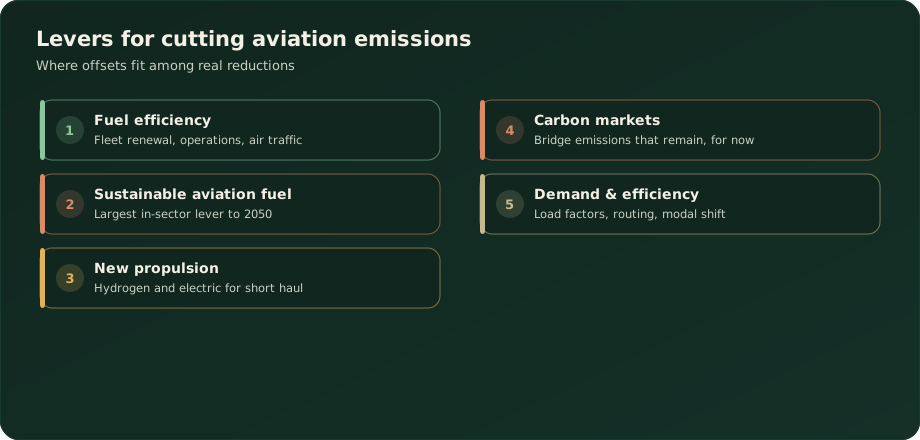
Qualifying CORSIA Eligible Fuels reduce your offsetting requirement directly. Where SAF is available and the sustainability criteria and chain-of-custody documentation can be satisfied, it is worth modelling against unit purchase as an alternative use of the same budget.
The comparison is not simply price per tonne. SAF has operational and supply-chain implications, the documentation burden is real, and availability varies sharply by region. But as unit prices rise, the crossover point moves, and operators who have never run the comparison may be assuming an answer that has changed.
Who Should Own Buying, Internally
CORSIA procurement falls awkwardly between functions, and the organisations that handle it badly usually do so because nobody clearly owns it.
Procurement brings contracting discipline and negotiation, and is the natural home for supplier management. What it typically lacks is the technical judgement to distinguish an eligible unit from one described as eligible.
Sustainability or environment brings the carbon market understanding but is often not equipped to negotiate a supply agreement or allocate risk in a contract.
Flight operations owns the emissions data that determines the volume, but has no reason to be involved in purchasing.
Finance and treasury owns the budget and the cross-border payment mechanics, and needs to be involved early rather than presented with a completed deal.
Legal needs to see the eligibility warranty and risk allocation, and rarely has a template for this.
The workable pattern is a single accountable owner — usually in sustainability or a dedicated carbon role — with defined input from the others and, critically, the authority to decline a transaction. Diligence that cannot stop a deal is not diligence, and a procurement process where the person who understands eligibility can only advise will eventually approve something that should have been refused.
For smaller operators where no such role exists, this is a legitimate reason to use an external adviser — not to transfer accountability, which cannot be transferred, but to supply the technical judgement the internal team does not have.
The Mistakes That Cost Most
Waiting until the deadline. Competing with the whole sector for thin supply, with no time to walk away from a bad unit.
Benchmarking against voluntary prices. Producing a budget that is wrong by a wide margin and a procurement team told to hit an impossible number.
Accepting seller assurance as evidence. "The seller confirms the adjustment is in place" is not documentation.
Ignoring vintage. Buying units that age out before you cancel them.
Concentrating. All supply from one programme, one country or one project type, then a regulatory change lands on exactly that exposure.
Keeping poor records. The transaction was fine; the evidence cannot be reassembled when a verifier asks three years later.
Frequently Asked Questions
How much do CORSIA credits cost? Substantially more than comparable non-eligible supply, and highly variable by project type, vintage and volume. See the price guide.
Can I buy directly from a project? Yes, and it often gives better pricing and documentation access, but you carry the full diligence and counterparty burden.
What if a unit I bought turns out to be ineligible? That depends on your contract. Address it before you sign, not after.
Can I over-purchase and carry the surplus forward? Cancellation discharges the obligation for the period it is reported against. Surplus cancellation does not build a balance for future periods, so accuracy in the requirement calculation has direct value.
Should I use a broker? Brokers speed access to supply. They do not transfer your diligence obligation, and their understanding of eligibility varies. Verify independently regardless.
When should I start buying for the second phase? Modelling should start now. Purchasing depends on your forward-versus-spot view, but arriving in 2027 with no strategy is the position to avoid.
Buying CORSIA credits? DSTechnoverse provides specialist CORSIA carbon credit services — offsetting requirement calculation, eligible unit sourcing, pre-transaction due diligence, registry execution and cancellation reporting. We are based in Indore, Madhya Pradesh and work with operators across India and internationally.
Apply as a CORSIA buyer or seller
Talk to our carbon markets team about your requirement.