Any company with a serious net-zero target eventually hits the same awkward line item: air travel. It is highly visible, genuinely useful to the business, and one of the hardest emissions to cut. How you handle it says a lot about whether your net-zero plan is credible or cosmetic.
Why Travel Is "Hard to Abate"
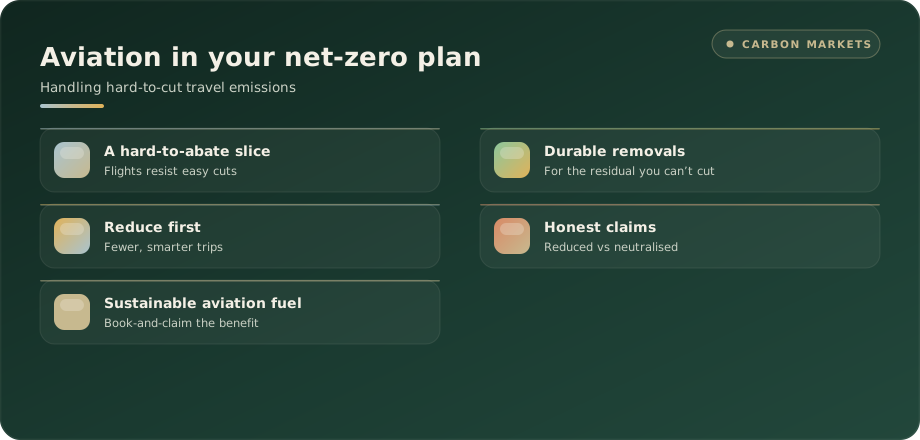
Net-zero frameworks distinguish between emissions you can eliminate and those you cannot — yet. Business travel sits firmly in the hard-to-abate camp: as aviation emissions shows, there is no clean electric substitute for a long-haul flight today. That does not excuse doing nothing; it changes the order of what you do.
The Credible Sequence
A defensible net-zero approach to travel follows a hierarchy, not a single move.
Reduce first
The cheapest, most certain reduction is flying less: a travel policy that questions trips, virtual-first meetings, rail for short-haul, and direct economy flights. This is where the real cuts are, as covered in reducing business travel emissions.
Cut the fuel emission with SAF
For flights you cannot avoid, sustainable aviation fuel — often bought via book-and-claim — reduces the actual aviation emission rather than compensating for it. It is the closest thing to decarbonising the flight itself, and it counts differently from an offset.
Neutralise the residual with durable removals
Whatever remains after reducing and using SAF is the residual — and credible net zero increasingly expects that residual to be neutralised with durable removals (biochar, engineered removals) rather than cheap avoidance credits. This is the carbon neutral vs net zero distinction applied to travel.
What Not to Do
The failure mode is skipping straight to cheap offsets and declaring travel "carbon neutral." That is the pattern regulators and customers now challenge. Offsets have a role — for the residual, with high-integrity credits — but they are not a substitute for reducing the trips and cutting the fuel emission.
Making an Honest Claim
Say what you did in order: how much travel you reduced, how much you addressed with SAF, and how much residual you neutralised with which removals. A modest, specific claim you can defend is worth more than a bold one you cannot — especially as science-based targets push companies toward real reductions over compensation.
Frequently Asked Questions
Why are flights hard to include in a net-zero plan? Because there is no clean electric replacement for most flying today, so travel emissions resist elimination and must be reduced, fuelled with SAF, and only then neutralised.
Can I just offset business travel to reach net zero? No — credible net zero requires reducing emissions first and neutralising only the residual, ideally with durable removals, not cheap offsets.
What role does sustainable aviation fuel play? SAF cuts the actual aviation emission (often via book-and-claim), unlike an offset which compensates elsewhere.
What are durable removals? Credits that physically remove and durably store carbon — such as biochar or direct air capture — preferred for neutralising a net-zero residual.
How should I claim travel emissions in a net-zero report? State reductions, SAF use and residual removals separately and specifically, rather than declaring travel "carbon neutral" via offsets.
Buying carbon credits or measuring travel and freight emissions? DSTechnoverse works on the data and integrity side of carbon — footprint measurement, project screening, registry and eligibility verification, and defensible reporting. See our CORSIA carbon credit services and data analytics. We are based in Indore, Madhya Pradesh and work across India and internationally.
Apply as a carbon credit buyer or seller
Talk to our team, or start with the complete carbon credits guide.