CORSIA Vintages and Eligibility Windows
What a vintage is, how ICAO sets eligible vintage windows per compliance period, why windows have moved before, and the timing risk that creates for anyone holding or contracting for units.
A unit's vintage is when the reduction actually happened. ICAO restricts which vintages may be used for which compliance period, and that restriction quietly removes a large share of otherwise-qualifying supply.
What a Vintage Is
The vintage is the monitoring period during which the emission reduction or removal physically occurred.
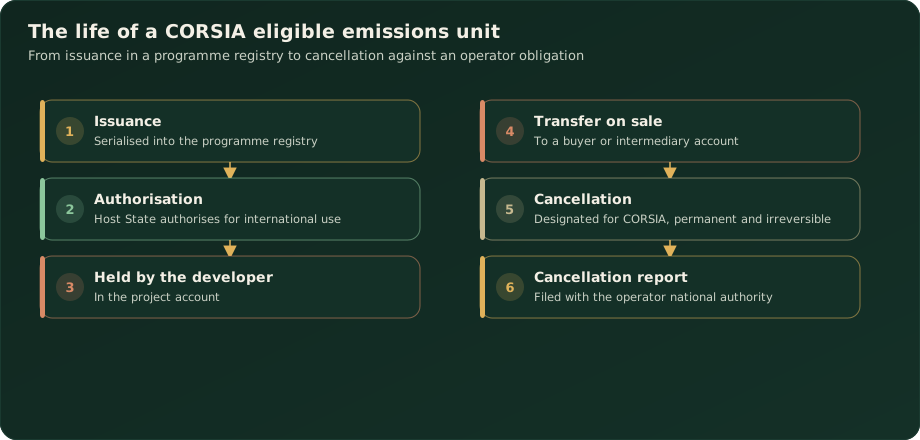
The vintage is not the issuance date. A unit issued in 2026 may carry a 2021 vintage, because verification and issuance follow the reduction by a considerable margin.
This distinction catches buyers. A seller describing units as "recently issued" is not telling you the vintage, and the registry record is what settles it.
Why Windows Exist
Two reasons, one environmental and one economic.
Environmental integrity. A reduction achieved fifteen years ago, under a methodology since discredited, in a market that has changed completely, is a weaker claim than a recent one. Restricting vintages keeps CORSIA away from the oldest and most contested inventory.
Market function. Without a window, the enormous stock of historical credits would flood in, prices would collapse, and CORSIA would provide no meaningful incentive for new mitigation. The window is what makes the scheme demand-creating rather than inventory-clearing.
How Windows Are Set
Eligible vintage windows are set by ICAO Council decision for each compliance period, on TAB advice.
Because they are Council decisions rather than fixed rules, they can change — and they have. Windows have been extended before, in response to supply concerns.
The current position is published on the ICAO CORSIA emissions units page. Check it for your compliance period rather than assuming a general rule.
The Timing Risks
For buyers — the boundary problem
Units near a window boundary carry the risk that the boundary moves, or that you cannot complete cancellation before the window closes.
Cancellation is not instantaneous. Registry account opening takes weeks, transfers take days, and the cancellation report has its own processing time. A unit that is eligible when you contract may not be by the time you actually cancel.
Mitigations: avoid concentration near a boundary; verify the window before cancelling as well as before purchasing; build the administrative tail into your timeline.
For sellers — inventory ageing out
A project that issues credits but cannot place them before the window closes finds its inventory has moved from the premium eligible tier to the general voluntary tier — a significant loss of value with no change to the underlying credits.
This is why authorisation delay is doubly costly for developers: it burns time against a vintage clock as well as deferring revenue.
Mitigations: run authorisation in parallel with development; do not assume a placement timeline you have not tested; keep a voluntary fallback.
For forward contracts — allocating the risk
If the eligible window shifts between contracting and delivery, who absorbs it?
Silence in the contract allocates it to the buyer by default. A well-structured forward names the risk and says what happens — price adjustment, substitution, termination, or acceptance at a reduced price.
Vintage and the Other Criteria
Vintage interacts with, but does not substitute for, the rest of the emissions unit criteria.
| Situation | Eligible? |
|---|---|
| Correct vintage, no corresponding adjustment | No |
| Corresponding adjustment, vintage outside window | No |
| Both correct, programme approval lapsed | No |
| Both correct, programme approved | Yes, if the remaining criteria are met |
All conditions are simultaneous. A unit does not qualify by being strong on one dimension.
Checking a Unit's Vintage
- Obtain the registry record, not a seller summary.
- Identify the monitoring period in which the reduction occurred.
- Compare against the window for your compliance period.
- Note how close it sits to a boundary.
- Capture the registry record and the published window as at the date you relied on them.
Point 5 matters. If a window later moves, you need to be able to show what the position was when you transacted.
Practical Guidance
Diversify across vintages. Concentration in a single vintage year is concentration of regulatory risk, not simplification.
Cancel earlier than the deadline. The gap between contracting and cancelling is where vintage risk lives.
Re-verify before cancelling. If significant time has passed since purchase, confirm both the vintage window and the programme's approval status. It is a few minutes of work against a material risk.
Do not accept "recent vintage" as a description. Ask for the monitoring period from the registry record.
Model the window into forward deals. For anything settling more than a few months out, the contract should address what happens if the window moves.
Where to Go Next
- The emissions unit criteria — all criteria together
- CORSIA Eligible Emissions Units — the two-layer test
- Registries and cancellation — the timing tail
- Compliance periods and deadlines — which window applies to you
DSTechnoverse verifies vintage against the applicable window as part of pre-transaction due diligence. Get in touch.
Need this applied to your position?
We assess operators’ obligations and developers’ eligibility pathways directly.